Showing posts with label family. Show all posts

Tuesday, July 12, 2011

Whew.

Hi. I'm sitting at Logan Airport, in Boston, waiting for my flight to London for KnitNation. I saw on Facebook that Clara Parkes is getting ready to leave Dulles for the same, and I know other teachers are on the move as well. Most of us will hit Crumpetsville tomorrow.

I like the idea of mass migrations of knitters. More colorful than migrating wildebeest. Less liable to poop on your head than migrating birds. Far more pleasant than the roving swarms of locusts or beetles or whatever it is that has been eating the damn leaves in my flower bed. (Oy. Don't even ask, seriously.)

My schedule for the next three weeks may be summarized thus:
  1. Fly to London.
  2. Teach in London.
  3. Play in London.
  4. Leave London for Southampton.
  5. Leave Southampton for New York.
  6. Leave New York for Portland.
  7. Teach in Portland.
  8. Leave Portland for Chicago.
Packing took nine hours and six different lists, and I still left the apartment without my #@$%!* phone.

This will be a family event. Tom joins me for numbers 3 through 5; Dolores and Harry will be in attendance for the whole shebang.

(Shebang is, don't you think, an almost too-apt description of an undertaking in which Dolores becomes involved?)

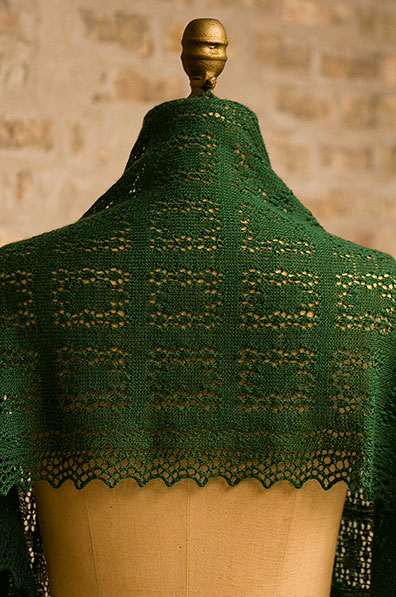
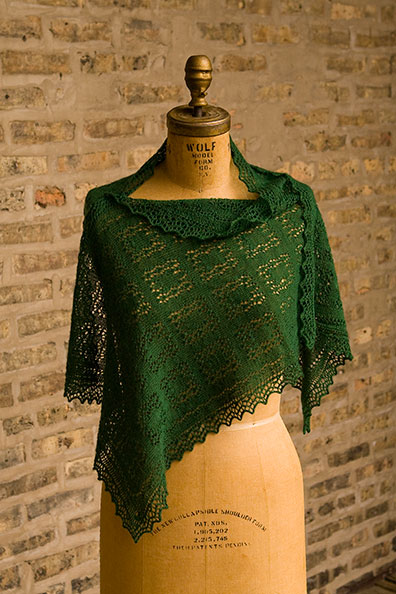
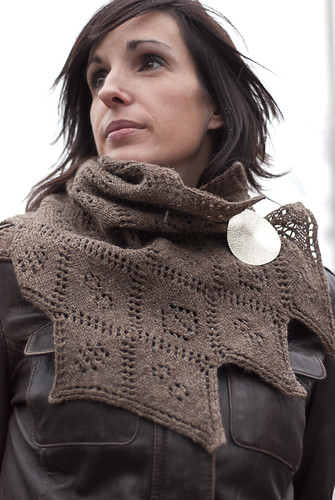
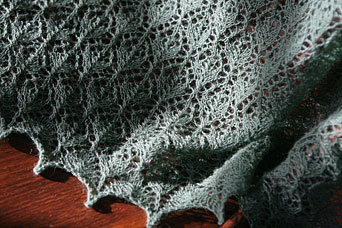
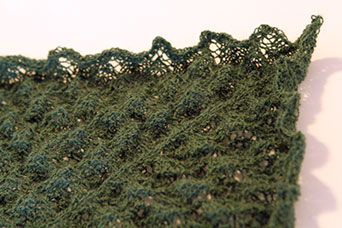
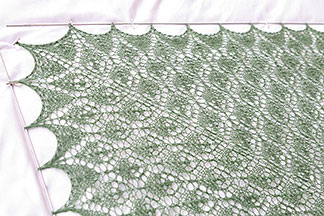
Getting ready for all this has turned me into a terrible blogger, and I beg your indulgence. Will you think more kindly of me if I show you some actual knitting? No kidding, actual knitting. A whole shawl, in fact. I was going to wait until after this trip to post about it, but I can't stand it any more. It's been finished for yonks.

Tell you what, I'll show you some of the test photos; the pattern will be for sale via download come August. If you want to see it in person, I have it with me.

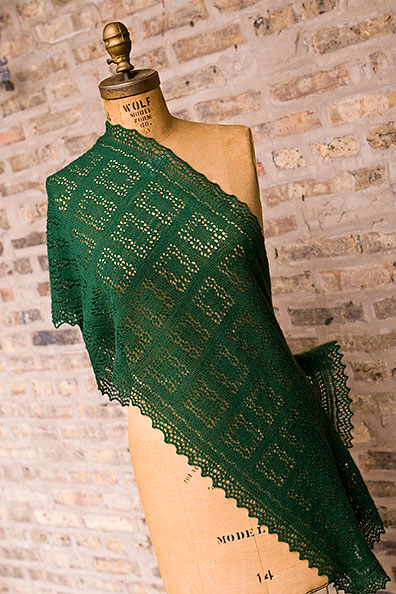
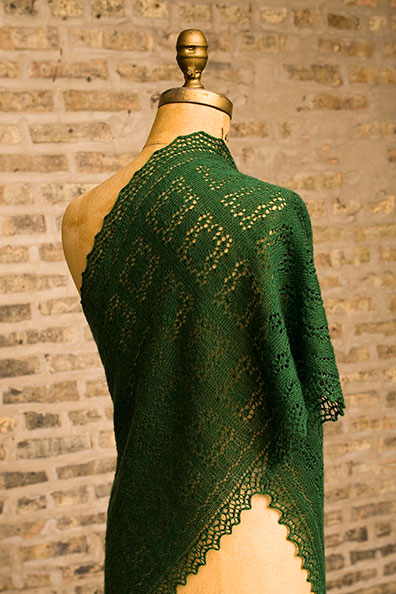
It's another in the series named for women in my family. This one's for my mother, so it'll be called Anna. Anna is Giovannina's daughter, Pauline's daughter-in-law and Sahar's mother.
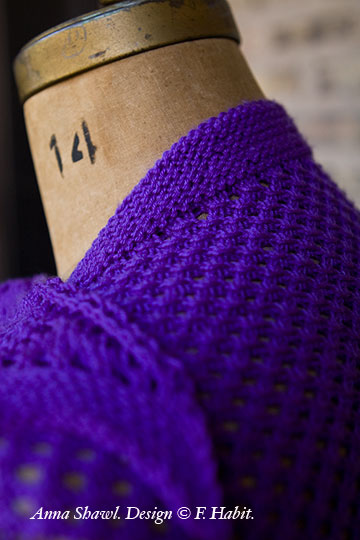
Anna Shawl

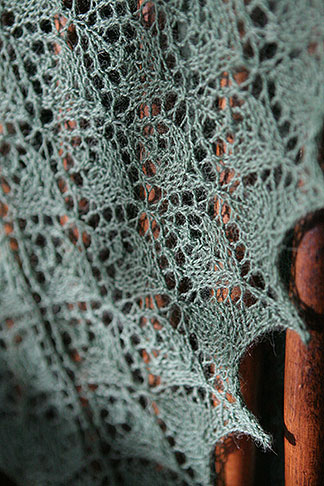
The yarn is Cascade Heritage Silk, about which I do not believe there is yet enough happy screaming. I fell in love with it halfway through Swatch #1; and having completed one project in it I'm already in the mood for another.
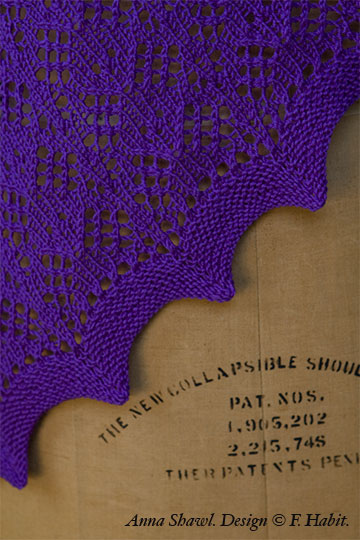
Anna Shawl

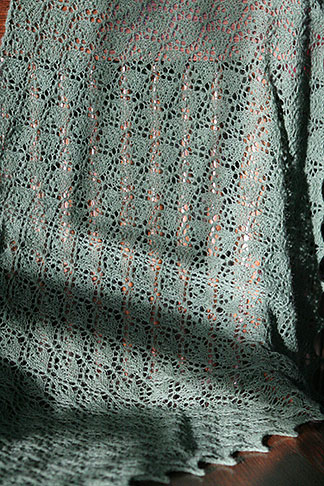
This piece taught me something interesting, which is that you cannot sum up your mother in a couple of stitch motifs. Or at least I can't sum up my mother in a couple of stitch motifs. So there's less overt symbolism here than in, say, Pauline; and fewer outside references than in Giovannina.

While I was designing the lace patterns, I tried knitting Things That Spoke of Mother; and every time the results fell short. How could they not? A woman goes through very scary labor in order to bring you into the world, then spends decades dealing with your quirky child self and your weird teenage self and your annoying adult self. She never once complains, she never stops loving you. And then you turn around and say, "Hey, I put everything you are and have done into in this bunch of yarnovers that kind of looks like a flock of doves if you squint." Right.

In the end I set the whole idea of symbolism aside. I just played with the yarn until what was on the needles seemed to bear some kinship to my mother's spirit.
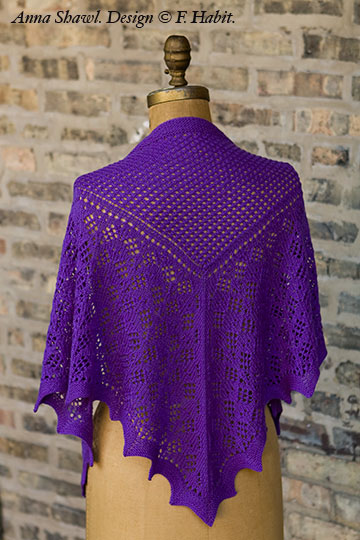
Anna Shawl

So almost every time I look at this shawl, I see different things. Once it was honeybees–very suitable for a mother who has uncomplainingly spent her life in near-constant motion, making things for other people. Another time, during the knitting, I realized that the little pair of yarn overs that pop up periodically reminded me of her eyes. Especially since they were all over the place. If there is anything that makes me think of my mother, it's all-seeing eyes. She was and is a modern Argus, only she's a hep chick from Detroit and she can dance better.
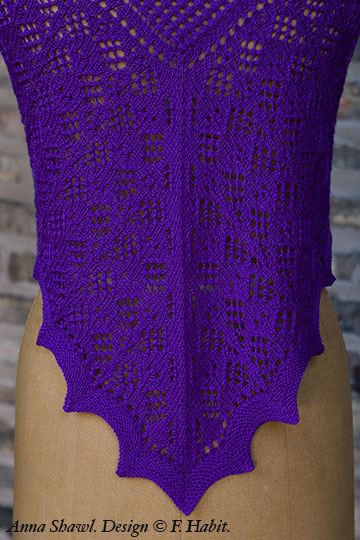
Anna Shawl

Mom, I hope you like it. In the end, I admit that I can't sum you up in one shawl. But what the heck. You know the truth. They're all dedicated to you, even when they don't have your name on them.

Monday, June 20, 2011

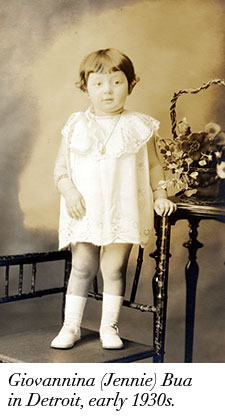
Giovannina

JennieThe series of lace designs I've been naming after beloved women in my family (it began with Sahar and continued with Pauline) has a new addition: Giovannina.

That was my maternal grandmother's given name, as recorded (to our collective surprise) on her birth and baptismal certificates. She never used it, and neither (so far as any of us recall) did her mother. She was called Jennie, and called herself Jennie, and signed my birthday checks (thank you, Grandma) Jennie.

She was born in the early 1930s in Detroit, Michigan, to parents who had immigrated from adjacent Sicilian towns but married (in a match arranged by their families) in the United States. On the day of their wedding my great-grandmother was a few days shy of 16.

Giovannina was the third of four children and the first of two daughters. She fell in love with a nice Sicilian boy from New York City and went on to have five children of her own - four daughters and a son.

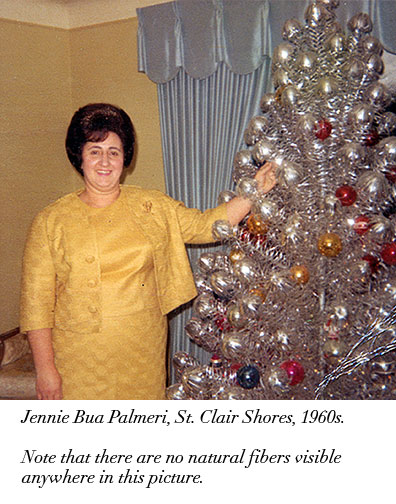
The priceless image below was taken before my arrival in the 1970s, but it's a fair representation of how I remember her.

Grandma Jennie

The Christmas tree was in the front room of the house in St. Clair Shores, a suburb of Detroit. In the local patois this space was invariably referred to as the "frontroom"–one word. It was reserved for state occasions: Christmas morning, wedding photos, visits from clergy, official visits from my mother's gentlemen callers–including, eventually, my father.

When I think of my grandmother, I think of this room. She decorated it herself, and it was filled with her favorite things. When she wanted new furniture for it, she did the unspeakable for a good Italian wife in that time and place–she went out and got a job to pay for it.

The front room was a textbook example of what I affectionately call Dago Baroque. Imagine the crossing of St. Peter's in Rome, but with top-of-the-line seven-layer curtains from J.C. Penney and pale yellow deep-pile shag that never, ever has vacuum marks in it.

The gigantic furniture, including the console record player, was French Provincial upholstered in white damask under clear plastic. The wallpaper was gold foil with green flocking. You could see yourself in it. It remained absolutely pristine for decades until the never-to-be-forgotten morning when one of my cousins accidentally smacked it with a wet lollipop. Years later, Grandma still could not refer to this incident without turning red.

Bric-à-brac of the most elevated variety covered every horizontal surface. The customary painted miniature pony cart, of course; and a cabinet stuffed with a prized collection of porcelain angels and bells.

I now own two of the other major pieces: an 18-inch high Infant of Prague with a metal crown and a full seasonal wardrobe; and a hefty cut-glass candy dish on a marble base guarded by a pair of gilt cherubs. There was one other candy dish - a white marble urn with birds perched on the rim. The former held ribbon candy, the latter green and pink pillow mints. The stuff was so vile that sneaking it when the grown-ups weren't looking wasn't even worth the risk. When my grandmother died in the late 1990s, the candy in the dishes is believed to have been the same that was already installed when my mother was a bride in the late 1960s.

There were also, on pedestals, a pair of plaster statuettes of Italian peasants lugging huge baskets of velveteen grapes. My father was parked in an adjacent armchair chair near these on his formal visit, while my mother stirred pasta in the kitchen and presumably begged her parents to go easy on this one. After a while the eligible bachelor got bored and started shooting spitwads into one of the baskets. My mother caught him and happily was able to clear away the evidence before my grandmother could get wise and throw him into the street.

I loved my grandmother, and as a child I loved this room because it was so beautiful and brilliant and untouchable. I used to stand by the door and just stare across the threshold. On occasion, because I was such an odious little goody-goody, I was allowed to sit quietly on the sofa and just look at things. Just look, not touch. If I so much as extended a tentative finger toward the incredible cover of the Bible on the coffee table (with an inset reproduction of Leonardo's Madonna and Child with Saint Anne) she would shout from the laundry room in the basement, "I told you, don't touch!"*

I had an epiphany in that room. Not a pleasant one, either. My mother and I drove in for a visit. I was in my mid-twenties, and we were there specially to see my grandfather, who was ill with the condition that would eventually kill him. He had been moved from the bedroom to a hospital bed in the family room (a later addition, off the kitchen). My grandmother, unable to face her wedding bed without her groom...had taken to sleeping on the Sacred White Couch in the front room. While we were there, she ceded that space to me. The plastic furniture covers were gone. There were clothes thrown in a corner near the glass cabinet, and bottles of pills scattered on the coffee table by the candy dish.

I was shocked. It was the first time that I realized that certain people and things you thought would always be there, unchanging–Grandpa, Grandma, Grandma's sitting room–are not as eternal as you would wish. It was the moment I first understood, viscerally, that nothing is forever.

I can't claim that I consciously intended it, but when I started working with the lovely Filigran (100% merino superwash) that Skacel sent to me with a request for a lace design, these memories of my grandmother manifested in the square motif that became the main element in the stole. It's ornate, but orderly.

Giovannina

I hope she would have liked it, though she was not one for wearing shawls. (She did like drapey flowy gowns, though, and bought one or two each year for my grandfather's annual convention in Las Vegas.)

Giovannina

The construction's a bit unusual, by the way. I took inspiration from the eminently sensible technique of the Orenberg lace knitters–who work their shawls in one piece, center and edging simultaneously. The method for turning the corners is different, but the end is the same: when the shawl is finished, it's finished. You have a center completely surrounded by a lacy edge, with nothing else to do but wear it.

Giovannina

Skacel wholesales their pattern collection to yarn retailers everywhere, so if you'd like a copy, contact your LYS. If you run (or know of) a shop that's got Giovannina in stock, please feel to speak up in the comments. If you'd like to ask your shop to place an order, the pattern number is 21100405.

Giovannina

*My mother has inherited this supernatural ability to see through solid surfaces, as well as the skill to effortlessly stun small children with it.

Thursday, April 28, 2011

A Stole Full of Peas

If Chicago's rainy streak doesn't break soon, I'm afraid I'll break out in moss. Everyone passing the café window is bent forward, shoulders hunched under the weight of the persistently beastly weather.

This has been a dreary spring even for a city in which dreary weather is a specialty. The only thing grayer than the sky is the grass. Optimistic trees that put out buds during a freak warm spell weeks ago are now shivering with regret. We got a few daffodils and tulips, here and there. Most died quick and humiliating deaths, beheaded or stabbed in the back by the north wind.

To garden near the lake in Chicago is to be a masochist. Nature intended this land to be swamp, wind-swept and mostly populated by grass and skunk cabbage.* You are reminded of this every time you watch a perennial trumpeted as "bulletproof" pop its clogs due to the sort of bizarre weather you thought went out of fashion after they put the finishing touches on the Book of Exodus.

Mind you, the city's official motto is Urbs in horto–city in a garden. Hah. A fib in Latin is still a fib.

But this is the first place I've actually got dirt to play with, after a frustrated lifetime of poring over gardening books and poking dejectedly at window boxes. It's not my dirt, but it's dirt. Though I don't own it–it's a series of neglected beds attached to a condominium in my neighborhood–as long as I've got it, I'm going to make it bloom, dammit.

Unlike many of my strong impulses, which will not be itemized here as my mother is probably reading this, I know where this urge to garden comes from.

One of my very earliest memories, clear as a bell, is of sitting on the turf by my grandmother's vegetable garden, watching her dig and plant. I can't have been older than a year-and-a-half. I may have only just learned to sit up. But I recall the scent, and the feeling of the clammy earth, and the print of her cotton shirt and the soft sound of the spade. It was a moment of pure joy, and before I die I plan to recapture it as nearly and as often as possible.

The garden is long gone, but I know for certain that my fascination with planting and growing–which for years has been stifled–comes from that moment.

A New Pattern

When Véronik Avery asked me to do something with Boréale, the fingering weight yarn from her St-Denis Yarns line, the color and texture sparked the memory of my grandmother's garden. I'm sure it was because of the richness of the brown–deep, not dull–very much like well-worked soil.

I turned into a stole, Pauline, named after this lady, to whom I owe more than I can ever hope to repay. It's in Issue 3 of the St-Denis Magazine, now winging its way to local shops and online shops pretty much everywhere.

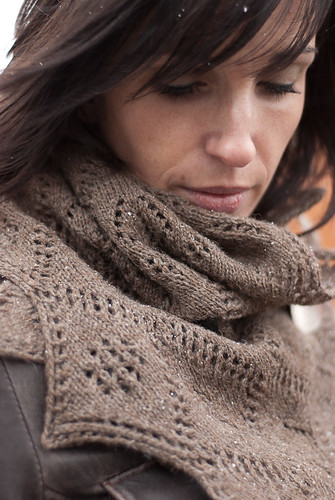
Pauline Stole

The pattern is designed to be extremely adaptable. Without any complicated math whatsoever you can change the width and length to suit your purposes. It'll scale down to a scarf or up to a bedspread with ease.

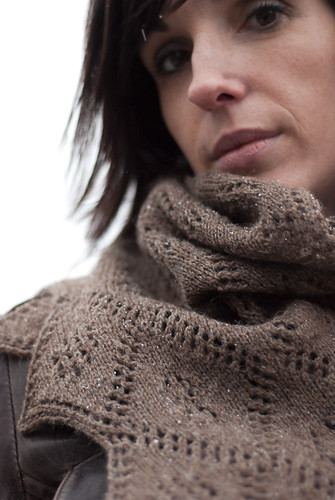
Pauline Stole

And the framework will accommodate your own choice of small lace motifs if you so fancy. I've put in things I remember my grandmother growing: peas-in-the-pod, strawberry blossoms, and (because even a vegetable garden should be pretty) hydrangeas.

Pauline Stole

The overall look is rustic. I wanted to see if I could make lace look pretty, but tough...just like my Grandma.

Royal Wedding Report

In case you haven't been following the unfolding events via Twitter at @yarnpoetharry and @doloresvanh, Harry made it to London. So did Dolores. She wasn't supposed to go, of course, but was (this is what I've been told) a victim of her own selflessness.

So worried was she about Harry's ability to negotiate the perils of O'Hare Airport on his own that she jumped through hoops to secure a "gate pass" from the airline and accompanied him to the aircraft. After helping him settle his snickerdoodles in the overhead compartment, she tried to exit, but tripped and got stuck under an empty seat in First Class.

Fancy that. It's a good thing she had a toothbrush, a copy of Liberated Ewe Quarterly and a week's worth of clothing with her.

I asked why the airlines didn't send her right back upon arrival at Heathrow. All I got was somewhat incoherent babble about one of the pilots busting in on her in the loo, and now having something in his private life he'd rather not have her tell the tabloids. If you want to know more, you can ask her. I'm keeping out of it.

Harry's Twitter feed suggests that he is having a marvelous time, making friends with Australian yarns who are also staying at the International Yarn Hostel in Wapping, visiting Kew Gardens, and going to see friends at I Knit London. Dolores can barely type at all, so I infer that she is also having a marvelous time in her own way.

I have been promised a full report after the solemn occasion, so look for it here this weekend or keep an eye on Harry's tweets. I hope he remembers to iron his formal morning ball band before setting off for the Abbey.

*Shikaakwa or chee-ca-gou in the tongue of the native peoples, from which comes our name.

Friday, December 17, 2010

Cookies

If this post smells of butter and drool it's because I've spent about half the day baking cookies. The kitchen looks like Open House at the Keebler Factory, including the flour-covered resident elf who is typing this from a perch by the cooling racks.

I hope you can't get fat from inhaling near a pile of fresh cookies. I just got back into these jeans.

Oh, such a display. We have pinwheels, we have brownies, we have chocolate chips–courtesy (respectively) of Maida Heatter, Irma Rombauer, and Ruth Wakefield.

Piled highest, at the back, are the other cookies. The special cookies. You won't find the recipe for them in any published book; and don't bother asking for it, because after I told you I'd have to kill you. It's a family secret–as deep and dark as the one that keeps the Kardashians on the air, except ours goes better with coffee.

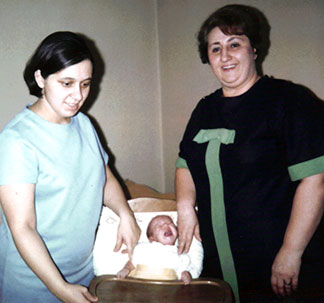
These are Grandma's Jennie's cookies.

Grandma Jennie, rest her soul, was my mother's mother.

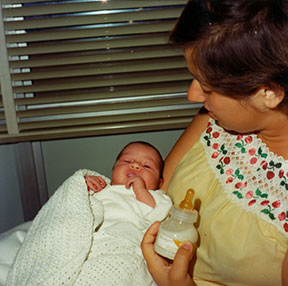
Three Generations

She's on the right, in the bow. That's my mother on the left, and the howling lump in the center is me–a week old. (I was either hungry, or commenting on the prevalence of drip-dry polyester fabrics in early 70s fashion.)

We assume Grandma learned how to make the cookies from her mother. We don't know for sure. We never thought to ask. It's a bizarre recipe. I've got about 32 linear feet of books on cookery ranging from 1747 to the present, and there's nothing in any of them that comes even close. It starts out a little bit like shortcake, only without sugar; and then–

No, wait. Can't tell you. Would have to kill you.

These cookies were the first thing I ever baked. I was about ten or eleven, and my younger sister was my accomplice. Every pass of the rolling pin was an act of transgression. Mom wasn't home, we didn't ask permission to use the stove, and these were Christmas cookies. We made unsupervised, unauthorized Christmas cookies in May.

I know that seems piffling at a time when the second graders on "Gossip Girl" get their kicks by snorting cocaine and crushed Flintstone vitamins during little bitty orgies in the VIP room at American Girl Place. But back then, to us, it was thrilling.

My sister, once the sous chef, is now the master baker. She inherited Mom's gigantic yellow Tupperware bowl–you could take a bath in it–which holds the stupendous amount of dough produced by the full recipe. She has developed and perfected a system that allows her to keep one hand clean and dry while the other adds ingredients and kneads them in. And her cookies always have the proper amount of crunch on the outside, while the inside melts in your mouth.

We grew up rolling out the dough and cutting it into moons and hearts and trees, which is what Mom does. But we were surprised to learn during a visit to Grandma's that she didn't use cutters. She rolled the dough out into long ropes with her hands, then twisted sections of rope into curlicues, knots and braids.

Her hands flew. She twisted, we watched. My grandmother was a lovely woman; but she didn't like children mucking around in the kitchen. Baking cookies wasn't a game, it was work. Without interference she could produce six dozen in record time. If you were good, you might be allowed to help with the sugar sprinkles. If you got too enthusiastic and sprinkled the floor, you'd better run.

A Tribute

Susan and I still mostly roll and cut, but near the end of each batch we also make a few twists as a tribute. It's not a hospital wing or a fountain in Central Park, but there are worse ways to be remembered than through a cookie recipe. I think Grandma Jennie would have appreciated it. Especially with coffee.

Monday, February 22, 2010

Go Go Kimono

Once upon a time (January 2008) a knitter (me) put the finishing touches (three embroidered dragonflies) on the baby kimono from Thoroughly Exceptional Babies and the Men Who Knit for Them by Debbie Bliss.

Kimono Front

I wrote in this entry that I'd begun working the 9–12 months version when it seemed impossible that the exceptional baby in question–Abigail, my niece–could ever be so large as to fill it out. Each flat piece was a square acre of stockinette; Abigail could have fit into a shoebox. Not that we tried it, but she could have.

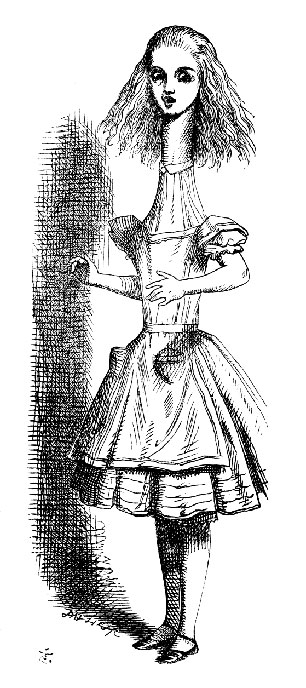
But she did grow. She grew at such an alarming rate that I accused my sister of feeding her on a diet of breast milk and

Alice Large

small cakes inscribed EAT ME.

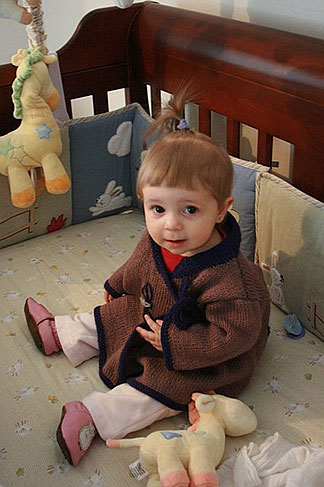
I finished the kimono in what I figured was the nick of time, so that Abby could cuddle up in it for a month or two before it would be relegated to the chest of outgrown knits. It fit her like a mid-length spa robe (simple, but chic) and became a go-to woolen garment for chilly weather.

Kimono 01

A year later, when the frost returned to the pumpkins, it still fit. But it had become a short jacket.

Kimono 02

Kimono 03

A year after that (two days ago, in fact), a freak spell of mild weather in southern Maine caused my sister to reach for it again. It is now a little shirt with three-quarter sleeves.

Kimono 04

For those of you who knit, crochet, sew or otherwise fashion handmade clothing for children, I need not explain to you why this series of photographs fills me with matchless gratification.

For those who do not, let me walk you through it:

  • I made it for her to wear, and she wore it.

  • Her mother made sure I got to see her wearing it.

  • There's honorable evidence of heavy use (note the pilling on the sleeves) but also of proper care (and it isn't machine-washable).

You make a baby garment hoping it'll fit for an entire season. Three seasons? A small miracle. And sometimes I think the small ones are the best.

Monday, May 12, 2008

Proud Son

Yesterday was Mother's Day, and all across the country mothers were getting things–flowers, cards, telephone calls–from their children. My own, dear mother deserves her own island in the Caribbean, a pony and a chocolate fountain; but since I didn't want to embarrass her with extravagance I just sent flowers.

She sent me something, too, and I want to share it with you.

First, a bit of background.

mom-babysue
Mom and one-day-old Susan.
Susan just celebrated her own first Mother's Day.


My mother is a can-do sort of woman. If she wants to excel at something, she will. She did not, for example, learn to sew at her mother's knee. As a young wife, she decided sewing would be a useful skill. She got a sewing machine, took a class, and turned into the second coming of Betsy Ross. We reveled in an abundance of expertly hand-sewn clothes, gorgeous Halloween costumes, perfectly tailored school uniforms and matching family Christmas pajamas.

She also learned from a friend how to knit. Aside from an occasional afghan, however, this was a skill that lay dormant for years. The first time I ever saw her do it was Christmas 2005, when our incessant chatter about the joys of yarnplay persuaded her to join the fun. Her powers of recall were startling. We gave her a pair of needles and a gentle nudge, and soon she'd turned out several very nice scarves and a few patterned washcloths.

Then she decided it was time to try a shaped garment. She picked a doozy–Elizabeth Zimmermann's Baby Surprise Jacket. In case you've been knitting in a cave, the Baby Surprise Jacket (which you can find in The Opinionated Knitter and Knitting Workshop) is a little cardigan sweater that's knit as one flat piece, folded up like origami and seamed at the shoulders. It's a classic pattern and a fun project, but not always an easy knit for a beginner.

My mother, however, does not care about easy. She wanted to knit the jacket. She got the yarn, the needles, the pattern and Meg Swansen's instructional DVD, and off she went. And look at this.

Mom's BSJ

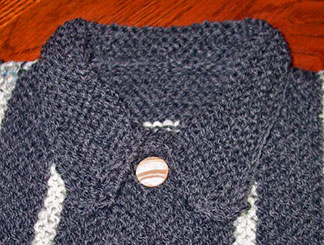
Not only did she finish, she worked in a bunch of Meg's fine details including paired increases and decreases, a collar, and a cast off that eliminates the little dog-ear at the very end.

Mom's BSJ - Collar

I'm choking up just looking at that. How you've grown, mother darling. There's a Rogue Hoodie in your future. I just know it.

Saturday, March 29, 2008

On the Road Again

This is a dispatch from the the Panopticon Mobile Unit, reporting from base camp at Grandma's kitchen table. I'm in Pennsylvania for a brief spell, gathering bits of this and that to be fashioned into an article for Piecework.

Of all the houses I knew as a child, this is the only one with doors still open to me. The others are long demolished or sold out of the family. Grandma, bless her heart, won't budge and I don't blame her.

It's a sweet little place, barely larger (excluding the cellar) than my apartment in Chicago. The single floor has a kitchen, living room, bathroom, main bedroom and second bedroom so compactly organized that there's no hall; the rooms just open into one another. I know folks who have media rooms larger than this. But my grandmother raised three children here, by herself, on her income from sewing and cleaning houses.

Behind me, on the door from the kitchen to the porch, there's a Colorform in the shape of Charlie Brown. I stuck it there  in the early 1970s when I was three or four years old, to remind Grandma of me and show her I'd come back again. She's never taken it down, and I do keep coming back. These days, it's being away that's hard.

Friday, December 28, 2007

Christmas 2007 Knitting Revealed!

Talk about your narrow escapes. Last night's plane out of Maine narrowly escaped the snapping jaws of one snowstorm, and today Chicago–which was clear when I landed at eight o'clock–is being socked by another. My view, which normally stretches to the lake's edge and beyond, has diminished to intermittent glimpses of the street below and the tip of the high-rise three blocks north.

A grand display, to be sure; but I'm happy to neither fly through it nor shovel it off the walk.

Instead, let's talk about knitting. Better still, let's look at some.

Christmas is past. The gifts have been opened. This year, there were two that came from my needles and the first was a piece of lace.

Flower Basket Shawl

Project:
The Flower Basket Shawl by Evelyn Clark (Interweave Knits, Fall 2004). Now available from Fiber Trends.

Yarn: Misti Alpaca Lace in colorway...uh...it's green. Will I ever learn to hang on to the ball band?

Needles: Addi Turbo size US 3

Genesis: I was visiting my parents in Indiana and my mother suggested that I might like to go out yarn hunting. (She's come a long way, has my mother, since I was a little kid and she'd suggest that I might like to mow the lawn on Saturday morning or have another helping of green beans.)

We were at Stitches 'n' Scones when Mom spotted the Misti Alpaca Lace and mentioned that it was her favorite shade of green. I bought it as casually as ever I could, affecting the nonchalant pose of one who might, one day, perhaps, knit something with it. Or then again, he might not. He might instead use it to tie up tomato plants, or trade it on the playground for Meg Swansen and Beth Brown-Reinsel bubblegum cards.

But secretly, in the deepest wrinkles of my brain, I decided that if I could find a suitable pattern quickly enough, Mom would be getting a lace shawl for Christmas.

Flower Basket ShawlNotes on the Pattern: Deservedly popular. According to Ravelry, as of this writing 537 members have begun or completed this shawl and another 575 have it queued up.

You begin with this nifty little set of seven or so stitches and then the thing gets bigger, and bigger, and deeper, and wider. You think, Aha! I am beginning at the tip and working toward the top.

But you are not! No! You have begun at the center of the top and are working downwards and sideways simultaneously!

You realize this with a gasp. And you think, Oh Evelyn Clark, you clever little minx! Come over here right now so I can tweak you on your dear nose and feed you a peppermint bonbon!

Or something like that. Your actual thoughts may vary.

And then you knit and knit and knit and knit, and for a pattern that is so much of the same thing over and over it's astonishingly fun and relaxing.

Evelyn Clark, you are a genius and I hope you are living a very comfortable life being waited on hand and foot by unusually attractive servants of whichever gender you prefer.

Flower Basket Shawl

Variations:
Evelyn's original calls for two strands of Misti Alpaca held double throughout and worked on a US 7 needle. It yields a handsome product which can be knit up by most folks in a surprisingly short (for a shawl) amount of time. Some Ravelers claim to have finished it in a week.

I wanted something lighter and more delicate, so I used a single strand of Misti Alpaca on a smaller needle. This meant doing many more repeats than are called for in the written pattern, but as the stitch growth rate per row remains the same it required no additional math. You can't beat that with a stick.

I worked Mom's shawl for a total of 22 repeats, which (when blocked) yielded a finished piece slightly larger than Evelyn's.

And speaking of blocking, I include the following action sequence for the pleasure of all but particularly for Brenda Dayne, who apparently gets a sadistic kick from watching lace tortured on the rack.

Before.

Flower Basket Shawl Unblocked

After.

Flower Basket Shawl Blocked

Auuuuuggggghhhh! Yes! Yes! More please, Master! Yes!

Ahem.

I'm going to tell you about Abigail's Christmas present tomorrow. I just don't seem to be in a mood appropriate for discussing baby clothes right now.

Friday, December 21, 2007

Psssst!

OMG, I am totally sitting in the back of my sister's classroom in Maine and blogging at the same time. Everybody else has to work on their research presentations, but I get to play with her computer and draw cartoons and even knit my sock. And I can't get sent to the principal's office!

School is so much more fun when you can threaten to tell the kids a story about the teacher slipping out of her diaper one morning and running around the block naked singing "I'm a little teapot" at the top of her infantile lungs.

I've wanted to watch Susan in front of a class for as long as she's been teaching. It's one of those jobs I lack the temperament to perform, like waiting tables or reading the funnies to the president. Herding young people through the brambly hedgerow maze of knowledge day after day would reduce me to hysterics in five seconds flat.

Teachers, I salute you. This is my first time in a high school classroom since my own senior year and I don't envy you. And these are, on the whole, good kids. Nice manners, stable homes. We're in an affluent suburb of Portland and the class isn't all that large–perhaps fourteen students.

And yet the job seems to require the sort of skills one would need to pilot a bus full of live chickens backwards, with no brakes, down a rocky road through the Andes while simultaneously providing colorful and informative commentary on the scenery.

The questions fly at her–and at Julie, her co-teacher–from all sides all at once, as do the excuses. Amazing, the excuses. Dogs no longer eat papers, it seems, but computers do.

I typed it all out, and it was so good, and now I just can't find it anywhere on my hard disk!

I typed it all out, and it was almost done, and then my computer crashed and I lost it all!

I typed it all out, and then my Internet predator boyfriend spilled Coke all over the keyboard when the people from "Dateline NBC" showed up and I lost it all!

Susan and Julie take these confessions as an opportunity calmly to teach the conceptual difference between "your problem" and "my problem." Perhaps they are saving the Angry Professor and her colleagues a bit of trouble down the line.

Class is almost over so I have to sign off now. Lunch period is next. I hope I don't have to sit alone in the cafeteria.

Personal to Anne, my editor at Interweave: I'm working on my book right here in the classroom! See? How's that for dedication?

MyPicture

What do you mean you don't get it?

Saturday, November 24, 2007

Baby Talk

Just over six months ago, when my Exceptional Niece Abigail® was born, the whole family spent hours bent over her in wondering attitudes, rapt. We analyzed every squint and gurgle, trying to puzzle out what she might be thinking.

Well, sit down on a sturdy chair and move your coffee mug away from the keyboard because my dears, I've cracked the code.

Dolores* and I were sitting in front of the television a couple of morning ago giving each other pedicures and watching "Today" when Meredith Viera introduced a segment on babies and sign language. Apparently it's been discovered that long before they can say, "Uncle Franklin, don't you agree that Barney the Dinosaur is utterly jejune?" in so many words, they can be positively chatty by means of wiggling and waving.

At least I think that was the idea. I only caught the first part of the report because just as Meredith and some doctor with three names were getting to the heart of the matter, Dolores choked on the fruit in her cosmo and nearly severed my Little Piggy Who Had None with the nail file. By the time we stemmed the bleeding and cleaned up the carpet, "Today" had moved on to Al Roker interviewing Angelina Jolie's former housekeeper's sister-in-law's best friend's college roommate about her views on Afghanistan.

However, I was still fascinated by the thought that Abigail might have been signing to us all this time. I grabbed the first three volumes of her baby book and began poring over the snapshots for any hint of intelligibility. And lo, armed with my newly acquired scientific knowledge, it took mere minutes to bridge the communication gap that once yawned betwixt uncle and niece.

Below, a few astonishing examples of Abigail's baby sign language translated into idiomatic English.

Sockless

A couple skeins of Socks That Rock would be a great Christmas present.

Rough Night

Can we talk about this later? I was up until midnight reading an article on sleeve caps in the new Interweave Knits.

Rock

A rock? We hiked all this way for a @$%!* rock? I thought there was going to be a @$#% yarn store up here.

Surprise

Have you seen the pile of lost stitch markers under our sofa?

Phbbbt

I got my Ravelry invitation before you did.

Reading

Oh, it's quite good. But what I'm really looking forward to is the reissue of
The Principles of Knitting.

*Don't forget...the Dolores Look-Alike Contest deadline is 28 November!

Tuesday, October 30, 2007

Personal History

When I was a junior in college, studying art history, my tutorial group of six drove from Boston to New York to have an in-person look at several pieces large and small, including a visit to the Frick Collection.

Our tutor had connections of some kind there, and so the six of us were met at the door by a very tall, thin woman who introduced herself to me by saying "My name is ________.* My great-grandfather was Henry Clay Frick, and he is responsible for the works of art you see around you."

I shook her hand and said, "My name is Franklin Habit. My great-grandfather dug coal in a Frick mine for most of his life, and so is he."

I am pleased to report that the august lady's response to this piece of impudence was a hearty laugh and an arm around the shoulder. Times do change.

The Fricks have their museum, and now my great-grandfather (and great-grandmother) have theirs, though not on quite so grand a scale. A couple years ago, a group of volunteers from Smock, the coal patch where my grandmother grew up, got together and turned the company store building in the center of town into the Smock Heritage Museum, a set of rooms dedicated to the memory of patch life during the "Coal and Coke Era" of 1884-1943.

I've wanted to visit the museum ever since it opened, and on this trip I finally got the chance.

Grandma in SmockFamily history has always fascinated me. Although my grandmother left school after fourth grade, she has an astonishing gift for vivid description and recollection of detail. Under other circumstances, she would no doubt have become a novelist or a journalist. For as long as I can remember, a visit to her meant perching on kitchen chair and peppering her with questions about how she lived as a child, then listening as she peeled potatoes and told stories. I still ask questions, and she still has new stories.

I was always particularly interested in the details of household life–how people in the patch cooked and slept and spent their days–and the newest features of the museum (which Grandma hadn't yet seen) are re-creations of the four things found in every company house: the back porch, the kitchen, the sitting room, and the bedroom.

That's all a miner's house had, really. A porch, a kitchen, and two small bedrooms. Whether you had no children or (as one Smock family famously did) fourteen, that's all you got. At one point, in my great-grandparents' house, there were two parents, four unmarried daughters, a couple of unmarried sons, and one married daughter and her husband, and their baby.

I asked grandma where they all slept. "Where we could," she said. Cozy.

The model patch house rooms were put together by volunteers using items donated by families who'd lived in Smock, with most of the work being done by local Boy Scouts as part of their Eagle Scout projects. How well they did is probably best gauged by my grandmother's reaction. When we walked into the kitchen, she just about burst into tears.

For my part, I was dumbstruck. It was like finally, after all these years, standing inside one of her memories.

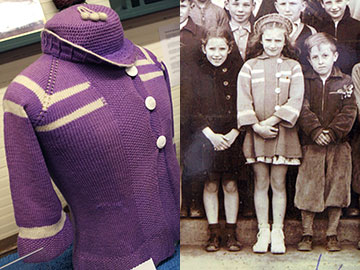
I distinctly recall my grandmother saying that every self-respecting woman in Smock filled up her house with needlework, and evidence of that was everywhere. There was very little knitting, however. The only piece I found was this jacket (with matching crochet hat), made for a little girl named Eleanor Vandigo by her mother. The museum has it on display next to a school photo they found of her wearing it.

Sweater and Hat Set

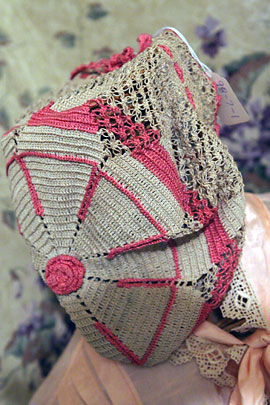
If the number of surviving objects is any indication, crochet was far more popular. In the patch bedroom, I found this nightcap displayed with the bed jacket (trimmed in filet crochet lace) it was made to match.

Crochet Nightcap

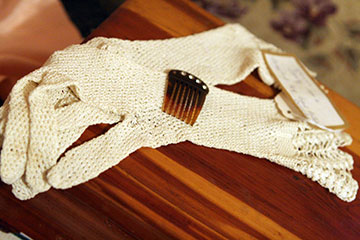
There was also a delicate pair of crochet gloves; Grandma remembers these as being reserved for extremely solemn occasions.

Crochet gloves

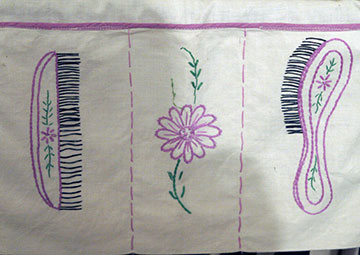
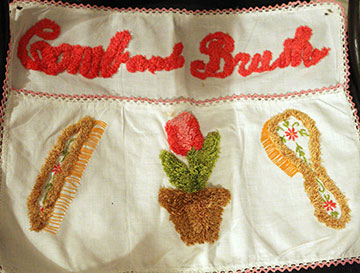
Embroidery was everywhere, worked from patterns either drawn by hand on the fabric or purchased from the local company store. Grandma says every house in the patch had one of these comb-and-brush holders over the kitchen sink–the only source of running water in the houses until after World War II.

Comb and Brush holder

Comb and Brush Holder

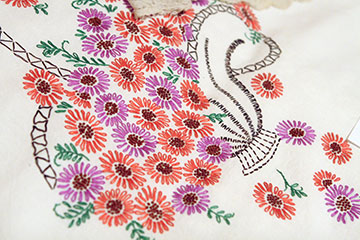
Embroidery brightened up other everyday items like bedspreads....

Bedspread

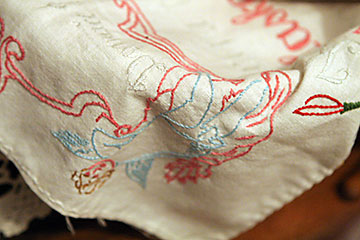
...as well as special occasion pieces like covers for the basket of food taken to church on Easter Saturday for a blessing.

Easter Basket Cover

This one was hard to photograph, but just like the one Grandma has (made by her mother) the florid inscription is written in Slovak.

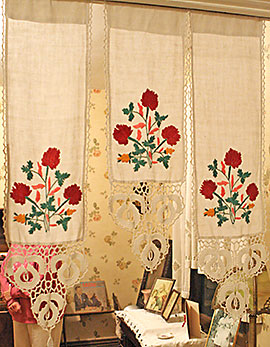
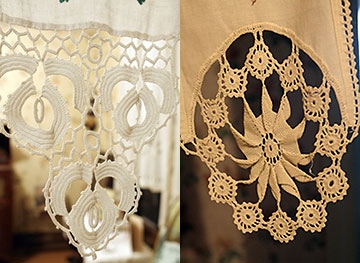
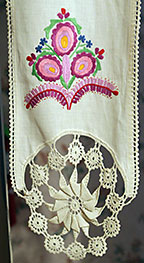
The museum has two sets of three-panel portières. Portières hung in every home in the doorway between the kitchen and the sitting room. They were a prominent showpiece, embroidered on both sides and embellished with crochet lace and medallions.

Set of Portieres

Portiere Medallions

Portiere PanelMost of the mining families in Smock (including ours) were some flavor of Eastern European. I was fascinated to see that a lot of the colors and designs were reminiscent of the folk art from that part of the world. I asked Grandma whether she knew if the commercial patterns were shipped from abroad or created domestically for the immigrant market, but she couldn't say. All she knew is that it all came from the company store.

Most households had several sets of these, and also several sets of window curtains. Both had to be taken down every month and washed, because the air pollution from coal dust, ash-paved roads, coal burning kitchen ranges, and the the adjacent coke ovens for the mine, soiled everything so quickly. It must have been an absolute nightmare to keep house under those conditions, especially using a hand-cranked washing machine or (if you weren't so lucky) a washboard and tub.

It was good to see a monument, however humble, to the people who lived and raised families in the patch. It was a hard life, at times desperately poor, but my grandmother remembers it as being on the whole not a bad way to grow up.

If you're interested in a visit, the museum has a Web site. If you go, see if you can spot my great-grandfather in the photograph of the band that used to perform at weddings and dances. Here's a hint: five of the six men are tall and the other one is shorter than the body of his bass fiddle.

Yeah, that one.

*No, I'm not going to tell you her three names. I'm a gentleman.