When I was a junior in college, studying art history, my tutorial group of six drove from Boston to New York to have an in-person look at several pieces large and small, including a visit to the Frick Collection.
Our tutor had connections of some kind there, and so the six of us were met at the door by a very tall, thin woman who introduced herself to me by saying "My name is ________.* My great-grandfather was Henry Clay Frick, and he is responsible for the works of art you see around you."
I shook her hand and said, "My name is Franklin Habit. My great-grandfather dug coal in a Frick mine for most of his life, and so is he."
I am pleased to report that the august lady's response to this piece of impudence was a hearty laugh and an arm around the shoulder. Times do change.
The Fricks have their museum, and now my great-grandfather (and great-grandmother) have theirs, though not on quite so grand a scale. A couple years ago, a group of volunteers from Smock, the coal patch where my grandmother grew up, got together and turned the company store building in the center of town into the Smock Heritage Museum, a set of rooms dedicated to the memory of patch life during the "Coal and Coke Era" of 1884-1943.
I've wanted to visit the museum ever since it opened, and on this trip I finally got the chance.
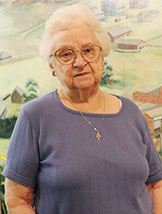
Family history has always fascinated me. Although my grandmother left school after fourth grade, she has an astonishing gift for vivid description and recollection of detail. Under other circumstances, she would no doubt have become a novelist or a journalist. For as long as I can remember, a visit to her meant perching on kitchen chair and peppering her with questions about how she lived as a child, then listening as she peeled potatoes and told stories. I still ask questions, and she still has new stories.
I was always particularly interested in the details of household life–how people in the patch cooked and slept and spent their days–and the newest features of the museum (which Grandma hadn't yet seen) are re-creations of the four things found in every company house: the back porch, the kitchen, the sitting room, and the bedroom.
That's all a miner's house had, really. A porch, a kitchen, and two small bedrooms. Whether you had no children or (as one Smock family famously did) fourteen, that's all you got. At one point, in my great-grandparents' house, there were two parents, four unmarried daughters, a couple of unmarried sons, and one married daughter and her husband, and their baby.
I asked grandma where they all slept. "Where we could," she said. Cozy.
The model patch house rooms were put together by volunteers using items donated by families who'd lived in Smock, with most of the work being done by local Boy Scouts as part of their Eagle Scout projects. How well they did is probably best gauged by my grandmother's reaction. When we walked into the kitchen, she just about burst into tears.
For my part, I was dumbstruck. It was like finally, after all these years, standing inside one of her memories.
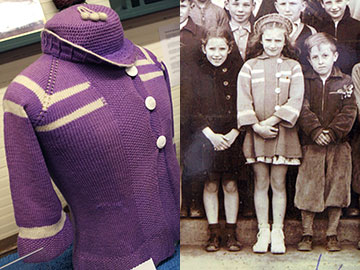
I distinctly recall my grandmother saying that every self-respecting woman in Smock filled up her house with needlework, and evidence of that was everywhere. There was very little knitting, however. The only piece I found was this jacket (with matching crochet hat), made for a little girl named Eleanor Vandigo by her mother. The museum has it on display next to a school photo they found of her wearing it.
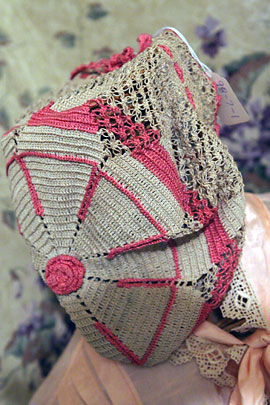
If the number of surviving objects is any indication, crochet was far more popular. In the patch bedroom, I found this nightcap displayed with the bed jacket (trimmed in filet crochet lace) it was made to match.
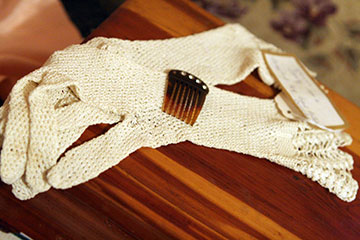
There was also a delicate pair of crochet gloves; Grandma remembers these as being reserved for extremely solemn occasions.
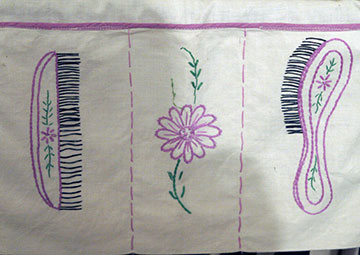
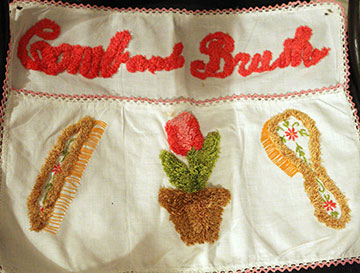
Embroidery was everywhere, worked from patterns either drawn by hand on the fabric or purchased from the local company store. Grandma says every house in the patch had one of these comb-and-brush holders over the kitchen sink–the only source of running water in the houses until after World War II.
Embroidery brightened up other everyday items like bedspreads....
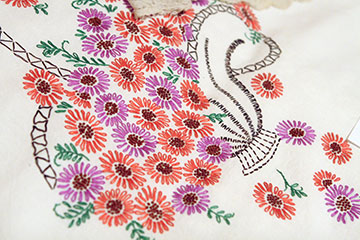
...as well as special occasion pieces like covers for the basket of food taken to church on Easter Saturday for a blessing.
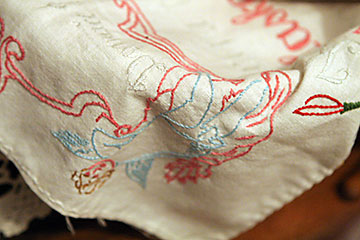
This one was hard to photograph, but just like the one Grandma has (made by her mother) the florid inscription is written in Slovak.
The museum has two sets of three-panel portières. Portières hung in every home in the doorway between the kitchen and the sitting room. They were a prominent showpiece, embroidered on both sides and embellished with crochet lace and medallions.
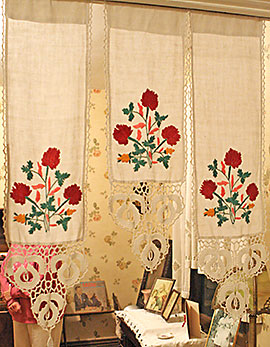
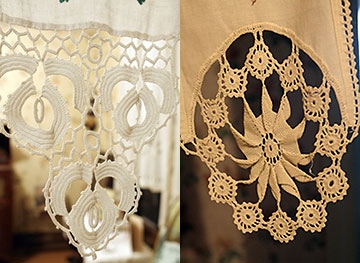
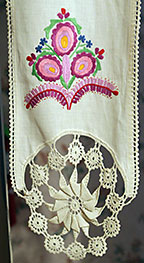
Most of the mining families in Smock (including ours) were some flavor of Eastern European. I was fascinated to see that a lot of the colors and designs were reminiscent of the folk art from that part of the world. I asked Grandma whether she knew if the commercial patterns were shipped from abroad or created domestically for the immigrant market, but she couldn't say. All she knew is that it all came from the company store.
Most households had several sets of these, and also several sets of window curtains. Both had to be taken down every month and washed, because the air pollution from coal dust, ash-paved roads, coal burning kitchen ranges, and the the adjacent coke ovens for the mine, soiled everything so quickly. It must have been an absolute nightmare to keep house under those conditions, especially using a hand-cranked washing machine or (if you weren't so lucky) a washboard and tub.
It was good to see a monument, however humble, to the people who lived and raised families in the patch. It was a hard life, at times desperately poor, but my grandmother remembers it as being on the whole not a bad way to grow up.
If you're interested in a visit, the museum has a
Web site. If you go, see if you can spot my great-grandfather in the photograph of the band that used to perform at weddings and dances. Here's a hint: five of the six men are tall and the other one is shorter than the body of his bass fiddle.
Yeah, that one.
*No, I'm not going to tell you her three names. I'm a gentleman.