Showing posts with label Zen. Show all posts

Friday, August 17, 2007

The Joy of Small Things

Some projects are epics, and when they're finished you stand there blinking and thinking "I made that?"

Some projects are more of a short story, and when they're finished you regard them with a cheerful countenance and say, "I made that."

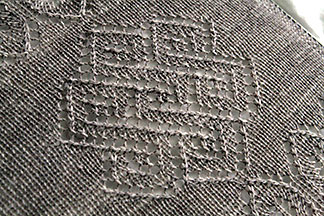
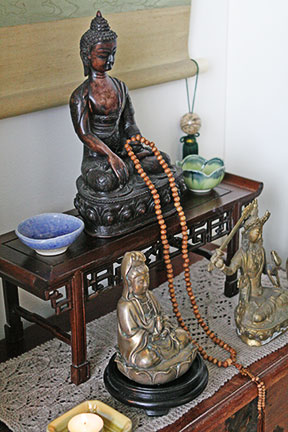
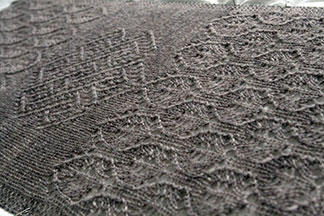
In the aftermath of Abigail's shawl I find myself not at all inclined to cease knitting lace. On the other hand, jumping right into another shawl of comparable size didn't feel right. Instead, I pulled some sock yarn out of the stash and created Altar Cloth V.2.0. (Version one, which you can see here, went some time ago to live with my grandmother in Pennsylvania. It has since converted to Roman Catholicism and now prefers to be called a doily.)

It took about a week or so, and was fun all the while. Here's the dossier on a simple but satisfying little project.

Blocked, Detail

Yarn: Mysterious itchy sock yarn out of my stash. The same stuff I used to make the Orenberg sample shawl for the Knitting Olympics.

Needles: Inox US 2 3/4 straights

Knot

Patterns: The stitch motif used by Cheryl Oberle for the Kimono Shawl in Folk Shawls for the sides. In the center, the knot pattern collected in Barbara Walker's A Second Treasury of Knitting Patterns and also to be found, charted, in Meg Swansen's A Gathering of Lace.

Method: Disgustingly simple and wholly unoriginal.
  1. Using a loose, stretchy technique (I did a knitted cast-on over two needles) cast on enough stitches sufficient to accommodate however many repeats of the Kimono Shawl motif you want, plus three edging stitches on either side.

  2. Work six rows (three ridges) in garter stitch.

  3. Commence Kimono Shawl motif, working first and last three stitches of each row as garter stitch.

  4. When you've made the edge deep enough (preferably ending on a complete repeat of the Kimono shawl motif), knit two rows plain and begin knot pattern. Take care to center it perfectly.

  5. When knot pattern is complete, knit one row plain and place live stitches on holder or length of waste yarn. Break working yarn.

  6. Repeat steps 1-3 to create a second piece, identical to the first up to the beginning of the knot pattern.

  7. Put first piece back on the second needle and graft the two pieces together using Kitchener Stitch.

  8. Block severely, but with compassion.
In UseOf course, if the Kimono Shawl motif were not directional or if I hadn't cared about making the tips of all the leaf shapes point at the central knot, I could have just knit the entire piece in one shot.

It ain't perfect. I rather wish I'd done something more with the plain stockinette areas around the knot. Perhaps in version three.

But the roughness of the yarn, which I would not have appreciated in a sock, looks well on a small, Zen altar and on the whole, I'm pleased.

So pleased that I think it's time for more lace.

Monday, May 07, 2007

Nibble, Nibble

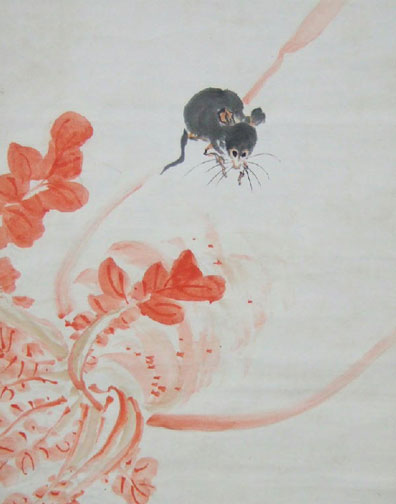
There's a standard motif in Japanese painting of a teeny-weeny mouse chowing down on a great big daikon. In some renderings, instead of a mouse it may be a rat. Or instead of a daikon, it may be a radish. But the basic idea is the same: small thing eating big thing.*

Nibble
Mouse and radish (detail). Not my scroll, but the motif is the same.

I've a nice specimen of this is in my collection. I'm so fond of it that I kept it over my altar for two months; usually I change the altar scroll every thirty days. The image of the little guy fearlessly tackling a gigantic project appeals to me at a very basic level. If you've ever stood next to me when I'm barefoot, you know why.

Last night as I was giving the homestead a general wash-and-brush I replaced the mouse with a painting of Jizo, the bodhisattva who watches out for expectant mothers and unborn children. (My sister is half a continent away, but she's uppermost in my mind at the moment.)

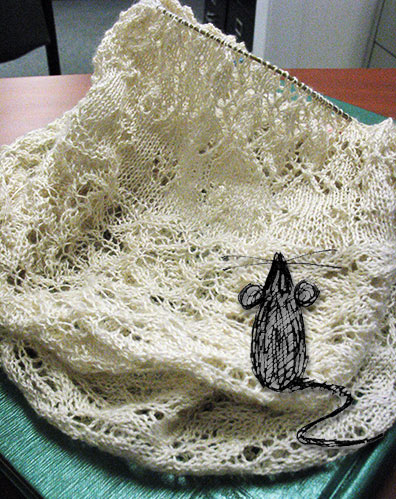
The mouse is rolled up and tucked away, but I'm reminded of it every time I pick up the christening shawl. The rounds are getting really long now (somewhere in the area of 600 stitches). When I consider how long they'll be before I start the edging I begin to teeter like Dolores after a wedding reception with an open bar.

So I try not to consider that. The mouse, you will notice, is not standing back casing the daikon and wondering whether he should have ordered the shrimp appetizer instead. He's just eating the bit that's in front of him. And that's what I'm doing. I'm knitting what's in front of me. 50,000 stitches? Big and scary. One stitch? Not scary at all. No sir. No reason to be scared of one tiny stitch.

Nibble Nibble

(Squeak.)

*Omigod, that totally reminds me of a wild story about something that happened in Ogunquit one summer which I'm not going to tell you because I'm sure my mother is reading this.

Tuesday, April 10, 2007

Zen Interlude: Spring Awakening

It's terribly unfair.

Chicago, like most of the United States, is experiencing wintry weather that has no business showing up in mid-April. Mind you, I know better than to expect a balmy, shirtsleeves spring beside the Lake. But I do look forward with desperate longing to the arrival of the daffodils every year. Once they bloom, I feel a certain sense of accomplishment in having survived yet another nasty go-around on the Hivernal Carousel.

This year, they bloomed, and then got sucker-punched by snow squalls and freezing temperatures. The bed of daffodils I pass every morning on the way to the office is blackened and shriveled, and I don't feel so well myself.

On the other hand, the other spring arrival–baseball fans–is right on time.

I've nothing against professional baseball. Truly. In general I regard it as most Americans do the opera season, which is to say not at all. Because the transit line I ride services both ballparks in Chicago, however, I do have to deal with baseball fans. Especially Cubs fans.

And yesterday was the home opener.

Illinois is supposedly a blue state, but I've noticed that North Shore (i.e, white and affluent) parents who bring their offspring into the city for Cubs games turn a violent shade of tomato red.

I've tried to understand why this is so. I've concluded that it's because they see a trip to Wrigley Field as a to connect their children with their own past, in those halcyon days when America led the free world, gasoline was cheaper than milk, and Certain People had to sit in the back of the bus.

As the train heads south and Addison Station looms, the parents become so emotional that some actually produce handkerchiefs to deal with the tears. "We're almost there," they gasp, choking on rising nostalgia. "Can you watch for the stadium, Caitlyn? Do you see it coming up?"

I'd be the last person to have a problem with this except that in the midst of a crowded commute, the parents get pushy about art directing the experience and become visibly (and sometimes audibly) annoyed at any extras (that would be the rest of us) who don't fit the motherhood-flag-apple pie aesthetic they're after. For example:
  • Passengers occupying window seats, including the elderly. (I once saw an able-bodied man unblushingly ask an old woman if she could give her seat to his five-year-old daughter so she would have an unobstructed view of the Wrigley Field sign.)

  • Persons of African, Latin or Middle Eastern descent.

  • Persons speaking languages other than English.

  • Persons whose appearance deviates in any way from the white, suburban, middle class idea of "normal," i.e. goths, punks, transvestites, homeless people.

  • Males of any stripe who are knitting lace.
During yesterday's commute, I of course fell into at least two of these categories. Possibly three, depending upon how you feel about earrings on men.

This was a source of enormous consternation to a father whose daughter–she was perhaps six–was interested in the progress of the christening shawl.

I didn't notice the family of three–Dad, daughter, son–at first because I was, well, knitting lace. But the daughter kept getting up from her seat and leaning toward my needles. After she'd done this three times I glanced up and gave her a smile.

She smiled back. And then her father yanked her away and pushed her firmly into her seat.

But she got up again, and came over, and this time asked if the design had flowers in it. I was about to explain that the shapes were fir cones when her father yelled, "Halley! Get back here now."

I honestly thought he was concerned that she might be bothering me, so I smiled and said, "It's okay, I don't mind questions."

To which he replied, "You leave my kid alone!"

And then, not directly to me, but just as audibly, "Goddamned freaks."

Rude? Oh yes. But this is not supposed to be another man-knits-in-public-and-attracts-idiocy story. Those are too common to be interesting in and of themselves.

This is a reminder to myself that my own brain's not so different from his.

I may not be inclined to tell a stranger on the subway she's a freak, but it doesn't mean I don't think it. I do it all the time. In fact, I did it at the beginning of this entry, no?

I look, I categorize, I judge. And just as I believe that man got me wrong in believing me to be a threat to his child, I'm certain I often misjudge others.

One of the aspects of elusive Enlightenment I'm pursuing through Zen Buddhism is (I hear) a genuine understanding that between yourself and myself, there is no difference. If I didn't believe that to be so, I'd probably give up sitting zazen. But even though I believe it, I haven't grasped it sufficiently to act upon it.

Hmph. Back to the damn cushion.

Tomorrow: actual knitting. (I know! I can hardly believe it, either!)

Saturday, November 18, 2006

Jukai

Note: This is a very long and purely personal post. Please indulge me. On some occasions, this blog still needs to be the diary I intended. I want to write this all down quickly so I won't forget it, so I'm not going to spend a lot of time explaining every term, etc. And, as always when I write about Zen, all I'm doing is reporting my personal experience in as plain a fashion as I can. I write from a position of no authority. If you really want to learn about Zen, hunt down a qualified teacher or check out The Three Pillars of Zen by Philip Kapleau Roshi.

When I first set foot in the Chicago Zen Center (CZC) back in March, I'd been reading about Buddhism on my own for a year, devouring any book I could get my hands on that didn't seem too superficial or too weird. The more I read, the more Japanese Zen seemed to call me. (I once thought Buddhism was a monolith. Not so. There are many, many sects–same as in Christianity. In Japan alone, even Zen has three major branches.)

My first sittings, for about two months, were with a GLBT Buddhist group in Chicago. They were a pleasant fellowship, and well-meaning, but ultimately I decided I wanted to work with a teacher. The group, which bills itself as non-sectarian was distinctly anti-Zen for reasons I still can't fathom. I asked the others about training centers in Chicago and was told, flatly, that aside from the Korean Zen temple in Lakeview that there weren't any and that, in any case, GLBT people do not practice Zen.

I chalked this up as yet another instance in which I and the mainstream GLBT community disagree about what is right for me. A quick hunt around on the Internet turned up the CZC, which not only seemed to offer exactly what I was looking for, but also happens to be about a ten-minute walk from my office.

After one visit, I suspected this was the place for me. After three, I was certain. The place is welcoming, but they don't give you a big hug when you come in the door. I was shown how to do prostrations, how to ask for the kyosaku during a sitting, how to do kinhin, and how to sit properly. And then into the zendo I went, to do it all best I could.

For somebody who has always been compelled to get even complicated things right the very first time, there have been moments of terror over the past nine months. Because, as I am beginning to comprehend, there's no such thing as a Zen prodigy. And at the CZC there's no hand-holding, no dumbing down, no gold star stickers for minute increments of progress. This is the real thing, not some hippy-dippy smiley-happy Easy Zen substitute, where the path to satori is ordering a platform bed and ecru curtains from Pottery Barn. As a matter of fact, nobody seems to mention (or care about) satori at all.

Sensei and the other members have been very kind to me as I've stumbled over my robe (and my own feet), bowed in the wrong direction after a sitting, got lost on the way from the Buddha Hall to the zendo, and (during one sitting I will never forget) slid right off my cushion with a deafening THUD because my entire ass fell asleep during zazen and I was trying surreptitiously to wiggle it around and wake it up.

I'm allowed to make mistakes, I'm expected to make mistakes. When they happen, I'm gently but firmly corrected or nudged in the right direction. It's like being a child, except that when I was a child in school my errors were punished far more harshly. I can remember so many times hearing a teacher yell, "I would have expected [insert problem here] from any other child, but not from you!" And now I'm not special, not special at all. What a luxury.

All of this led up to last night, and a ceremony called Jukai, during which I (and the rest of the community) took the precepts of Buddhism. I don't know how to describe this in terms that really make sense to people who haven't read a lot about Buddhism. It sort of reminded me of the once-yearly reaffirmation of baptismal vows in a Roman Catholic church. But for me, personally, it felt like a conversion ceremony. I was once a born Christian with an interest in Buddhism. Now I'm a Buddhist. A small but important (well, important to me) line has been crossed.

So that I won't forget them, I want to write down the superficial details of the night.

Jukai was preceded by what the CZC calls Temple Night. Usually, our practice isn't what you would call devotional. We meditate facing the wall, not the altar, and the altars are very small and simple. On Temple Night, sitting is done facing not only one, but many altars set up all around the center. This was my first Temple Night.

I arrived about 7:15 and was greeted by Mike, one of the practitioners who's been there...I don't know...forever?...who gave me a typical CZC orientation for a new occasion: it was whispered, about ten words long, and delivered only once. At this point, I'm used to that. I even like it. It keeps you alert.

I noticed that a scroll I haven't seen before, a standing Bodhidharma, had been hung in the Center's living room. It looked like it was a rubbing from a masterwork, but unfortunately I never got a chance to check it out up-close.

I went down to the men's changing room and discovered that Jukai is something like Christmas Eve in a Catholic church–people come out of the woodwork. I was lucky to get a hook for my pants and such, even though I was early as usual. Note to self: next time, show up at 7.

Sitting was open, which meant we could sit in either the Buddha Hall or the zendo; and we could get up and move as we wished (usually, the stages of a sitting are strictly timed and announced through the use of different bells and gongs). Mike had told me the altar for images of departed loved ones was in the zendo, so that's where I went first.

I had brought Uncle Mike's picture with me–the one from this post. In the zendo everything was rearranged. Two arcs of mats faced a low, central altar of the many-armed Kannon (Bodhisattva of Compassion) against the west wall. There were a lot of photographs already on the altar. I added mine, bowed, and sat down, resisting the urge to stand there and examine the gorgeous figure. (The instincts of the art historian die hard.) It was odd, at first, to be facing the others instead of the wall, but I got used to it pretty quickly. Made a nice change. And then I noticed that everyone who came and went was doing prostrations to the altar* instead of merely bowing. Oops.

I sat, and felt that this sitting was really my time to remember and honor my uncle. My thoughts were very personal and I won't record them here.

After a time, I decided to move to the Buddha Hall and so got up, did three prostrations (without tripping over my robe!) to Kannon and headed downstairs.

My first sight of the Buddha Hall was so startling I had to stop for a moment and catch my breath. It's a low room, with dark pillars and walls and only small windows, high up. Normally the lighting is subdued, but on this night the only light came from hundreds of small candles on three altars and maybe six or eight smaller tables piled with offerings of fruit, vegetables, flowers, and bread.

From left to right, the altars were (I hope I remember this properly) Kannon (seated, gesture of the fist of wisdom); Shakyamuni Buddha (seated, zazen mudra) and Mahaprajapati (seated, gesture of fearlessness). I'm especially fond of that figure of Mahaprajapati. She was the Buddha's aunt/foster mother, and she was instrumental in persuading him to share his teaching with women. You go, girl.

In the dim light, robed figures sitting, sometimes moving to sit in a different place or do prostrations. Kinhin (walking meditation) at the back of the room. It felt...ancient. Imperturbable. Every so often, chanting. I discovered to my delight that both "Kanzeon" and the Heart Sutra are both now firmly in my brain, and about half the chant to avert disaster.

One thought that rang out loud and clear out of a quiet brain: How happy and fortunate I am to be here.

Sitting in front of Kannon, quite close to the altar, I had a strong sense of déja vu and couldn't stop from trying to puzzle out why. After about a minute it hit me. The overwhelming warmth, the peace in my chest were exactly those I'd experienced one Christmas, years ago, sitting in our darkened living room looking at the Nativity figures by the light of the Christmas tree. I've been trying to get back to that space, without success, for so many years. And here it was, perfect, as if twenty-plus years of angst had not intervened.

A round of kinhin, with chanting (something new for me–usually we're silent). I had never heard the chant before but recognized it (I think) as Sanskrit in praise of Shakyamuni Buddha. I need to go look it up to be sure.

And then, Jukai. I ended up quite by chance directly behind the mokugyo player, in the middle of things. As far as I know, I may have been the only person taking the precepts for the first time. Sensei led from the front. His sense of conviction was palpable. Another luxury: a teacher who believes what he's teaching.

I recited the Three Treasures, the Precepts, and the Bodhisattva Vows as directed. Meant every word of it. May not ever be able to live up to it, but I mean to try. Knelt, prostrated, bowed. And when Sensei read about this ceremony being the way in which "we enter the Buddhist family" I felt a tear roll down my cheek. I have so far to go, more miles than from here to the next galaxy before I'll even feel I've moved an inch, but at least I've started.

About the prostrations: the CZC's Web site explains them better than I could, in answer to the question of why there are figures on the altar if there's no "personal God" in our practice: "The Buddha (and the other figures) are inspiring to the practitioner. They embody, in a kind of metaphorical, crystalized manner, the enlightened, open mind that is our truest nature. When we prostrate or bow to a figure it is not a form of worship, but rather an affirmation that the purity that is represented by the figure before us is really within us, and we are lowering our smaller, limited ego before this all encompassing truth."

Tuesday, October 17, 2006

The First Patriarch of Zen Is a Noodge

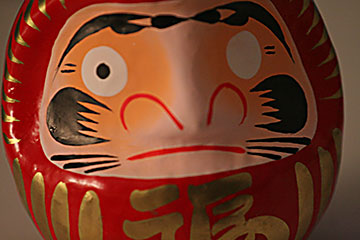
Daruma

Daruma says, "Franklin, kindly finish that Big Nameless Project so you can give me my other eye."

Daruma says, "Did you finish recording your Hallowe'en piece for Cast On yet?"

Daruma says, "Why don't I see that second cabled sock around here anywhere?"

Daruma says, "If I had arms and legs I could ski down that pile of dirty laundry."

Daruma says, "Weren't you supposed to remind folks about RSVP'ing to the Dulaan Knit-In as soon as possible?"

Daruma says, "So, how's the new sketch for the shop coming along?"

Daruma says, "Your photography Web site has been sitting there untouched for so long I think mice have nested in the Javascript."

Daruma says, "If you're going to design a Christmas ornament this year, now would be a good time."

Daruma says, "I was checking out your list of deadlines for freelance clients and wow, are you ever in trouble."

Daruma says, "Hey! What are you doing with that rolling pin? Help! Help!"

Wednesday, September 20, 2006

Zen for Sale

The Book Impulse runs strong in my family. When we develop a new interest, there is always a corresponding rush to the bookshop. This is why a year ago I had one knitting book, and now have about forty. And why eight months ago I had one book on Buddhism, and now have half a shelf.

(Yes yes yes, I know you can't get Zen out of a book. But the covers are so pretty.)

I'd never thought about Buddhist magazines, though, until two days ago when I picked up something called Shambhala Sun because of the amusing cover illustration of George Washington sitting in full lotus. Ha, ha.

The articles were worth a read, aside from one Buddhist mother's endless description of how her son's "innocent, wondering" questions keep her on her Zen mettle. That one just set my teeth on edge. Lady, if you're reading this:

  1. I recommend you learn to make liberal use of the phrase "Because Mommy said so, that's why."

  2. This was transparently an excuse to write about how your child is the latest incarnation of Master Hakuin. Bully for you. Check in with us again after he robs his first liquor store.
I was also a smidgen startled when the fellow who interviewed the Dalai Lama said he was so compelled to be "pure" for their meeting that he refrained from "pleasuring" himself. I'm not sure I needed to know that. On the other hand, it's amusing to wonder if anybody's ever felt such a compulsion before interviewing Julia Roberts.

After I'd gone through all the articles I started noticing the ads. If I buy another copy of Shambhala Sun, I admit with a blush that it will be for the ads. Because they are delicious.

Some are what you'd expect. This meditation center, that cushion supply company. But then there are banners for companies that will furnish you with digital "Zen clocks" or invest your money according to the principles of the dharma. (The ad for the latter featured a statue of Buddha buried up to his pendulous earlobes in gold coins.)

And there are real estate advertisements. Properties, most of them in Santa Fe or Colorado, beginning in the half-millions. Not so different from such listings in uppity mainstream rags; except that instead of noting access to spectacular golfing, or electrified perimeter fences to zap unwanted Mexicans, they tout the proximity of stupas or retreat centers. Sotheby's, known worldwide as an avatar of the simple life, even takes care to note that it practices "mindful" real estate.

I love that. I can just imagine a pair of clench-jawed WASP Zennies looking down on the Asian-style adobe next door and thinking, "Sure, they have two Bentleys, but we can see the stupa from our his-and-hers teak jacuzzis from Dharmabubble."

Amazing how much non-attachment you can get for a couple million, no?

This lovely warm smugness filled up my stomach and a fully-complete blog entry sprang into my mind like Athena from the head of Zeus. Silly Americans buying enlightenment. Thinking that a triangular digital clock and an expensive platform bed will bring them closer to satori. An AmEx Gold card is not the key to enlightenment. What fools. Ha ha ha. Snark snark snark. Everybody knows retail consumption doesn't make you more of a Buddhist.

And then that frigging little voice in my head spoke up.

You bought the magazine, didn't you?

Monday, August 28, 2006

Just Eat

A little introductory note: I've noticed in my stats and on Bloglines that there are suddenly a whole lot of new readers. Welcome! I'm pleased as punch that you're here. I just want to warn you that this is not a knitting-only blog. I often veer into other topics that interest me. Chalk it up to the male fear of commitment.

One of my favorite Zen stories is about two novice monks from long ago who were discussing the relative merits of their teachers.

The first said, "My teacher can do amazing things. He can stand on one side of a river with a brush, while an assistant stands on the other side of the river with a sheet of paper. As he moves the brush through the air, writing appears on the paper."

The second said, "Interesting. My teacher can also do amazing things. For example, when he eats, he eats. And when he sleeps, he sleeps."

To which the first monk replied, "Yo' mama."

The first time I read this (and the second, and third, and fourth–it's a Buddhism Greatest Hit) I thought I understood it. When you sit down to eat, pay attention to your food and to eating. Do not distract yourself with thoughts of other meals, of a past you can't change, of a future that doesn't exist. When you lie down to sleep, let go of the day's worries and don't invent new ones for tomorrow. Just sleep.

Sounds rather impossible; but okay, fine. Great. Got it. What's next?

Well, I didn't get it. As popular as stories are in Zen teaching, Zen isn't about words. It's about experiencing things directly, yourself. You can't get that out of books.

Me, I love books. I love books the way that Fafnir, the dragon in Siegfried, was rather fond of treasure. Books have been my greatest, sometimes I think my only, teachers. So when I've been told that reading books on Buddhism isn't going to get me anywhere, I've nodded and said, yes yes. And then I've gone out and bought another book.

Time for an attitude adjustment.

Sunday was a great big helping of Direct Experience. Our center held "zazenkai"–a full day of meditation. This was my first time. Here's the schedule:
  • 7 am-10 am: zazen (seated meditation) and kinhin (walking meditation)
  • 11-noon: teisho (lesson)
  • noon-12:45: lunch
  • 12:45-2 pm: zazen and kinhin
I love zazen, but that's a whole lot of sitting still. By the time teisho was over I was definitely ready for lunch. I imagined kicking back around the big table with the other Zennies and comparing which parts of our bodies had gone numb and might very well fall off.

Instead, I was shown in silence that I was to help myself to the soup, rice, fruit, and crackers in the kitchen and then take a seat in a chair in the living room. And just as in the zendo, the seats were arranged to face the walls.*

There I was, after five hours of not talking, being sent to eat soup and crackers while looking at nothing and speaking to nobody. For just a second I considered slipping out of my robes and into my clothes, and running away into the street shouting at the top of my lungs.

Instead, I sank dutifully into a chair by the fireplace. There's a small bronze Buddha on the mantel. I looked at it and thought, "2,500 years ago you had a bright idea under a tree, so now I'm sitting here in Chicago dressed like Obi-Wan Kenobi having lunch with a wall."

I took a spoonful of soup and my eyes rolled back in my head. The taste was incredible. It didn't make sense, though. This was pretty plain stuff. Broth, vegetables. But it blew my mind. So did the cracker when I bit it.

I kept eating, trying to get a grip on the sensations rocking my head, and then I realized this was possibly the first meal of my entire life in which I was permitted–compelled, really–to just eat. No checking e-mail, or making calls, or dishing friends not present. It was just me and the soup.

The word that sprang to mind was luxury. I've never enjoyed any meal so much, not even dinner on the Minerva II, eating five French courses while watching the sun set over the Aegean. It felt unspeakably indulgent. I stretched out my bare toes and sighed, which in the hushed room sounded like a car alarm.

Oops.

And so...so what?


I don't know. There's no pat conclusion here. No specific lesson learned. I'm not going to start declining dinner invitations so that I can have tete-à-tetes** with a sheet of plasterboard. I do feel that I've been shown something interesting. I might never have seen it if it weren't for practice.

Reason enough to keep practicing. (Plus I get to wear cool robes. I look pretty darn cute in the robes.)

* In the Soto Zen tradition, which I practice, we meditate with our eyes open, facing the wall. It's an homage to the Zen ancestor Bodhidharma, who is said to have reached enlightenment after meditating for years while facing the wall of a cave in China.

**Where the hell is the circumflex on this keyboard?

Tuesday, August 08, 2006

Conundrum

With little effort I can summon compassion for tens, even hundreds of thousands of people I do not know and will likely never meet, who live in far-off countries I've never been to. Even when they practice religions whose tenets confound me. Even when they hate my country and, by extension, myself. Even when they actively seek to destroy me.

Yet when a neighbor lady in ridiculous platform shoes topples over in the elevator and causes a needless commotion from which I cannot extricate myself for twenty minutes which means I miss my first train which means I miss my second train which means I arrive at work late instead of early as I'd intended which means my entire morning is crap with a side of chaos, I think about my neighbor and instead of feeling compassion I imagine bludgeoning her with one of those damned shoes.

Conundrum

I haven't figured out the sound of one hand clapping yet, either.

Tuesday, May 23, 2006

What Is the Sound of One Bitch Slapping?


So. I have now been practicing Japanese-style zazen (silent meditation, both sitting and walking) for about a month. I've left the sangha I'd been sitting with on Thursday nights and begun practicing at the Chicago Zen Center, which offers the community I need under a teacher who impresses me mightily.

(Also, I get to wear a kicky brown floor-length robe.)

The upside of this is that I notice already a shift in my bearing. Less of my time is spent fuming over things that make me angry, more of it is spent being productive.

You might not think that facing a wall for 30 minutes a day at home, with an additional two hours or so at the zendo (meditation hall) twice a week would make much difference in a person. I certainly didn't expect it. And to be sure, I'm not becoming a goggle-eyed automaton. I still want to slap at least twelve idiots upside the head every day.

The change is more like the faint tinge of green you'd see at the base of a plant which appeared dead a month ago, but which with water and care is beginning to show the smallest sign of revival.

Certainly nobody else would notice such a subtle shift, right?

Wrong. Other people are making it crystal clear to me what a sour-pussed bitch I've apparently been.

I came into work a couple days ago feeling good, but not radiant. Just a normal me, on a normal day, following the usual routine.

Passing the reception desk, I said good morning, then went upstairs to my office. I'd just sat down in my chair when the phone rang. It was the receptionist.

"Um, Franklin," she whispered. "You can tell me. I'll keep it a secret. You're so...happy...today. Did you get a new job?"

Later that day, I was in conference with my boss regarding a pain-in-the-ass bullshit project that's been plaguing us for weeks. He told me a point of design about which I had been adamant was being overturned at the caprice of a big-spending volunteer. I said that on reflection, it didn't seem like such a big deal and I was fine with the change.

My boss leaned over the conference table and said, "Is there something you'd like to tell me? Did you get a new job?"

Still later, there was a small meeting of about seven of us from different teams within the organization. Nothing remarkable about it at all, that I noticed.

Afterward, I stayed to go over copy writing with one of the directors. We were in mid-edit when she sat back in her chair, crossed her arms and said, "Come clean. You're out of here, aren't you? I can totally tell. You're in much too good a mood."

When I was about five years old and living in Tucson, Arizona, my kindergarten class received monthly visits from a Native American teacher. He taught us a bit about the indigenous culture of the area and over the course of the year gave some of us "Indian" (his term) names.

Mine was Little Thundercloud.

Now I guess I understand why.