Monday, November 24, 2014

Me, Elsewhere: Twist Collective

The newest issue of Twist Collective was published yesterday. My contribution is a paean to Elizabeth Zimmermann's knitting videos, plus a drinking game.

In our time, what greater tribute can a devoted fan offer to a beloved series than a drinking game?

Slash fiction, I suppose. But I'm not going to do that so don't even ask.

(If you don't imbibe, don't worry. Neither do I. It works equally well with cocoa or tea. Or, come to that, it works with little bits of chocolate, or shortbread, or... .)

Read it here

Friday, November 21, 2014

Magic

I've been taking a multi-week course in bookbinding.

This will surprise absolutely nobody who knows me well and has therefore heard me pine wistfully for a press and a bindery to call my own.

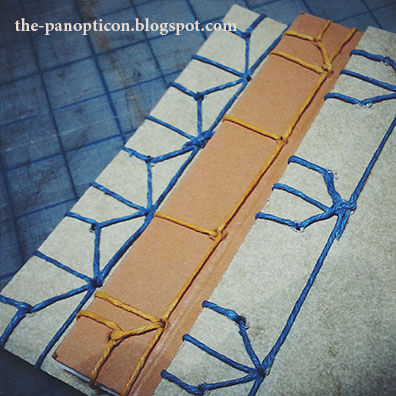
I'm enjoying it. The teacher is excellent, the fee is reasonable, and my first efforts are imperfect but promising. Last time we did Japanese stab bindings:

three-bindings

The studio itself has taken getting used to.

I'm usually surrounded by fiber arts folks. Here's the thing about fiber arts folks: they're humble. Doesn't matter who they are or what they've done, you'll have to look hard to find a knitter who will throw attitude at you because she's got four decades of professional experience and has written a string of classic books.

This is probably due at least in part to the greater world's general sniffing disdain for textile arts, especially knitting and crochet. These are (so they say) unserious, unimportant, practiced by the sad and the shut-in. They're wrong and stupid about that; but on the positive side it does tend to keep us grounded.

Snobs there are, yes, and those whose folies de grandeur make for fun industry gossip. But they're a distinct minority.

So it was a bit of a cold bath to be reminded when I walked into the print studio for the first time what a room full of extreme self-importance feels like. Absolutely everyone in sight (except me) was a Serious Artist to Be Taken Seriously.

I heard more theorizing, posturing, and pronouncing in five minutes than in all the previous year. I heard an early-twentysomething who was silkscreening a cartoon owl onto a t-shirt refer un-ironically to "my earlier body of work."

I don't do very well in situations like this. I get scared and I shrink. I mumble. I took my bone folder and awl and sat in a corner and tried to disappear.

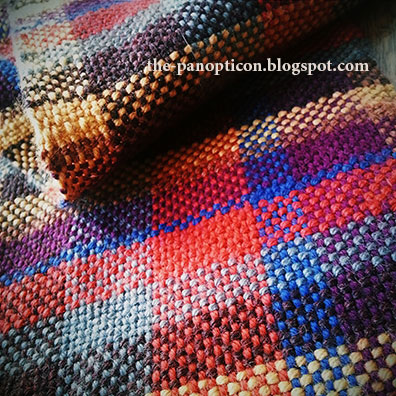
Last week I went into the room where the paper guillotine* lives, and just as I was getting ready to chop the head of my little perfect-bound book, one of the Serious Artists looked up from her bench–she was scrutinizing a very gorgeous letterpress poster–and asked me about my scarf. This scarf, which was made of leftovers from Longer on the Inside:

wove-scarf

"I love those colors," she said. "Where did you get it?"

"I made it," I said.

She was taken aback.

"You mean you...what? You sewed it or something?"

"No, I made it. I wove it."

"You wove it? You mean you made the actual fabric?"

"Yes. On a loom."

"You made fabric?"

"Yes."

"Oh my god," she said. "That's incredible. You actually made fabric? From scratch? Can I touch it? Would it be okay if I touched it?"

I let her touch it.

"I just can't believe you made fabric," she said. "That's like...magic."

Good to hear. Good to be reminded that what we do can startle even Very Serious Artists.

We're magic.

*Ohhhhh, the paper guillotine. It's so beautiful. Cast iron, almost five feet high, easily a century old. Can slice tiny slivers off the edge of stack of telephone books. Enormous, graceful curving lever to lower the blade. The paper guillotine. Mmmmmmm.

Saturday, November 15, 2014

All About That Lace

I am nothing if not easily distracted. What's below is the kind of thing that creeps into my notebooks when I am supposed to be doing serious work.

If Meghan Trainor's bouncy ode to the curvaceous posterior, "All About That Bass",


can spawn a Star Wars version, a high school literacy version, and a forties jazz  version, et al., I see no reason why we knitters should not have a version of our own. 

I sing like a screech owl and haven't got the time to make a video (perhaps the Mason-Dixon ladies will oblige?), but here's my contribution to the boom boom on the dance floor.


Because you know
I’m all about that lace, 'bout that lace,
No cables.

I’m all about that lace, 'bout that lace,
No cables.

I’m all about that lace, 'bout that lace,
No cables.

I’m all about that lace,
'Bout that lace, lace, lace.

Yeah, it’s pretty clear
I need a size 2.
'Cause I been swatching, swatching,
Like I’m supposed to do.
'Cause I know what you need to make it all lace–
All the right holes in all the right places.

The knitting magazines down at the local shop,
You want a pretty shawl? They got a bumper crop.
Yarn over, knit together, and never stop
'Til every inch of it is perfect
From the bottom to the top.

You know my mama she told me don’t worry about the size,
She said a shawl can be tiny or cover you to the thighs.
You know I won’t knit your sweater for Christmas like Santa’s elf.
So if that’s what you want you can knit it your own damn self.

Because you know
I’m all about that lace, 'bout that lace,
No cables.

I’m all about that lace, 'bout that lace,
No cables.

I’m all about that lace, 'bout that lace,
No cables.


Hey!

I’m using silk and yak,
I like the way my little needles clack,
I maybe wish I hadn’t chosen black–
But I won’t give up
'Til every inch of it is perfect
From the bottom to the top.

You know my mama she told me don’t worry about the size,
She said a shawl can be tiny or cover you to the thighs.
You know I won’t knit your sweater for Christmas like Santa’s elf.
So if that’s what you want you can knit it your own damn self.

Because you know
I’m all about that lace, 'bout that lace,
No cables.

I’m all about that lace, 'bout that lace,
No cables.

I’m all about that lace, 'bout that lace,
No cables.

I’m all about that lace, 'bout that lace,
No cables.

I’m all about that lace,
'Bout that lace.

Hey, hey, ohh.

You know you like this lace.

Sunday, November 02, 2014

Strongly Disagree

I taught at Vogue Knitting LIVE! Chicago once again this year, and it's always kind of a kick to do a gig in my own town. No jet lag, no airport security lines, and I already know where to get lunch.

I also get to say hello to a fair number of friends who live in various places around the Midwest and travel in for the big shows or events. One of them–I'll call her Martha–decided to sign up for my class on the gorgeous traveling stitch patterns (the stitches travel, not the patterns) commonly known to English-speaking knitters as Bavarian Twisted Stitch. You may also know it as Austrian Twisted Stitch, or (if you speak German) you may know it as one of the many forms of Strickmüster, or knitting patterns.

You may not know it at all, in which case please allow me to recommend my class. (My calendar is always here–did you know I'm sailing to Alaska in July?)

Anyhow, Martha showed up a bit early to chitchat and catch up. We went to Meg Swansen's Knitting Camp together a couple times, but don't get to see each other much. She asked how the show was going. Dandy, I said. Good students, happy classes.

"I'm sure your classes are always happy," she said.

Well, I try. I try my damnedest. My classes take about a year of preparation to début; and ever after they are subject to constant fine-tuning. It's not enough to know how to do something in order to teach it. You have to–this is my opinion, anyhow–know it well enough to explain it at least five different ways. Not everyone learns in the same way, or at the same pace. You must be able to adjust your teaching to suit the students who walk through the door, and anybody can walk through the door.

Even so, you can't please everyone. Sometimes your feedback forms come back with disgruntled comments. I've had marks taken off for
  • the font I used in a handout ("Sans serif faces are unprofessional"),
  • wearing a bow tie ("so pretentious"),
  • not keeping the room warm enough (we were in a barn at a fiber festival),
  • talking too much (I was, you know–teaching),
  • being too gay,
  • being too unattractive, and
  • not making it clear in advance that a class on lace charting would require the students to use lace charts.
Martha sat in the back of the classroom with the other bad seeds. At the conclusion, though I clearly asked the students to please place their feedback forms on the chair by the door,  she insisted on handing hers to me.

I wish to share with you select excerpts from Martha's comments on my teaching.

Would you take another class with this teacher?

I don't know. Will there be wine?

Would you suggest this class to a friend?

Only if they want to learn something.

Additional comments and/or suggestions.

Although instructor wore hat, nevertheless appeared to be unable to bilocate. Only in one part of room at any given time.

Was unaware that knitting is prerequisite for this class.

Purl stitches do not travel? This seems discriminatory.

Cannot decide whether these German-style charts prevent Alzheimer's or promote it.

Instructor's bow tie did not light up.


EDITED TO ADD: I must not be coming across quite clearly to all. Martha is (as I wrote) a good friend.  Her lampooned feedback form, as quoted above, made me laugh. The other comments, from other classes at other events, aren't posted as a cry of pain–I thought they were funny. What can person do in the face of such absurdity but roll his eyes? Outrage would be an overreaction.

Thursday, September 25, 2014

That's What Friends Are For

I was in Seattle, enjoying a weekend of lectures and classes at Makers' Mercantile, when a long-time reader came forward with a magnificent gift.

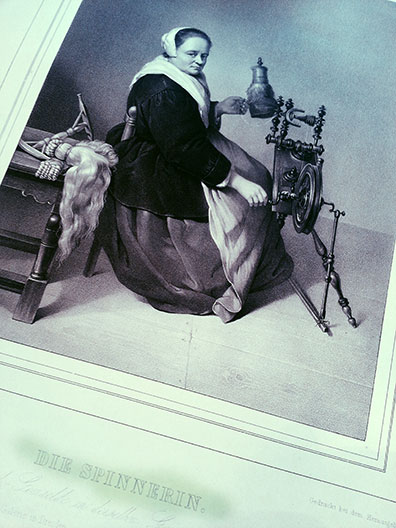
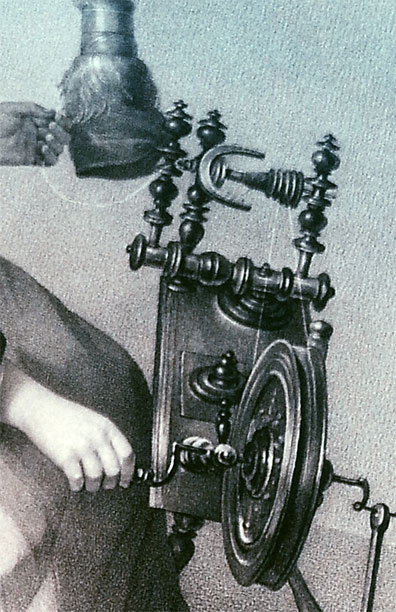
She remembered that I am (in a very small way) a print collector, and gave me this.

Spinnerin (detail)

It's called Die Spinnerin, engraved in the nineteenth century after a painting by the 17th-century Dutch artist Caspar Netscher. It made my dark little heart go thumpitta-thumpitta-thumpitta-boom.

The folio sheet (21 by 28) hasn't been cut. The tones and textures, which defy capture by my cut-rate phone camera, are pure velvet.

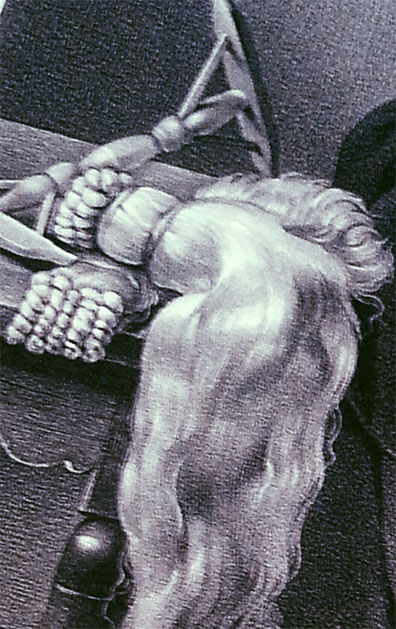
Then there's the subject matter, of course, with all the lovingly rendered details: the niddy-noddy, the hank of flax,

Spinnerin (detail)

the little hand-cranked* (!) wheel. (Single drive? Curious. I would love to hear from anyone who might know whether this is accurate, or whether the artist goofed. All the rest is captured in such fine detail that it seems odd he would leave out an entire loop of the drive band, if it were actually there.)

Spinnerin (detail)

This isn't the sort of thing you fold up and stuff in a suitcase, so I asked my good buddy Chuck at Skacel if he could please hand it over to their shipping department and have it sent home to me.

I got a message from Chuck a few days later saying that (as you might imagine would happen at a yarn company) the print had caused quite a stir and everybody had wanted to run away with it.

In due course, a sturdy tube arrived from Skacel. Inside was the sweet spinning lady, looking as beautiful as ever.

Spinnerin

Thanks, Chuck! You're the best!

*Edited to add: Mind you, there is a footman, which suggests there is also a treadle hidden under the skirts. So, hand-cranked and foot-powered? The more I look at this the more fascinated I get.

Sunday, June 01, 2014

Miniature Entry: Cheat Sheet from the Past

A dear friend recently gave me a magnificent present that deserves (and will get) its own entry. But tucked inside this gift was a piece of paper, the survival of which amazes me.

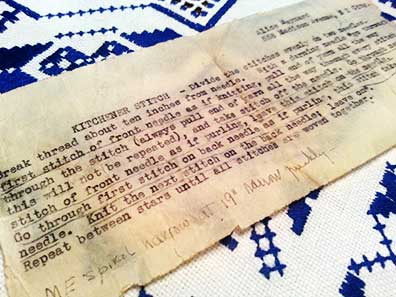
It's a sheet of the slick, translucent typing paper that some of us remember was called onionskin.

Yellowed, battered, and containing...

ktichener-full

typed instructions for Kitchener stitch.

Below the typed copy is a spidery line of manuscript that reads...

ME spiral narrow at 19" narrow quickly

Somebody was making socks, I bet. Knee socks, maybe? If you were to knit a 19-inch tube, quick spiral decreases would give you a toe at the right point for a short woman's knee sock.

Or, possibly, "spiral" applies to "ME" and the socks were akin to the spiral stockings (knit without heel shaping) in Mary Thomas's Knitting Book.

I can't say with any certainty what "ME" means. Make Even? Possibly, though it's not a usage I have run across before.

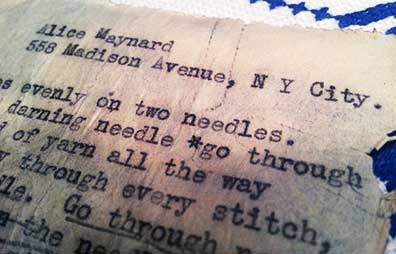
In the upper right corner is a name and address:

kitchener-close

Alice Maynard
558 Madison Avenue, N Y City

I wondered who she was, what sort of apartment she would have had on Madison Avenue in the East Fifties, and why she was typing instructions for Kitchener stitch for one of my friend's relatives. The miracle of the Internet gave me an answer in seconds:

Expert Guidance Offered to Knitter and Crocheter (New York Times, August 18, 1964)

Knitting help at Macy's,* Gimbel's, and Bloomingdale's. The mind boggles.

If any of you have memories of knitting at Macy's, Gimbel's, or Bloomingdale's; or of shopping at Alice Maynard, I would love to hear about it in the comments.

*Although Macy's "has no time for anyone who has not mastered the basic stitches." Love it.


Wednesday, May 28, 2014

Miniature Entry: Advice That Made a Difference

My favorite quote by the late Maya Angelou isn't from one of her poems, and in fact there's not even a trace of it (that I can find) online.

It came from an answer to a college student's question about changing the world. She told the student that if you want to change the world, start by making your bed every day.

Why?

Because if you haven't got sufficient will and dedication to do that one simple thing, you might want to reconsider whether you have what it takes to reach your more ambitious goals.

You don't have to agree with her about this. But I do. And it's one of the only pieces of Advice from a Sage Thinker that has made any damn difference in what I do with my day.

Thursday, April 17, 2014

Miniature Entry: On the Loss of a Great Writer

I wish I had something poetic to say about the wonderful Gabriel Garcí­a Márquez, who has just died; but I don't.

Instead, I can tell you that in my freshman expository writing/fiction writing class at Harvard, which I hated, I once said in a discussion that I saw great similarities between the plots of "The Handsomest Drowned Man in the World" and Auntie Mame.

I did this just to provoke an aneurysm in a snooty bitch classmate from Miss Porter's. She always spoke in a breathy voice redolent of italics of her desire to "explode the confines of linear fiction," and she openly loathed me for turning in assignments that were funny. Every time one of my stories got a laugh, she would shake her Annie Hall bob in disgust and bite the end of her pen.*

It worked. She actually did get so angry she left the room. I've always been grateful to Mr. Márquez for that. And, of course, to Patrick Dennis.

This will probably be the only Márquez tribute that mentions them both.

RIP, Gabe.

Now I have to go finish roasting a chicken.

*She was also an avowed Freudian.

Saturday, April 12, 2014

Miniature Entry: Life at Sea

hemispheres

At present I am aboard the Cunard liner Queen Victoria, sailing from San Francisco to Fort Lauderdale via the Panama Canal.

If you've been reading for a long time you know I love Cunard ships, past and present. I am supposed to be having (on doctor's orders) a complete rest from work but of course you know I wasn’t going to climb aboard without any knitting.

So I've taken to doing a little in the Winter Garden, in the mornings. As you would expect, it's a surefire conversation starter. The passengers are in the main fairly elderly. I wouldn't be surprised if a few of them knew Queen Victoria personally. When she was a little girl. I couldn't be happier–this is my crowd. We tend to like the same music and the same movies.

I was clicking away a few mornings ago as we headed for Costa Rica and a flurry of tropical print hove into view. The person in the print stopped, then dropped into the next chair. She was English, ambiguously eighty-ish, artfully preserved.

"That," she said, pointing at my knitting, "is very impressive work. My father was a knitter, so I know."

Whereupon we started chatting.

She is doing the World Cruise, Southampton to Southampton. This is something like her forty-fourth Cunard voyage. (The brand breeds loyalty.)

"Of course my favorite is and forever shall be the QE2," she said. "They'll never build another like her."

I nodded. I never sailed in her, mind you. I only saw her, once, back when I was on the Minerva II and she docked beside us in Malta. I remember that seeing C-U-N-A-R-D on the side of ship for the first time gave me chills.

"But may I say something? I'm going to say something."

She leant toward me and through her dark round sunglasses I could feel her glare. "You young* people," she said firmly, "have absolutely no stamina and no idea how to have a good time. No. Idea."

I raised my eyebrows.

She pointed towards the windows above us, which belong to Hemispheres–the ship's disco. "They will close that bar tonight at one o'clock and you will all go to sleep. Ridiculous. Ridiculous! On the QE2 we never dreamt of bed before sunrise. A party every night. Until sunrise. We knew how to have a good time. You young people, I don't know what's wrong with you."

"Well," I said, "the seventies were different, weren’t they? All that cocaine would keep anybody awake."

This time her eyebrows went up. She leant even closer.

"You'd better believe it, kid," she whispered. "You'd better believe it."

 *Yes, on this ship I'm young. I'm quite possibly the youngest person aboard not scrubbing pots or being looked after by the Cunard nannies.

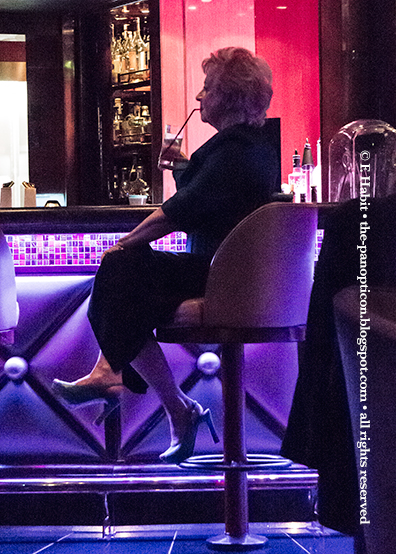
Note: The lady in the photograph is not the lady in the story. She's another lady, with whom I danced rather madly one evening.

Tuesday, March 18, 2014

Loretta

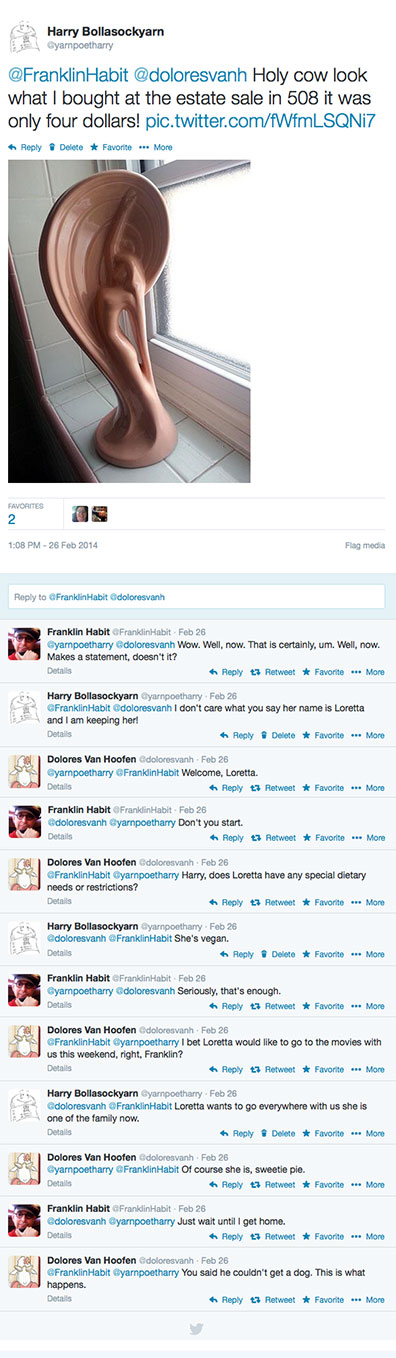
You may not know that the chief residents of our little household are all on Twitter. I am @franklinhabit. Dolores is @doloresvanh. Harry is @yarnpoetharry.

That was how I found out about our newest resident. She's still here.

loretta-final

Monday, March 17, 2014

Miniature Entry: Other String

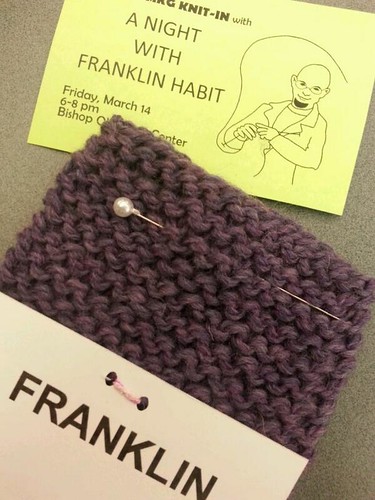
I'm in Madison, Wisconsin. This weekend was the local (enormous) guild's annual Knit-In, and they asked me to come up and do a bunch of fun stuff. On Friday I gave a talk. It was all very prim, as is my wont, but they made it sound dirty.

BiuKRKMCUAA25sk

For the record, a night with me ends at about nine. Party down.

I leave for home in just a wee while but wanted to show a bit of progress with the tatting. When I remembered that dear, old Weldon's Practical Needlework had offered tatting numbers of course I had to pull them out and see if they were any good. Turns out they were.

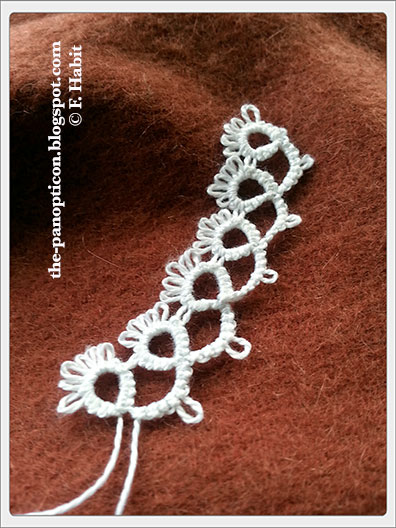
Working in odd moments between furious, deadline-driven labor I've crept along to two-thread tatting (Some folks call it continuous tatting or tatting from the ball.) This is a Weldon's two-thread edging.

double-thread-tat

The thread (some old crochet cotton I had lying around) is really too coarse for the work and my tension is all over the place; but hey, I'm having a good time.

When I showed the first shots of my tatting I got a couple of comments–some quite concerned–that this must signal the end of my engagement with knitting. Really? Really? How? Why?

Are you afraid I'll be unable to resist the pull of the tatting market, and the legions of tatting enthusiasts who flock in their thousands to the glamorous international tatting circuit? Are you certain that within a year I'll have been put under contract to appear exclusively on one of the several tatting television series that ornament the airwaves?

This happens every time I mention a craft other than knitting.

So, to clarify.

If I write about a flirtation with crochet, tatting, weaving, embroidery, quilting, sewing, or any other fiber-y fabric-y gerund, it doesn't mean I'm jumping off the knitting ship. It means I'm looking to find out what else string can do for you. I find it refreshing. I find it inspiring. I don't believe in craft monogamy or textile purity. I'm all about seeing how techniques combine and complement.

I wrote a piece for Lion Brand Yarns about my desire to see knitting and crochet returned to their former unity. With John Mullarkey I've been mixing knitting and weaving in projects like our Ligeia Stole. And when a Madison student brought this in to show me, my heart skipped a beat:

antique-tat

She found it rolled up in her grandmother's sewing machine. On the right is a tatted chain. On the left is what the chain looks like when you complete the edging pattern with...crochet.

Mix it up. Mix. It. Up.

Tuesday, March 04, 2014

Miniature Entry: Intern

I decided that before one of this week's finished pieces goes to its forever home, it needs a little extra love. Pride in your finishing isn't everything, but it's almost everything.

I brought it with me here, to the coffee shop where I do so much work that we call it my field office. Between bouts of pattern writing I ripped out the imperfect seam and started sewing a new one.

A nice little girl, maybe six years old, came in with her mother for a hot chocolate. I liked her immediately, as you often do take to a person whose drink of choice is also yours.

As they sipped and chatted, it was pretty obvious the girl was curious about my work. The mother quietly told her to stop staring, but I asked if she'd like a closer look.

She stood at my shoulder and I showed her what I was doing with the needle. I chanted a little bit for her, the way I always do in my head when I sew by hand. Up, around, down, through. Up, around, down, through.

"Oh!" she said, after about six stitches. "I get it. You have to do it the same way, in the same places, all the way to the end. And that's how you win."

Kid, you're hired.

work

Monday, March 03, 2014

Miniature Entry: On Pattern Writing

When you design knitting patterns for multiple clients, part of the deal is sending in your finished patterns using each client's house style.

This can become confusing when three patterns for three clients all reach the finish line simultaneously.

One client insists that "inches" always be written out in full; one insists you must always use the double apostrophe (non-curly!) and never the word; the third will only accept the abbreviation "in" (no period!).

You pause in your writing, and remember a very nice student asking, "Why don't we have one standard for knitting patterns? Don't you think that would be a good idea?" and you laugh quietly and reach for the rum bottle.

Wednesday, February 26, 2014

New Tat

This month I was out in Tacoma, Washington for one of the grooviest fiber gatherings you'll ever encounter–the Madrona Fiber Arts Winter Retreat. I was enjoying a rare morning off when I found a bunch of tatting shuttles for sale at the Carolina Homespun booth in the marketplace.

Tatting shuttles are used for making tatted lace. Tatted lace is very pretty. I did not know how to make tatted lace. All I knew about making tatted lace is that many, many of my friends have tried to make it, and have failed spectacularly.

So I bought two shuttles (silver, brass). I also bought cotton thread to go with the shuttles (white, ecru). I very nearly bought a third shuttle (bone); but buying three would have been silly.

That morning was my only free time for the whole of the festival, so it wasn't until I headed home that I got a chance to unwrap the shuttles and fiddle with them. My first flight out of Seattle was canceled, so I spent five hours in the Alaska Airlines Board Room drinking fruit juice and watching "Tatting for Beginners" videos on YouTube.

This is where I began.

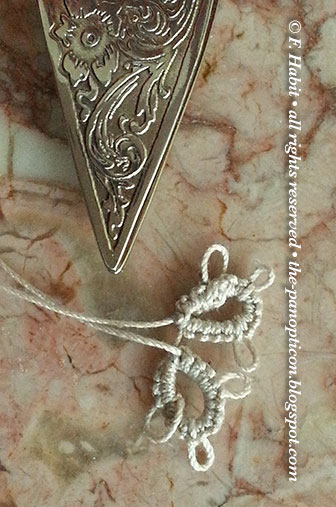
before-tat

This is where I ended, five hours later.

tiny-chain

To give you an idea of how small that loop is, if I inhale deeply it will disappear right up my nose.

Perhaps you are entirely unfamiliar with tatting and would like to know how it works. Here is a brief overview.

Tatted lace is really just a series of simple knots tied one after the other into a piece of string. You begin by winding the string onto shuttle, as shown above.

Then you pull a little string off the shuttle and wrap a loop of it around your left hand. Then it's sort of like your left hand is doing cat's cradle, and your right hand is tying sailor knots, and meanwhile you are having a sneezing fit.

Tatting is something that gets mentioned all the time in those 19th century books I read. Usually it's the daily occupation of a frustrated maiden aunt with dim eyesight. She sits in her room all day, embalmed in black bombazine, morosely tossing the shuttle from hand to hand. You think knitting has a reputation for being stuffy? Honey, compared to tatting, knitting is a drug-happy orgy being thrown by a Playboy bunny in the zero-gravity Jacuzzi of a rocket ship headed for Jupiter. Tatting is for people who are afraid to try lace knitting because they think it will make them look slutty.

Needless to say, I find the appeal irresistible.

Back at home, as a break from the deadlines that are the reason this is the only post for February, kept at it. At great length, I made a ring almost (but not quite) the size of half a dime.

Then for about a week I just kept making rings, which are formed by a series of double stitches. Part of the fun of tatting is that the very first thing you learn, the thing you must learn before you can do anything else, is the double stitch. But the double stitch is, so far as I can tell, the hardest thing to do in all of tatting. So once you scale that wall, you're in good shape. But it's a very tall wall, crumbly, without a lot of good footholds; and there are gargoyles at the top who keep pooping on you.

Anyway, to practice my double stitches I just kept making them, and turning them into rings.

practice-chains

They're not difficult, really; but you have to do them all perfectly or your chain will freeze and won't close into a ring. If you mess up even one, the only thing you can do is get a pin and a magnifying glass and unpick all the way back to that stitch, one knot at a time, and do it over.

I will never complain about ripping back my knitting ever again.

Once I had something of a grip on rings I moved on to picots, which look like little mouse ears.

first-picots

Here's my current chef d'oeuvre: two rings of the same size with picots that are pretty much the same size if you step well back and squint.

two-chains

I don't need to learn tatting, you know. It's not like my life lacks for diversion. But I spend a great deal of each day knitting, and sometimes I find it fascinating to see what else string can do for you.

P.S. Before you mention it, I already know that there is such a thing as needle tatting and needle tatting has a reputation for being faster to learn. However, needle tatting does not give you an excuse to buy pretty shuttles. Nor am I much interested in going faster. Slow and painstaking suits me fine, thanks.

On the Horizon

On the calendar, may I please draw your attention to a few noteworthy additions you may find interesting?

March 29-30, I'll be at a shop I've been hoping to visit for years–the inimitable A Verb for Keeping Warm in Oakland, California. There will be both classes and the lecture I think I may need to re-title "The One with the Victorian Bathing Drawers."

April 25ish-26ish, I'll be at dear, old Yarn Over in Minneapolis, and also doing some classes (to be announced) at StevenBe. At the Yarn Over dinner, I'll be debuting my new talk for this year, "Five Women, Five Shawls." There will be history, as ever–but this time most of the history will be personal.

And May 3-6, one of the things I'm looking forward to most this year: the North Light Fibers Retreat on Block Island. A quiet, beautiful island off the coast of Rhode Island, in May, headquartered in a couple of handsome Victorian hotels? Plus knitting? And run by a small luxury fiber company? Do you see why I said yes? Four seconds after they asked?

My life is rough. Come share it.

Saturday, January 18, 2014

Miniature Entry: New York

The desk clerk on the second floor at The Strand looked exactly like a Fred Armisen character from Portlandia and I was going to snicker and then I realized that I was wearing a bow tie and a 1930s Swedish shooting jacket and a newsboy cap and wingtip shoes and a chin beard and so do I.

strand-shot

Friday, January 10, 2014

YO, Mama

There is no other way to start than with a word of thanks. Your reaction to the bathing drawers was everything I could have wished. Quite aside from the compliments, for which I am grateful, I was so happy (and relieved) that my preamble was taken as it was intended: as a plea for civility, not for praise.

You might like to know that the drawers will be going on the road. I'm heading to St Louis and the Kirkwood Knittery, and on the evening of January 24 I'll be giving one of my favorite talks: Impractical Magic: Oddities and Curiosities from Weldon's Practical Needlework. (Seating is limited. For tickets, call the shop.) The original photogravure from the pattern has been the title card for that lecture since I wrote it, and now I'm thrilled to present a realized specimen.

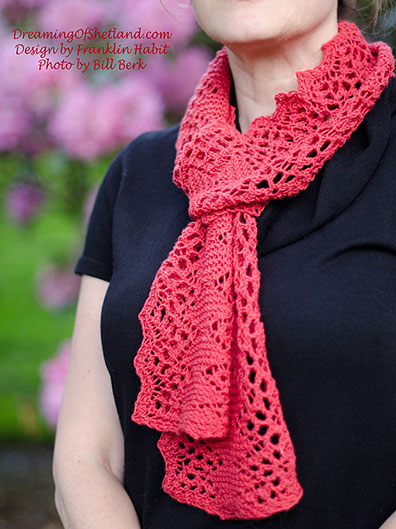
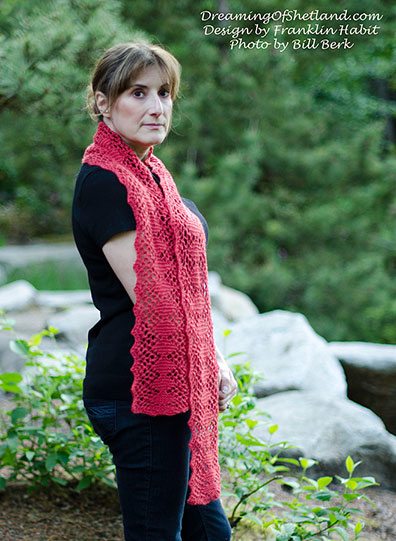
Around the same time I finished those, I finished a simple design that has since come out as part of a collaborative eBook, Dreaming of Shetland. The project was undertaken in support of Deborah Robson's research into Shetland sheep and Shetland wools, about both of which I am unabashedly crazy. Deb and I had a chat about it a year ago at the Madrona Fiber Arts Winter Retreat (read her own words here), so when the chance came to help support her I jumped at it.

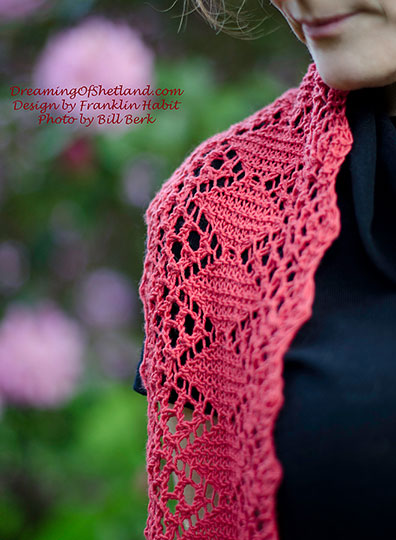
This was my contribution: a lace scarf called "Fair Phyllida."

phyllida-01

You may be aware that I have borderline-creepy obsession with old lace edgings. My first sketch for this piece was, rather unsurprisingly, a scarf with a lace edging.

Then I thought–why fool around with the scarf part? Why not make the whole thing an edging? So I fixated on a 19th-century Shetland motif as my point of departure, fussed with it, mirrored it, and this was the result.

phyllida-03

Fair Phyllida is a gentle ride. (That doesn't sound quite right, does it? Never mind, time presses. Moving on.) If you have basic lace-knitting skills, you can do her. (No. Never mind, moving on.)

phyllida-02

There are all kinds of things (not all of them lacy) designed by all kinds of people in the book, from bags and mitts to wristlets, shawls, and baby clothes. Take a look.

So's Your Mother

A couple of months ago, in my monthly column for Lion Brand Yarns I presented a selection of riddles reimagined for the yarn-centric. A friend who read it asked me if I'd consider doing the same for her favorite humorous tradition: the yo mama (var. yo momma, yer mom, yer mum, tu mamà) joke.

Before you curl your lip, please remember that maternal insults, like motherhood, have probably always been with us. They are ancient. They are hallowed. They go back as least as far as Shakespeare, who used them; they are almost certainly far older than that. My knowledge of classical theater is imperfect, but if there's not a yo mama joke in Oedipus Rex, there should be.

That being said, if you're one of the gentle, dewy-eyed souls who is never remotely amused by this sort of thing, you'll want to stop scrolling now and head elsewhere.

I mean it.

Seriously, stop now.

Okay, fine.

I warned you.


Yo mama's so short, she needs a ladder to read the top row of a chart.

...

Yo mama's so old, she remembers when they invented the second knitting needle.

...

Yo mama's so skinny, she tripped and fell through a yarn over.

...

Yo mama's so stupid, she thinks stranded colorwork is stuck at the airport.

...

Yo mama's so lazy, she gets First Sock Syndrome.

...

Yo mama's so tall, when she drops a stitch it takes three weeks to hit the ground.

...

Yo mama's so cheap, she tries to k2tog with one stitch.

...

Yo mama's so fat, she can't even cross her cables.

...

Yo mama's so ugly, she can only get gauge by sneaking up on it.

...

Yo mama's so fat, she tried to make an Elizabeth Zimmermann
percentage sweater and ran out of numbers.

...

Yo mama's so greasy, all her stitches are slipped stitches.

...

Yo mama's so stupid, when she saw "k1 tbl" she knit a coffee table.

...

Yo mama's so chunky, she knits up at three stitches to the inch.

...

Yo mama's so hairy, she is easily mistaken for a ball of Rowan Kidsilk Haze.

...

Yo mama's so twisted, she biases sharply to the left when worked in stockinette.

...

Finis


Tuesday, December 24, 2013

Christmas Package

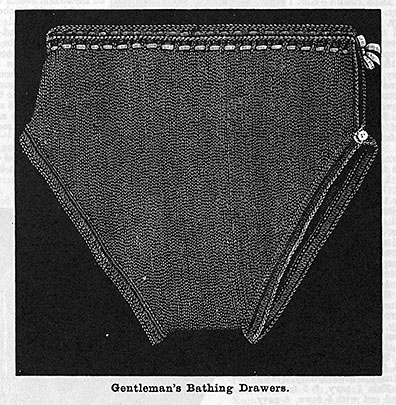
Around the time that Melissa Leapman's "Nautical Knitting" cruise was announced, I said that I (as Melissa's guest teacher) would use the trip as an excuse to knit up a pattern that had intrigued me for some time: a pair of men's bathing drawers from an 1880s pattern published in Weldon's Practical Knitter.

The idea of knitting bathing costumes had interested me since I first saw pictures of two made by Elizabeth Zimmermann (one for herself, one for her husband) in her lovely memoir Knitting Around. I thought it was interesting that knitted suits had been ubiquitous, and then gone. Usually outmoded styles of dress take time to fade away completely. Those who are long accustomed to a cut or style, especially those of a certain age, are often slow to give them up. But it seemed that knitted bathing suits, once other options became available, vanished virtually overnight.

Why? Could they really have been that awful?

When I announced the drawers project, several folks who had personal experience of the suits came forward to assure me that yes, they were that awful. The itched, they stretched, the stretched-out crotches filled up with sand, they smelled like wet dogs, and so forth. Nobody, not one person, remembered them with anything like fondness.

I didn't set out to make the drawers expecting them to replace my lycra suits and (spoiler alert) they sure haven't. However, I wanted to know, first-hand, what a knitted wool suit was like. This sort of curiosity about What Once Was is the reason people become historians–either the real kind, or my kind of passionate amateur.

You would not believe some of the mail I've had about this. Most bewildering were those insisting that the suit was too brief and revealing to be authentic to the 19th century. These messages persisted after I posted the photogravure from the original pattern:
bathingdrawers

They persisted after I posted this photograph of a men's bathing club in Brighton, England in the mid-19th century:

TopHatBTNSwimClub1860s

Some people will insist on re-writing the past to suit their modern ideas, even in the face of conclusive evidence. The human brain is a curious thing. I wrote about the phenomenon to a fuller extent in this post.

I promised to show myself wearing the drawers in here once they'd been revealed to the folks on the cruise. I promised it with a lump in my throat and a pit in my stomach, and my worst fears were pretty much immediately confirmed.

I am not a person who is confident in his looks. I never have been. It wasn't uncommon when I was child for adults to make critical remarks about my appearance–openly and within my hearing. Sometimes directly to me. I was described at various times by teachers, strangers, and blood relations as being (these terms are verbatim) way too dark, too swarthy, green-skinned, yellow-skinned, big-nosed, scrawny, tubby, husky, dwarfish, awkward, big-assed, funny-looking, or just plain unfortunate.

Then I reached adolescence, and things got worse. I was pimply, hairy, and oily in addition to all of the above adjectives. For about twenty years I didn't look at myself in the mirror. Ever. Not once. I couldn't bear to. I avoided having my picture taken and when pictures were taken, if at all possible I destroyed the prints when I got my hands on them. I wore clothes two sizes too large to cover as much of myself up as possible.

I fell in love with the history of architecture, but felt guilty walking into beautiful buildings. On my first visit to Westminster Abbey, I stood in the nave and thought, "It's so magnificent, and you're standing in the middle of it and wrecking the view."

I had my worst fears confirmed repeatedly by my fellow gay men. This still happens all the time. I stand five feet, four inches (which is too short). My waist is about twenty-nine inches (which is too fat for my height). My eyes are brown, when they should be blue. My nose is big, when it should be aquiline. My skin is olive, when it should be white. I am hairy about the chest, when I should be shaved. I am bald, when I should have a full head of hair.

There have been a few times in the history of this blog when I've shown some part of me in a photograph. If you go back and find them, you'll notice they were always a punchline. Always. Because that is what my physiognomy is suited to, and I know it.

I know I'm not a swimsuit model. I know that.

Once somebody, entirely without my permission, lifted an image of my chest from a blog post and stuck it up in a men's group on Ravelry. I wandered into the thread–I was a member of the group–and found myself being discussed in a "hot or not?" sort of way. The overwhelming consensus was "not." That was a fun afternoon.

With all that in my past, it didn't please me to find a pack of comments in here (now deleted, and wouldn't you?) openly discussing my disgusting body. And yes, the word "disgusting" was used. So were the words "spare us." Apparently the commenters in question had seen my chest hair (disgusting) in a photograph from the Blue Lagoon in Iceland and were hoping that any and all shots of the bathing drawers were spare them more disgusting shots of disgusting me and my disgusting secondary sex characteristics. They also noted that I didn't have the body for the bathing drawers. One person helpfully suggested I hire a male model to show them.

I wonder what would happen if I commented publicly that some female knitter's waistline was too big, or that she was far too bony to show herself in that outfit, or that I found her enormous (or tiny) chest disgusting, or pointed out after she posted a sock selfie that it was high time her legs saw the business end of a Lady Schick?

I don't need to wonder what would happen. What would happen is that within ten minutes my career in knitting would be over. Women, with good reason, are beginning to object strenuously to the constant objectification of their fellow women. Unfortunately, some of them don't have any trouble doing exactly that to the male of the species.

Yes, I am a professional in the business. And yes, being a professional means putting you work on the line for critique. Your work. However, one hopes that perhaps the ad hominem insults might be kept to a minimum.

So please, if you look below, be forewarned. My horrible horrible fat fat waistline and my disgusting abominable body hair will be on full display–along with the piece of knitting that is supposed to be the point of all this.

Without Further Ado

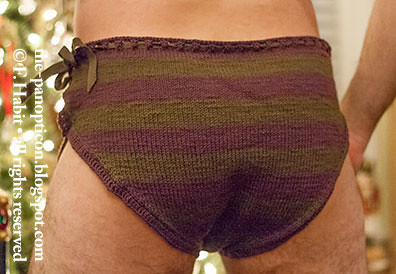
I gotta tell you, these things surprised me. The shaping of the Weldon's pattern is simple in the extreme–basically a large diaper. You start at the waist in the front, work down to the center of the crotch, and then the directions tell you to it all over again in reverse. That's it.
drawers-back

I expected them to be horribly, horribly droopy and ill-fitting. There's no special pouch shaping and no accommodation in the posterior for, um, fullness. The idea is that the stretch and drape of knitted fabric will do it all. And I'll be darned if it doesn't work rather well. The crocheted edge along the leg openings was quick to work and keeps the selvedges from curling. Looks nice and neat, too.
drawers-front

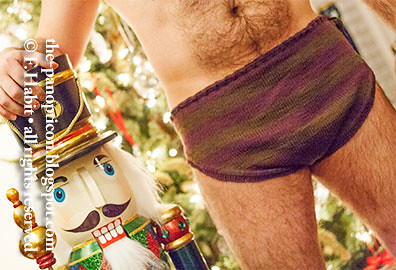
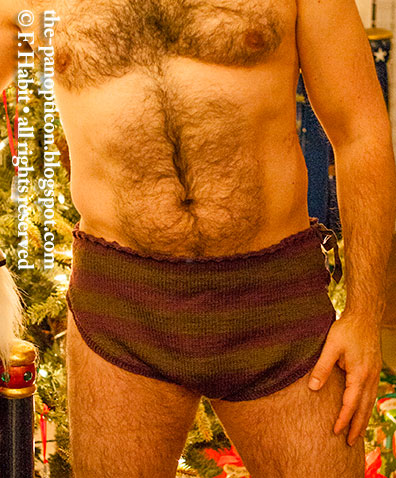
The pure wool Quince and Company Chickadee proved to be a perfect yarn choice. The itch factor even when wet (and no, I am not going to show you photos of that–they have proved impossible to take) was negligible, and while the suit did sag it didn't fall off. I wouldn't wear these in a situation requiring perfect modesty, but as I wrote previously they weren't intended for such a situation.

Another score for Weldon and Company. Turns out they knew what they were doing after all.
drawers-midshot

Saturday, December 21, 2013

As I Was Still Saying

I was going to blog again yesterday, yeah; but I had to do stuff. Christmas-type stuff, with the ribbons and the glitter glue and the peace on Earth and the what–another party, and the hey–what did you put in that egg nog and the excuse me–where are my pants.

But I woke up eventually, and so here's something else from my stack of backlogged blog topics.

Thing Four.

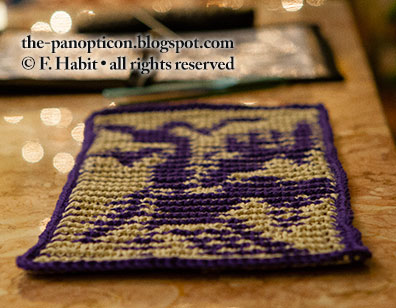
Look at this. What does it look like to you? Besides an indifferent cell phone shot? Stripes, right? White and purple stripes?

griffin-01

But...let's look at it from a slightly different angle.

griffin-02

Huh. What's that? Is there something weird going on? Let's try another angle.

griffin-03

WHAT? A GRIFFIN?! IS THAT A GRIFFIN?!! HOLY CRAP! WHAT DID YOU PUT IN THAT EGG NOG?

Calm down, please. I didn't put anything funny in the egg nog. However I did put a griffin in the stripes. He was there the whole time–you just couldn't see him at first.

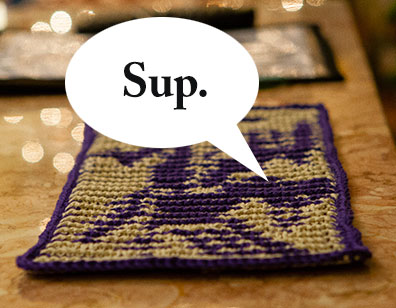
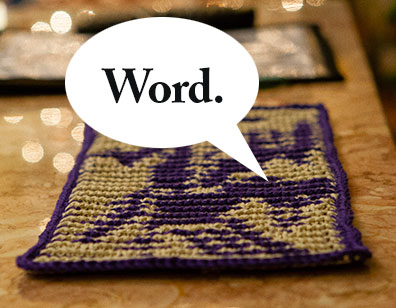
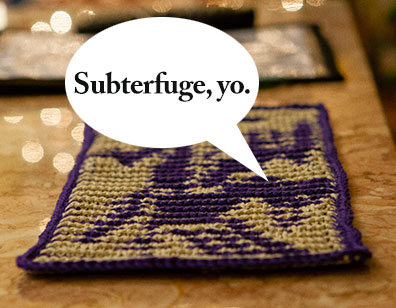
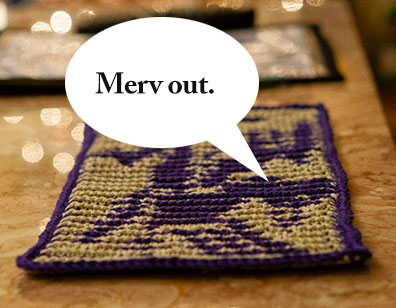
His name is Merv. Merv, say hi to the people.

griffin-04

Merv is very street.

This technique is called either Shadow Knitting or Illusion Knitting, depending upon who is doing the calling. I started fooling around with it this year, just as a goof. Merv was one of my early experiments. Now I'm unabashedly in love with it. It's a technique lots of folks look upon as a mere parlor trick. But I believe it has potential that hasn't yet been fully explored, in spite of Vivian Høxbro's excellent book from 2004 and the further elaborations of the UK outfit Woolly Thoughts.

Also, it's the only knitting technique I have yet encountered that makes non-knitters literally gasp. They gasp!

griffin-05

Exactly so.

I felt so strongly about Shadow Knitting's potential that I've spent a great deal of 2013 exhuming every bit of information I can find about it; and playing around with different ways of designing it, charting it, thinking about it, and putting it to use. In 2014, it will be a new addition to my menu of classes.

The début at the Madrona Fiber Arts Winter Retreat is sold out, but I will be teaching it at the Plucky Knitter Shindig, the Squam Art Workshops, and a bunch of other gigs that'll be added to the calendar as they're confirmed in full. We'll learn the technique, of course; but we'll also learn to make new motifs, and ponder larger philosophical questions like the merits of mystery, opacity, surprise, and subterfuge in design.
griffin-06

Precisely.

That may seem dreadfully ambitious for one knitting class, but if you've taken classes with me before you know I'm not kidding.

griffin-05

Yes. Thank you, Merv.

griffin-07

Yes. That's quite enough, thank you. Goodnight, folks. More soon.