Sunday, June 17, 2012

Never Say Never Again

My extreme dislove of baseball–both the sport and the act of going to see it played–is something I wrote about at length the last time I was persuaded to trot along with other knitters to see the White Sox to do their thang.

I won't sing that song again. I will take a moment to reiterate that while the American public insists it is my duty as a male citizen to love baseball, I insist it is my right as an adult citizen to not give a flying fig about it. I'm fully on board with the flag, motherhood, and apple pie; but even Ken Burns couldn't get me to regard our soi-disant national pastime with anything other than a jaundiced eye.

And yet.

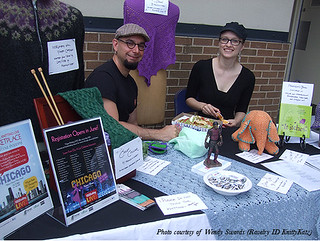
And yet when I got a call from the owner of our own, dear Loopy Yarns to please put together a promotional table on the day of Chicago's Stitch 'n' Pitch event, how could I say no? Baseball has not been good to me, but knitting has. There would be 150 knitters at the park–but also a few thousand people who might be among the lapsed or the latent. How often do you get a platform like that upon which to evangelize?

Would I do it? Sure I would. For knitting, I would do it.

Happily I had an accomplice and companion for the day–my friend Abigail. I first met her when she lured me up to LaCrosse, Wisconsin, to address the town's annual fiber gathering. You don't spend a wild weekend with somebody in LaCrosse and not form a bond.

Abigail is the sort of person who will drive you to the South Side, roll your dress form across five acres of parking and up a ramp while people cat-call, and never complain even though all she gets out of the deal is free nachos and beer. She will even push the dress form down the ramp and back across the parking lot, drive you home, and continue speaking to you.

Abigail is, to borrow a slangy bit of praise from P.G. Wodehouse, a complete brick.

So we set up a table and talked to people. I brought samples of my stuff and posted a directory of Chicagoland yarn shops and guilds, as well as information about the upcoming Big Deal Yarn Events (Stitches Midwest, Midwest Fiber and Folk Art Fair, Yarn Con, Vogue Knitting Live! Chicago) of which we have an abundance.

At Stitch 'n' Pitch Chicago, 2012

The knitters and crocheters were all lovely, and so were most of the shop owners. (Note to the sole exception: I was advertising your shop. Free. Happily. With great spirit. On my first and only day off in weeks. And I spent my own money doing it. If you want top billing, design input, and no nasty hairy dark ethnic men mucking up your lily white women's event, you go ahead and run the table next year. Really. It's all yours, honey.)

Mostly, because they were the majority, Abigail and I talked to people who were not knitters, or crocheters, or needleworkers of any stripe. About thirty minutes into the game we realized we kept hearing the same things over and over. So to beguile the time and stave off madness, I drew up a bingo card. (If you click it, it'll get bigger.)

Stitch 'n' Pitch Chicago Bingo

By the top of the fifth inning, the drunks were starting to lurch perilously close to the lace and we decided to break camp. We had achieved bingo forty-seven times.

But I think we got a few more people into the tent.

It was worth it.

Friday, June 15, 2012

I Like to Swatch

From Fleisher's Knitting and Crocheting Manual, 1906:
Nowadays, every woman who gives thoughtful preparation to her wardrobe includes a variety of knitted or crocheted garments, because of their artistic beauty and their comforting warmth. Wherever women meet, the art of knitting and crocheting is discussed–the newest garments, the best stitches, the prettiest colors. Many have recently been converted to the charm of this work, realizing that machine made garments do not equal in softness, beauty, and distinctive elegance, those made by hand, and that, therefore, the time spent in knitting and crocheting is both pleasant and profitable.
Pleasant and profitable. That goes right to the heart of why I fell in love with knitting.

Pleasant, in the sense that needlework steadies me sufficiently to keep me out of the Police Blotter. Profitable, in the sense that after the pleasure fades I am left with something tangible and (amigurumi and novelty fruit handbags aside) useful in exchange for my time.

The longer I'm at it, though, the less I find I care about the tangible outcome. I had been knitting for years before I learned about gauges and swatching; once I learned about them, it was another few years before I learned to care. I didn't want to swatch for the thing, I wanted to make the thing. A rogues gallery of the elephantine and miniscule hats that followed would be shown here as evidence, if said evidence had not been destroyed.

After the fifth gift hat a friend refuses to wear because she could easily fit her own head and those of both her children inside, you start to get the message: Swatch. Swatch, and learn something.

Nowadays I love practicing, experimenting, playing with process.

When I get the "What's that you're making?" question, about half the time the true answer is "Nothing in particular." But that draws puzzled looks and prolongs the conversation, so usually I just say it's a scarf. Non-knitters are satisfied, since they can't tell the difference and don't really care. Knitters glaze over at the word "scarf" and will happily change the subject, which allows me to go back to swatching.

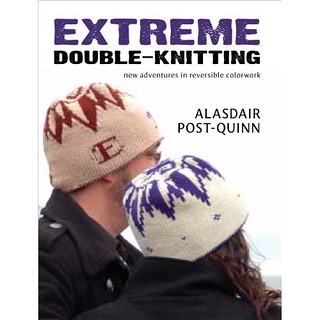
Extreme Double-KnittingA new-to-me technique is my favorite thing to swatch. Recently I sat down with a book that's been on my worktable in the "PLAY WITH THIS" pile for ages, Alasdair Post-Quinn's Extreme Double-Knitting: New Adventures in Reversible Colorwork. Full disclosure: I saw the book before it came out, and liked it. I liked it so much that there's a quote from me on the back cover, saying so.

But this was the first time I really sat down and threw myself into working from it. I'd played with two-color double-knitting before; but it was of the slip-this-side-then-slip-that-side variety and I found the process tedious and the results unsatisfactory.

I like Alasdair's method, though. You get a firm, handsome, dense fabric with it. And when I say dense, I mean dense enough to wear as a winter hat in Chicago when you are a bald male of Mediterranean and Middle Eastern descent and therefore are genetically designed to crumple at the first blast of January wind from Canada.

Alasdair takes "Extreme"–a sadly overused word these days, often denoting either a modest level of skill or an immodest level of bad taste–seriously. His basic method in two colors is a bit of challenge to begin with; but he blows past two-color reversible patterns into working it in the round, shaping it, adding extra colors, working different patterns on opposite sides of the same fabric, double-knitting cables and other textures, and building three-dimensional double-knitted objects. He would probably have zoomed onward into metaphysical double-knitting that alters the time-space continuum if the editor had not at last told him to Put a Lid on It.

I waded into the shallow end with a wrist warmer. The design in the book is cute–a pair of opposing spirals–but as usual I had to get funky and Make It My Own so I adapted a pair of charts from a book I bought at the university bookshop in Reykavik. One is either a flower or a snowflake. The other is a dragon, a griffin, and a Boston Terrier all at the same time.

dbl-knitting-cozy

The result–worked in DK leftovers from my stash–was fun to knit. It's a real charge to flip your work inside-out and see the same pattern with the colors reversed.

This was fun enough that I know I'll take another crack at it, albeit with smaller needles. Alasdair urges you to work at a tightish gauge, and he's right. This specimen, worked with a size 4, would benefit from sliding down to size 2.

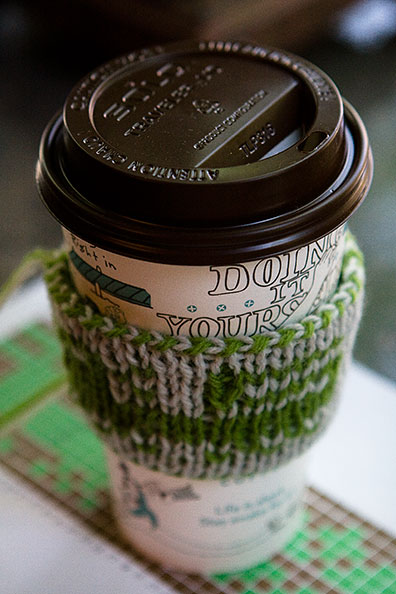
My wristlet looks more than a little frowsy and is much too big for my wrist, yet I keep getting compliments on it at the coffee shop.

cozy-on-cup

Yeah. Cup sleeve. I know I said it was going to be a scarf, but I really meant to say cup sleeve.

Sunday, June 10, 2012

On the Unusualness of Squam

When I travel to teach, my hotel doesn't usually look like this.

squam-ishnanna

My hotel room doesn't usually look like this.

squam-bedroom

The path to my classroom doesn't usually look like this.

squam-path

My classroom doesn't usually look like this.

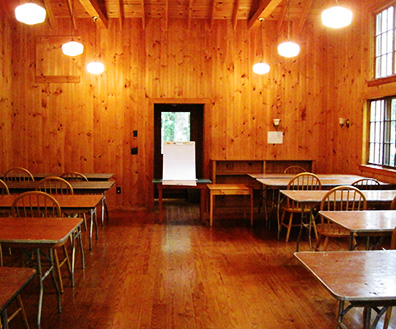
squam-classroom

I don't usually have one of these,

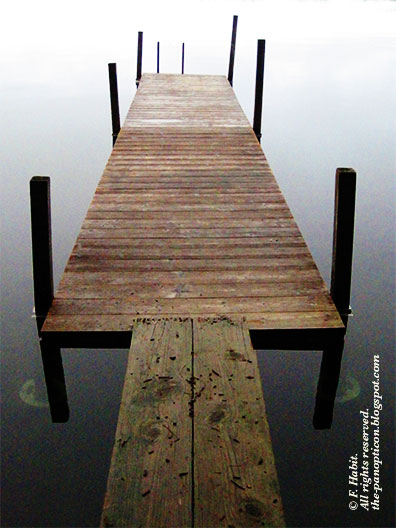
squam-dock

upon which to do this with Jess, Ysolda, and Gudrun.

squam-sunbathing

There are not usually bedtime stories by the fireplace with Casey and Eloise.

squam-story

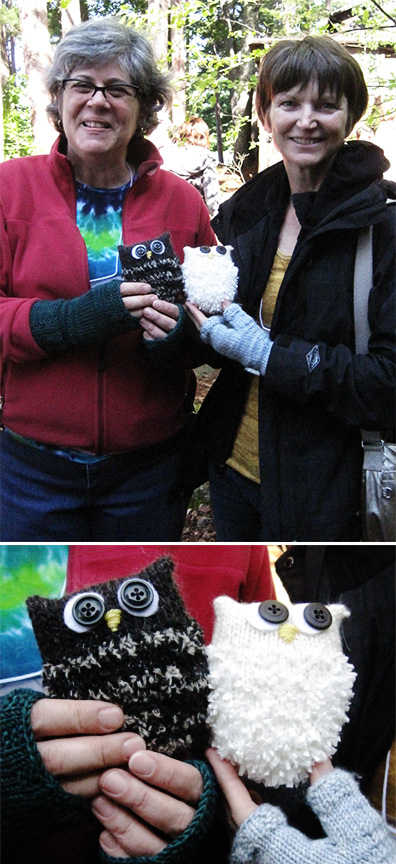
There are not usually random acts of owl-bombing by a mysterious knitter.

squam-owls

I do not usually look like this,

squam-me

and cry a little when it's time to leave it all behind.

squam-sihlouette

Thanks, Squam.

Love,
Franklin
xoxo

Tuesday, May 22, 2012

Zip Files

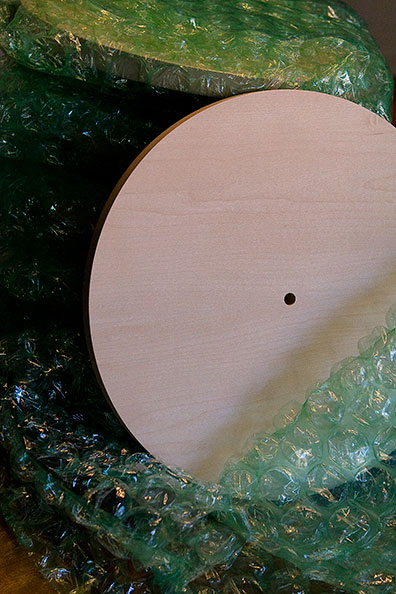
Do you know what this is?

pocket-wheel-blank

Time's up.

Who said pizza peel? Wrong. Cutting board? Nope. African lip plate? Biodegradable Frisbee? Avant garde sunhat? Uh uh.

It's the flywheel for one of these–a Pocket Wheel. It's propped up against four more of the same, still bubble-wrapped.

I didn't get any other bits of wheel, just five flywheels.

In a normal household, this would suggest a serious slip-up in the shipping department. At my house, however, "normal" is but an elusive butterfly. We accepted the delivery of five flywheels with great joy.

I've wanted a Pocket Wheel since my first test-drive at Madrona. As it happens, lots of people want Pocket Wheels, which is why the Pocket Wheel Waiting List is at present 67 people long (not including the folks already in various stages of production) and has its own Ravelry fan group.

The most prominent piece of the teeny-tiny apparatus is the flywheel. So round, so smooth, so perfectly blank.

It simply screams to be drawn upon, don't you think?

I thought so, so I asked Mr. Pocket Wheel*–Jon McCoy, the man who makes them–if I could do that. He said yes, and sent me five of them.
  • One is for practice.
  • One is for a Pocket Wheel for me.
  • Three are for other Pocket Wheels, to be owned by spinners as yet undetermined. That will be up to Mr. Pocket Wheel.
Heaven knows I do a great deal of drawing, but this is a novel challenge. The surface will be sometimes kinetic, sometimes static. I'm burning through pages in my sketchbook playing with ideas that will take that into account.

Just in Time for Summer

On the day it hit 92 degrees Farenheit in my neighborhood, I finished my Icelandic sweater.

We're friends, so let's not play games. The thing had been lying around, mostly complete, for months. I knit it, I cut the steek for the front opening, I bought the zipper, and then I turned into a big bowl of cowardy custard. I, who make such symphonic noises about what a cakewalk eleven-stitch Estonian nupps are If Only You Believe, was afraid of sewing in a stupid zipper.

Sweaters can sense fear. This one took to sneaking around the apartment. I'd turn around and there it would be–balled up in the corner, grinning, ready to spring. I'd back slowly away, brandishing the yardstick.

At length, I grew disgusted with myself and decided it was time to end the game of cat-and-mouse. After luring the sweater into the workroom with the new issue of Evil Fibers Quarterly, I surrounded it with dressmaker's pins, armed myself with Deborah Newton's Finishing School: A Master Class for Knitters–and just #@$%* did it, already.

Nobody died. I also discovered, to my surprise, that a) putting a zipper in is not especially difficult and b) I liked doing it so much, and felt so omnipotent in the aftermath, that I'm going to work zippering into one of the new classes I'm planning.

Harry took a couple of snapshots. I've left out the third frame, in which I collapsed from the ninety-degree heat and wet myself, but you can probably find Dolores's video on YouTube.

vetur-finished-01

The pattern, as I've noted before, is "Vetur" from Lopi No. 28.

vetur-finished-02

All I changed was the yarn, the gauge, the direction (I worked top down), the colors, the collar, the cuff chart, the yoke chart, the shape (I tapered it from underarm to waist), the finished length, and the bind off (I used the incredible sewn method from Jean Wong's DVD). Other than that, it's exactly as written.

I've now made two whole sweaters for myself. Two! Let it snow, let it snow, let it snow. Not just now, but eventually.

* Yes, Mr. Pocket Wheel has a lovely Mrs. Pocket Wheel. In fiber circles she elicits the sort of envy that would usually be reserved for, say, Mrs. James Bond or Mrs. Doctor Who. So fantasize, as you will, about life with a man who builds incredible spinning wheels–but it must ever remain only a fantasy.

Tuesday, April 24, 2012

I Sew Like a Girl

Longtime readers of this blog may remember the joy with which I discovered Jane Eayre Fryer's The Mary Frances Knitting and Crochet Book, an early 20th century kiddie lit masterpiece in which the title character has trippy (but educational) encounters with an animated pile of craft supplies, a fairy, and a petulant baby doll named Mary Marie.

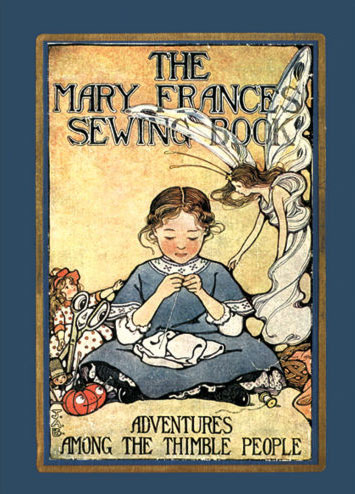
Well, Mary Frances is back in da house. This week I didn't have to pull extra shifts at the forge and that left me free to concentrate on sewing doll clothes. There is, I maintain, no better companion to that than The Mary Frances Sewing Book, or Adventures Among the Thimble People.

mf-sewing

Everything that makes the knitting volume such a hoot was already present in this earlier volume, in which Mary Frances learns to cut and sew with guidance from such merry, indelible characters as Mr. Silver Thimble; Scissors Shears; Tommy the Tomato Pin Cushion; and Ma Chine, the matronly Sewing Machine. (Ma Chine–see what she did there? See?)

When the tale opens, Mary Frances is cooling her heels during summer vacation at the home of her grandmother. Her father has business in San Francisco (unspecified business, but I like to imagine it has something to do with white slavery as depicted in Thoroughly Modern Millie), and has taken dear, compliant mother along with him.

Brother Billy is away on a long camping trip with the Boy Scouts, leaving our heroine with only Grandma and bitter Aunt Maria for company.

It should be mentioned that there is another child in the house, an implausibly cheerful Irish maid-of-all-work named Katie.

Katie is barely older than Mary Frances; but while Mary Frances has nothing better to do with her time than lie on the verandah like a boneless chicken in a pinafore, Katie has to rise at dawn, scrub the floors, answer the door, cook, clean, carry parcels, and pretend to be delighted by the steady stream of expensive guilt presents that Mother and Father keep sending to their widdle princess from San Francisco.

I earnestly hope that after the Great War, Katie either married well enough to hire her own maid; or joined the American Communist Party and set fire to the ballroom with a Molotov cocktail on the night Mary Frances made her début.

The Sewing Book provides us with an Origin Story for Mary Marie, the prissy porcelain doll whose insatiable demands for warm clothing and accessories fuel so much of The Knitting and Crochet Book. She arrives from California nailed up in a crate–which Katie, of course, has to haul into the kitchen. Katie pries the crate open with her strong arms, toned from long years of work in a spinning mill, and out pops the doll. She's naked except for a frowsy little slip and a painted-on smile.

Where are her clothes? Does she have a wardrobe in the trunk that came with her? No, she does not. She has, instead, a pile of fabrics that mother's explanatory note reveals are for Mary Frances to use in learning to sew. Except there's a wrinkle.

Per Mother's note:

"I've asked Grandma to let you do exactly as you want to with these things, and I ask you not to go to her with your sewing problems: for the doctor said that Grandma must not strain her eyes with any such work. I know you understand."

Understand? What's to understand? You send your daughter a nearly-nude doll and a bunch of dry goods and–then what? Expect her to pull the proper methods for cutting, tailoring and dressmaking out of her twelve-year-old butt? Don't ask Grandma. Who the hell else is she supposed to ask? Katie? Not Katie. Katie pried the nails out of the damned crate and then had to go back to hauling ash buckets and picking weevils out of the grape arbor. And Aunt Maria is only good on days when the pharmacy won't send her any more laudanum or medicinal whiskey until she pays the bill.

This, of course, is where the fairies and the magic needles and the talking pincushion come into play. But is it truly good parenting to rely on that sort of thing happening to further your child's education?

I'll add that this sort of spotty affection has already taken a toll on Mary Frances's budding maternal instincts. It's never openly stated, but is strongly suggested, that she is as capable as her mother of shutting off affection like a water tap. Case in point: When the book opens she's already got a "daughter"–a doll named Angie. After Mary Marie rears her curly blonde head, Angie gets one more brief mention and then entirely disappears from the book. If that doesn't give you a chill, you have no heart. Where did Angie go? Was she put out on the street to fend for herself? Was she buried behind the vegetable patch in Mary Marie's crate? Did Mary Marie eat her?

Don't bother hunting through the rest of the canonical Mary Frances literature for any sort of latter day Velveteen Rabbit-style Angie redemption. That doll is just gone, baby. Gone.

Mind you, all this (and a miasma of C-list Art Nouveau illustration) tends to obscure that The Mary Frances Sewing Book is truly a thorough and well-done introduction to sewing. Though the projects are graded by difficulty, there is no dumbing down. Mary Frances begins with a sampler of common hand stitches; by the end, she's experienced at just about everything an adult dressmaker needs to know. The intended audience for this book may have been juvenile, but it was still expected to learn to do things the right way, not the easy way.*

Example. In my own project–I'm getting to it, don't scroll down yet–I considered using buttonholes,  so I spent some time working them using the step-by-step instructions dispensed to Mary Frances by Aunt Maria. I cross-referenced those with Claire B. Shaeffer in the classic, not-for-dummies Couture Sewing Techniques. The methods are identical.

Bad puns and questionable parenting aside, I ponder this book and then look at the modern equivalents–in which kids "learn" to slap ugly crap together with glue and tape because it's Kwik! and Eezee!–and I think Jane Eayre Fryer was really onto something. In addition to possibly being On Something.

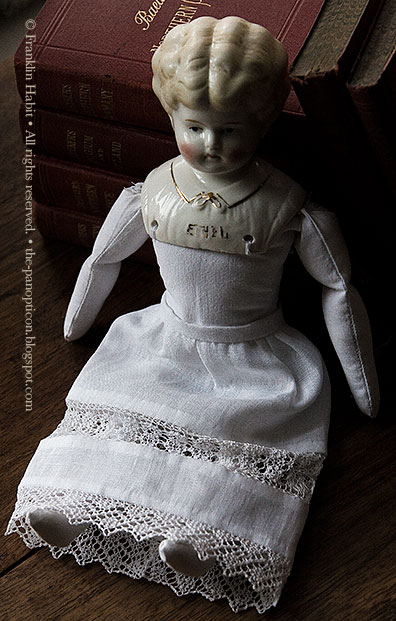
Ethel, Now Half-Dressed

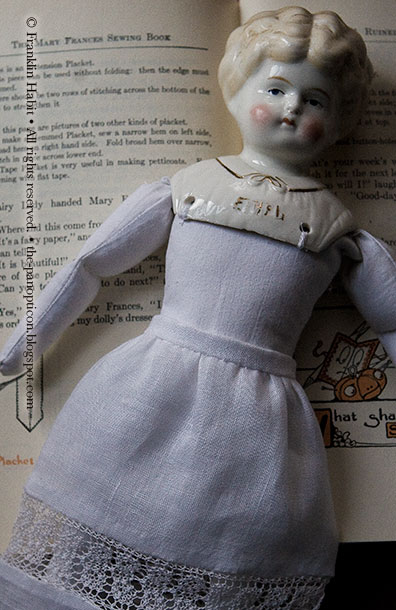
My own doll sewing took the lace I was knitting here and here and put it into a petticoat for poor Ethel, who until now has been nakeder than Mary Marie on the day she killed her sister.

I don't often say this about stuff I make, but this came out better than I expected. I have only the barest prior experience with sewing, but I was able to adapt the two petticoat (!) patterns in Mary Frances to fit Ethel's smaller, more womanly shape. Everything was sewn by hand using methods from the book.

petti-full

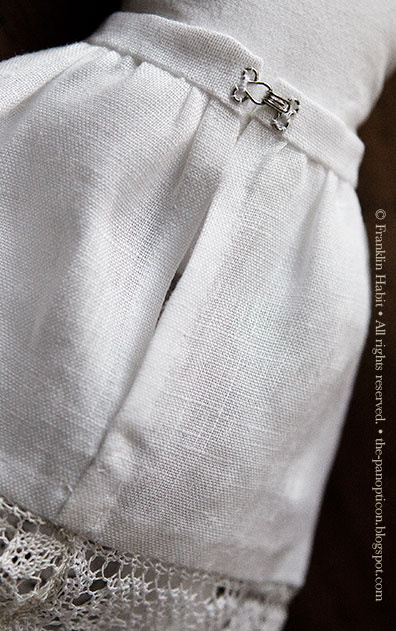
I learned a lot about working with handkerchief linen, including that it starts to fray like the dickens if somebody sneezes in the next room. I realized pretty quickly that none of the seams would last if they had raw edges, so every edge (inside and out) is finished. You know what? I'm proud of that. Even if my gathers aren't distributed as evenly as I would have liked. And even if I chickened out on putting in pin tucks.

petti-placket

Attaching the laces was a treat. (If you're curious about doing that sort of thing, I teach a class about it called Lace Edgings: Before, During and After.)

petti-page

Now she needs an underwaist and a dress. This time, I'm putting in buttonholes. If Mary Frances can do it, I can do it.

*Though it's amazing how often in sewing the right way, once fully learned, becomes the easy way.

Friday, April 20, 2012

Playing with Strings of Two Varieties

So, what have you been up to? I've been on the road. Kansas City and environs.

I thought this was my first visit to Kansas, but my father has since corrected me. Turns out that in 1974 we drove through on our way to a new assignment at Davis-Monthan Air Force Base in Tucson. We stopped at a rest area and had barely unfurled our picnic blanket when a sharp gust of wind carried it away. I weighed about as much as the blanket and was convinced I'd be next. I didn't stop screaming until we were back in the car heading for Oklahoma.

Now, Rodgers and Hammerstein said Oklahoma is where the wind comes sweeping down the plain, but they were native New Yorkers and knew bugger all about the Midwest.  On this visit, Kansas gave Oklahoma a run for the money–there was one superfestive night when both states broke out in tornadoes–and if I hadn't been so busy I might have worried once again about blowing away.

However, I was too preoccupied with yarn-related joy inside the hotel to bother with what was happening outside. The Sunflower Knitters Guild (an amazingly good group of people, even by knitting standards) puts on their festival–Knitting in the Heartlands–biennially. This was a growth year for the event, and I was honored to be the featured teacher at the moment when they expanded  to include a keynote address, more classes, and a marketplace that spilled out of one ballroom and into a second.

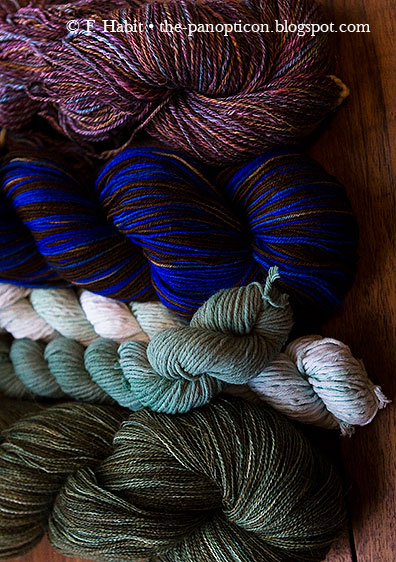
I love snooping around the vendors at regional events because you so often run into good stuff you haven't seen before. Here's some of what followed me home.

Yarns from KC

From top to bottom:
Before you ask–no, I did not punch up the blues in "Tenth Doctor." That's what it looks like in person. No way was I leaving it there for somebody else.

Not shown, but much coveted: Paco-Vicuñas yarns from Hickory Ridge Farms.  Not for the budget-conscious, perhaps, but dammit that vicuña fiber makes cashmere feel like asphalt.

While I was in Kansas City I did very little knitting. I don't mean I didn't knit much, I mean my knitting was very small. I finished the "Double Rose Leaf" lace insertion for Ethel's petticoat.

Insertion

That's all the lace I need for now, but I find myself feeling at a loss without something new on the US 00000 (1mm) needles. I may have to knit edges for a christening outfit just for the ducks of it, even though there's not an unchurched baby anywhere in the vicinity. Or maybe Ethel would like a fichu?

Meanwhile, the handkerchief linen is awaits cutting.

For Ethel's petticoat.

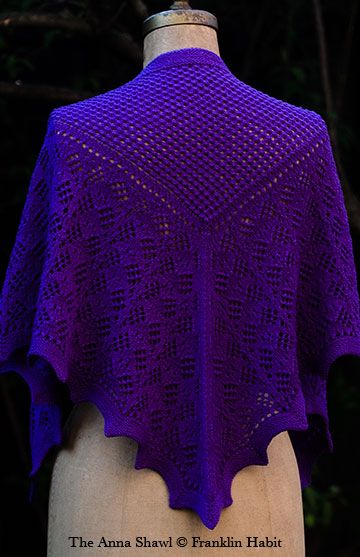
I'll also mention–in case you missed my jubilant screams on Twitter and Facebook–that while in Kansas City, I launched the pattern for the Anna Shawl.

The Anna Shawl

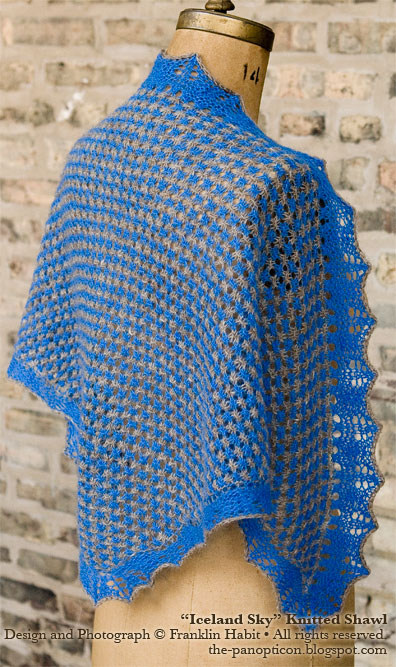
And that meant I was able to send Iceland Sky to the tech editor. He's making quick work of it, so if all goes well it will launch before I leave for my next trip–the Downtown Knit Collective Knitter's Frolic in Toronto, Canada.

A Floundering Minstrel I

One more thing. I spend so much time using the visual part of my brain–what with the knitting and the drawing and the photography and so forth–that a wise person of my acquaintance suggested I give my brain a rest and a stretch by taking up a creative endeavor that puts a different clutch of cells to work.

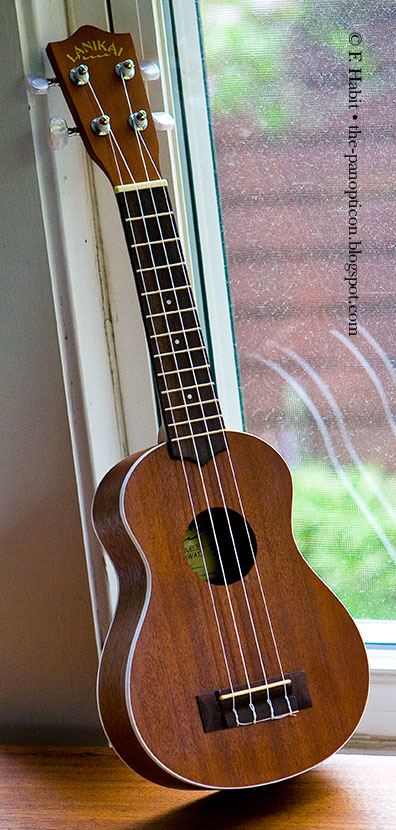
Which is why I now own a ukulele, upon which at present I can play three shaky chords.

New Buddy

Life is full of interesting things to do. If you're bored, it's your own fault.

Monday, April 02, 2012

Stars in My Eyes

I went to Iceland to teach knitting on a tour for knitters–and forgot to bring something to knit.

I left with knitting in my bag, sure. I didn't have a hat or neck warmer to wear on the trip, so I whipped them out en route. But that left me with nothing to knit once I landed.

Of course, in Iceland you are never more than two feet from a yarn display and I picked up two balls of Lopi Einband. Einband is Lopi's laceweight. Fuzzy, warm, decidedly on the crunchy side. Takes dye like a mofo, blocks like a dream.

Total cost: six United States dollars.

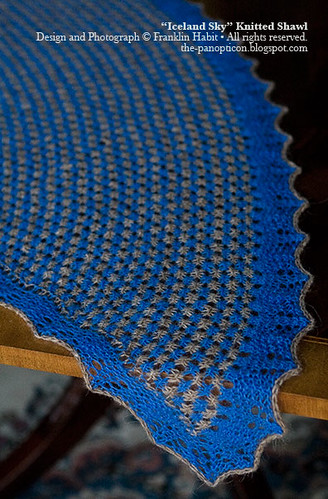
I started playing with the yarn during the tour, and now it looks like this. I'm calling it Iceland Sky–fathoms of blue studded with stars and draped in the aurora borealis.

skyshawl-collar


skyshawl-full

skyshawl-horiz

skyshawl-vert

Pattern forthcoming. This week, as soon as the Anna Shawl comes back from the splendid new tech editor, Iceland Sky heads out for him to review.

Sunday, April 01, 2012

Wow!

Look out the window, there's a parade! They have a marching band and cheerleaders and Nancy Bush is riding an elephant in a shiny bikini and working nupps!

Ha ha ha April Fool! Made you look!

Love,
Harry

PS Did I fool you? Ha ha!

Thursday, March 29, 2012

Fancy!

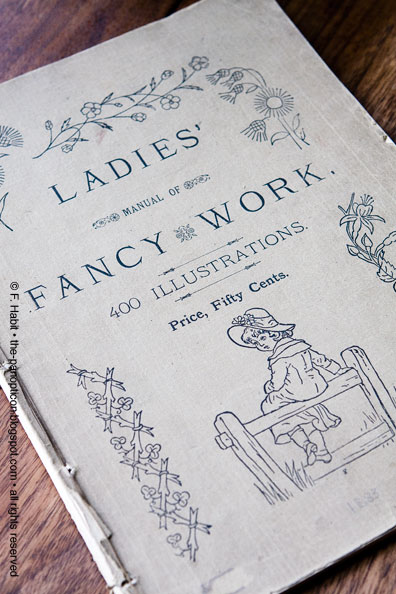
I was teaching in Madison, Wisconsin a few weeks ago when a thoroughly charming gentleman walked into my classroom and presented me with this,

fw-cover

once again confirming that in many ways I am a lucky sonofabitch.

Now, I do have new piece finished. It looks something like this,

fw-shawlblock

but as it's still drying the official photographs will have to wait.

Instead, do you fancy a riffle through the delicious pages of The Ladies' Manual of Fancy-Work, published in 1883 by A. L.  Burt of New York, and edited by Miss Jenny June?

Jenny June sounds suspiciously like a pseudonym, doesn't it? Possibly a pseudonym for a thick-necked and paunchy cigar-smoking drapery salesman whose real name was Irv Magee?

One's suspicion only grows upon learning that Mr. Stephen Foster–who dreamt, famously, of Jeannie and her light-brown hair–also wrote a popular minstrel ballad with the refrain:

Did you see dear Jenny June
When the meadows were in tune
With the birds among the bowers
In the sweet summer time.

We're on to you, Irv Magee. We see you there, behind the pen, with your cigar.

Irv's taste in fancy-work, not unusually for the time, inclined steeply to the florid.

fw-projects

Among the curiosities are instructions for artificial macramé (which Irv calls macreme).

fw-macreme

It's crochet.

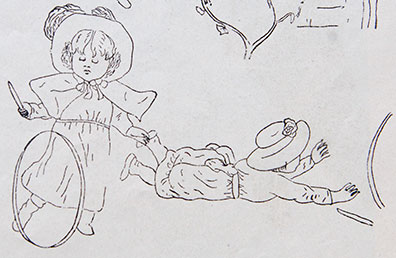
Also, there are pages of line-drawings of whimsical Regency moppets suitable for transferring to embroidery fabric, drawn by a D-list Kate Greenaway impersonator who remains anonymous (and no wonder).

fw-hoops

One of the vignettes has dialogue (click for a larger version), like a primordial New Yorker cartoon.


fw-scandal  

The Ladies' Manual of Fancy-Work was published in 1884. James Thurber was born in 1894. Just want to point that out.

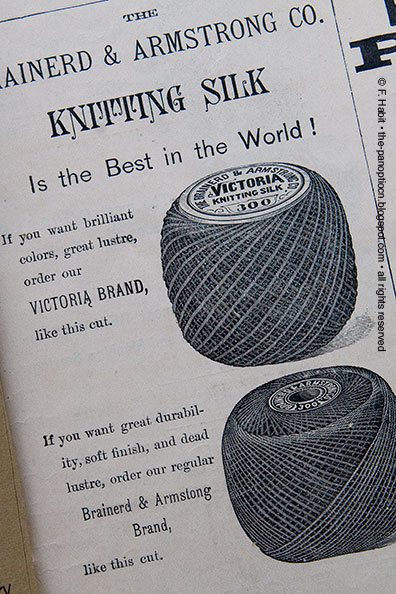
There are advertisements, too, including several for yarn.

fw-silkad

Nobody boasts anymore that their silk yarn has "dead lustre." Why not?

And since this manual of fancy-work is for ladies, there are also ads for ladies' things, like corsets.

fw-corsetad

My favorite, please don't miss it, is the "nursing" corset with the flip-top tit.

(Say that out loud a few times.

Flip-top tit.
Flip-top tit.
Flip-top tit.

You said it, didn't you? Out loud?

Are you at work?

I hope nobody heard you.)

Finally, the articles. Good stuff. Chinese embroidery, the history of the cashmere shawl, etcetera.

Here's one of them, in full.

Boys who Learned Needle-work

When the late Admiral –– was a young midshipman, he was sent on a voyage round the world in one of King George the Third’s ships. He was three years away, and, as he grew very fast, he found himself sailing in the Pacific Ocean with hardly a stitch of clothes to his back. His mother, sister of Admiral Lord ––, had taught her little boy to sew, so he got some canvas out of the ship’s stores, and cut out and made himself a new suit of clothes. His mother was very proud of these, and, when her son was an admiral, she used to show them to her grandchildren, and tell them the story.

Rather more than thirty years ago, a lady went to call on another one rainy afternoon; the house was built on a an island in a lake in Ireland. In the drawing-room were two little boys sitting on footstools, one on each side of the fireplace. Probably, the visitor looked astonished, for the mother of the little boys said in a low tone, “Please don’t laugh at them; what should I do with them on this island on a rainy day if they were too proud to sew?” One of these boys was a lieutenant in the Crimean War; he fought none the worse because he knew how to use the needle as well as the sword, when he with his men was for eighteen hours in the Redan on the memorable 18th of June.

The chaplain of an Irish institution had seen when he was young the straits to which the French artistocratic refugees were reduced, from having to learn how to do things for themselves; and he got a tailor to come to his house and teach his boys how to cut out and make and mend their own clothes. One of the boys is now an old general, but he sews on his own buttons to this very day; and when he was on service in one of the small British stations in Asia, he not only mended and patched his own clothes, but those of his brother officers; all the men of his regiment knitted their own socks.

Thanks for sticking up for the boys, Irv! Have another cigar!

Wednesday, March 21, 2012

Wee Wee Wee

I have always had an affinity for the small–possibly because I happen to fit neatly in that box myself, with plenty of room to spare.

Years of unfulfilled longing meant that when I saw this at a local thrift shop

dhouse-01

I decided it was coming home with me.

It's a home-built townhouse, front-opening. Age and provenance unknown. The style is decidedly of the first quarter of the twentieth century; but the windows that still retain their glazing are fitted with sheets of clear plastic. This could be a later replacement for celluloid/acetate, or it could mean a house constructed in the 1950s or later using an old set of blueprints.

However old it is, I love it. The exterior is agreeably battered and faded, with most of the pretty details intact.
dhouse-windows
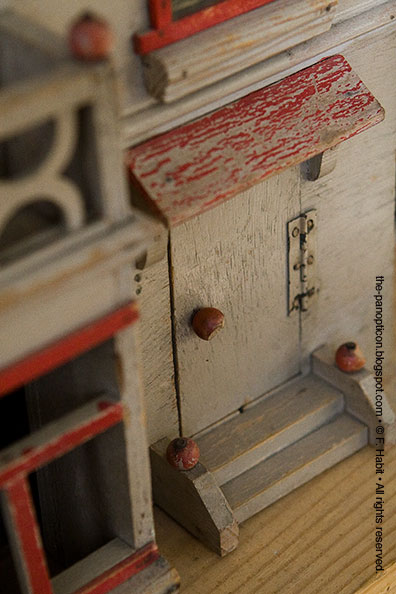
I love the way the builder used just two colors and simple materials (wooden beads, bits of stock moulding) to achieve a richness of effect.

dhouse-door

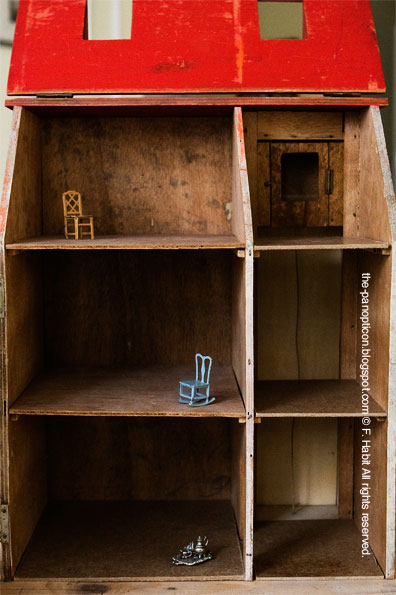
Inside, six rooms and an elevator. The elevator is operated via a crank in the base. It took some cleaning and oiling, but the car now travels up and down smoothly on the string while I hum "The Girl from Ipanema."

dhouse-interior

I've enjoyed imagining why the exterior was finished with so much care, but the interior was left completely unfinished. It might have been that a deadline (Christmas? birthday?) forced the doting amateur carpenter to deliver it half-made with a promise that interior decoration would follow. It might have been that the little owner was expected to do her own decorating, but never got around to it. It might have been that the miniature occupants got into such a dreadful fight over wallpapers for the front hall that they divorced and abandoned the property.

There's also a scenario involving alien abduction, but let's move along.

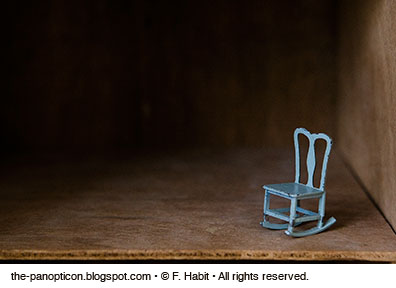
Whatever the reason, I'm happy the rooms are a perfect blank. In their current state, they have a melancholy I admire.

dhouse-bluechair

Also, were there even a scrap of 1930s linoleum, I'd feel honor-bound to preserve it. Since nothing period survives, I shall fill it up to my heart's content following my own fancy.

Of course that means needlework. A very small heap of very, very small needlework.

The scale of the house is not the 1:12 (inch-equals-a-foot) standard for modern "collector" houses meant for adults. It's 1:16, the old "play" standard for miniatures meant for children. Period furniture in 1:16 isn't impossible to find–the two metal chairs in the photographs are from Tootsietoy, a now-defunct maker once based here in Chicago–but it's uncommon, expensive, and often startlingly ugly. As much as possible, I want to make my own stuff.

I've already been knitting small, partly out of guilt. Remember Ethel? Ethel was supposed to be the doll who ended up in this, but proved unequal to the burden of all those layers. She was replaced by another model from the same agency. It happens all the time–even sample-sized gals aren't all built the same.

Ethel didn't complain, but I began to feel bad that she has ended up lying naked in a drawer for a year. She at least needs some frilly underclothes, lace-edged. I could buy doll's clothes. I could buy lace. But it's more fun to make them.

Enter the 00000.

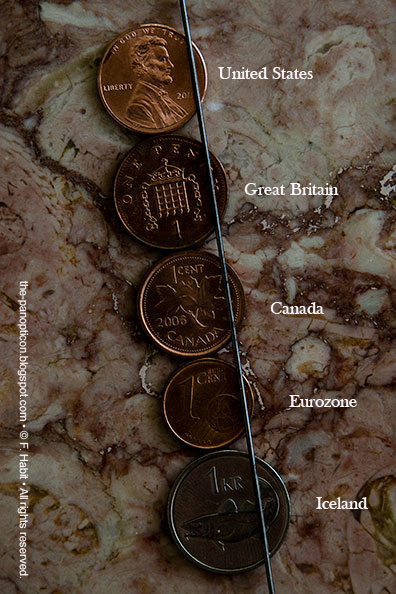
This 00000 (also called five-aught, or 1mm) knitting needle was part of a bundle of antique double-pointed needles given to me as a gorgeous gift by a marvelously generous knitter I met while teaching at Sealed With a Kiss in Guthrie, Oklahoma. To give you some idea of the scale:


As I'm fortunate enough to have this blog read in many countries abroad, I put in as many small coins as I could find in the change box. I'm sorry that the selection was limited to places I've been. (Asia, Australia, South and Central America–I'm ready when you are.)

Now, standard needles go down to a completely hilarious 00000000 (that's eight-aught)–so I don't pretend I'm breaking any kind of record in working with a pair of five-aughts. Nutjobs like Betsy Hershberg (have you seen her new book, by the way? disgustingly good) would think nothing of this.

This is the finest work I've done yet, though. And it's fun. Like picking at a scab is fun.

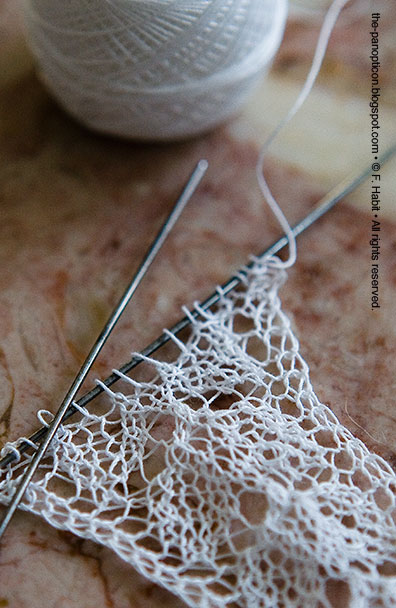
Here's the edging for the bottom of Ethel's chemise, on the blocking board. The thread is DMC 80 Crochet Cotton, which is not much thicker than sewing thread.

edging-pinned

If you're curious about the itttybittyknitty experience, some quick beginner's notes:
  • Yes, it takes a while to find a comfortable grip. In fact, banish the word "grip" from your mind. Any attempt to "grip" one of these needles will result in a crumpled piece of wire. On the other hand, it seems to be normal and desirable that as you knit, the needles will take on gentle curves that fit your hands just so. I find this endearing. They're not just needles, they're obedient pets.
  • I have seen (but do not own) knitting holders from the 19th century that protected fine needles inside stiff metal (sometimes silver) tubes. Having now tried to transport a pair of five-aughts in a standard knitting bag on the subway, I understand why.
  • A magnifying glass is a great help if you are over sixteen. (I am.) Good lighting is vital, unless you enjoy gnashing your teeth until they shatter like cheap wineglasses. I have never been so grateful for my Ott Lite, which has both a huge magnifier and a clamp that holds my chart where I can see it.
  • My antique five-aughts have blunt ends. I'm looking to play with some modern five-aughts and see if they have pointed ends. Pointy ends are a boon when you're trying to work a double-decrease. Fooling about with blunt-ended fine needles has kicked up my appreciation of 19th-century knitters another couple notches. I've seen photos of those women operating these things with gloved hands, which I think helps to explain the widespread Victorian notion of female hysteria.
Finally, if you take your five-aughts out in public, exercise caution. I brought this to the coffee shop the other day.

leaf-insertion-progress

It's a lace insertion for Ethel's chemise, yet another variation of the double-leaf motif that's been kicking around since the early 19th century.

I do a lot of knitting at this coffee shop. All the baristas know me. I've even taught a few of them the rudiments of knit and purl.

I was limping along, determined to make headway even without my magnifying glass and in dim light. I barely noticed the manager inching closer, pretending to wipe down empty tables but keeping one worried eye on me. When she was about two feet away she stopped and sighed with evident relief.

"Something wrong?" I asked, looking up.

"That is wicked small yarn," she said.

"You ain't kidding."

"Well," she said, "from over at the counter you can't see it. Or the needles."

"Really?"

"Uh huh. So you were sitting there...and moving your hands...and looking at them...and sometimes you were stopping to count...but it looked like you weren't holding anything."

"Oh, dear."

"I was sort of worried that maybe you were, I don't know–having some kind of knitting-related seizure?"

I reassured her that I wasn't.

But we all know it's only a matter of time.

Wednesday, March 07, 2012

How Green Was My Bottom

I must be spring, because Knitty says so. The new issue is up.

I'm ready for spring. We have had a shockingly mild winter in Chicago, by Chicago standards. Mild, in our case, means there have been multiple winter days during one has been able to step outside without bursting into tears which immediately freeze to the side of your face.

Listen, you want to know how crummy winter is in Chicago? Winter in Chicago is so crummy that when I told a bunch of Icelanders what our January is like, they gaped at me.

"No," said one of them. "I think we are not calculating this correctly."

I repeated our average January low, and he whipped out an iPhone to confirm the converstion from Farenheit to Celsius. There was a collective gasp.

"This is inhuman. This is like Greenland. How do you stand this?"

Yup. A typical Chicago winter is shockingly cold to people from  Iceland.

And please don't start in with the "Oh, but you can wear all your wonderful sweaters and hats and mittens and...". One of the reasons I love being a knitter is that making my own winter gear gives me a false but comforting sense of being in control of the season, but I hate, hate, hate being buried under 16 layers of clothing. Do you know 16 layers of clothing do to a short, broad man? Do you? They make him look like a laundry pile with boots, that's what.

When it's time to retire, kids, I'm moving to the desert and I'm never going to wear anything with a #@$*! sleeve on it, ever again.

So, as I was saying, this is a blog post about the Spring 2012 issue of Knitty.

My contribution is an antique pattern, as usual. Voilà.

Bag

It's a bag in the shape of a pineapple. Of course it is.

Pineapple purses were a bit of a fad for part of the 19th century, probably because the fruit–being tropical and therefore exotic–fit perfectly into a more general mania for All Things Oriental, with the "Orient," in this case, encompassing pretty much everything from Japan to North Africa.

One of the most pleasing things about knitting a pineapple is that it's like knitting cables. The whole world thinks you've pulled off the most amazing feat of virtuoso yarn-based legerdemain, when actually all you've done is have a whacking great time with a very bewitching pattern.

Believe it or not, there's more going on in a plain vanilla sock than there is in this pineapple. The whole thing is based on one stitch motif, 16 stitches wide. Once I got going, I absolutely flew through the leaves and the fruit.

Then came the bottom, which is written out thus in the original:

P6, A all around.
Plain, all around.
Repeat these two rounds till the bag is almost closed, then draw it together with a needle.

Translated, this means:

Round 1: (Knit 6, sl1-k2tog-psso) around.
Round 2: Knit.
Repeat rounds 1 and 2 until you have a bag instead of a tube.

But there's a wee hitch. You're starting out with 320 stitches, and the first round is asking you work a repeat of 9 stitches evenly around it.

320 divided by 9 = 35.555555555555556. For those of you non-knitters reading this,* that's a big negatory.

So what to do?

In this case, we have to find a way to close the bag that a) works and b) will be as close as possible to what Jane Gaugain intended.

However, we cannot call, text, e-mail, Tweet or otherwise harass Jane Gaugain to find out what she intended, because even the worms that devoured the worms that devoured her mortal body have long since gone to dust.

We cannot reverse-engineer from the picture, because there is no picture.

We can have a look at a few photographs of extant examples of pineapple bags, though frustratingly few show the bottom and all are obviously knit from patterns that, while similar to hers, are by no means identical.

And we can guess.

We can consider the practical requirements of a bag, such as that a flattish bottom will be more practical than a long, conical bottom.

We can consider the aesthetics of the bag, which is heavily sculpted for three-quarters of its surface and would probably look best with a bottom that matches.

So, we begin by listing theoretical solutions.
  1. What if, instead of beginning with 320 stitches, we began with a near-ish number of stitches into which 9 would divide evenly?
  2. What if the use of "A" (for the double decrease) in Round 1 is a typo? Did Jane mean to put in a T, her symbol for for k2tog? The repeat would take up 8 stitches, and 8 stitches does fit evenly into 320! Ooh!
  3. What if the "6" in Round 1 is a typo? If we substitute a 5, the motif uses 8 stitches, and 8 stitches does fit evenly into 320! Ooh! Ooh!
With a little testing–by which I mean calculations that make my head hurt, followed by a great deal of knitting and then a great deal of ripping out–these three solutions proved unworkable. They all assume that there is some combination of plain stitches, followed by a decrease,  that will close up the bag in an attractive fashion.

As it turns out, no there isn't. Or if there is, somebody who is not trying to meet a Knitty deadline will have to find it. Some of the test-knits did begin to close up the bag, yes; but the closure looked like ass. (In this case, "ass" and "bottom" are not synonymous.) The math never worked, either. There always came a point at which the number of stitches in the repeat no longer fit evenly into the number of stitches remaining. Further adjustments could be made at that point, but it would have meant a set of decrease instructions so convoluted that they seemed way out of step with the succinct nature of the rest of the pattern.

Plus, did I mention it looked like ass?

The next option is drift further from Mrs G's two-round instructions. They look so elegant on the page–but if they don't work, they don't work. Hey, it happens. Then, as now, sometimes the instructions aren't just a little off, they're completely broken.

I decided to see what would happen if I had another shot at both Theory 2 and Theory 3–but instead of maintaining the same number of stitches between decreases, I'd have 1 (or 2, in the case of double decreases) fewer stitches between them in every decrease round. This is, of course, the common method for decreasing the tops of hats.

I started with Theory 2, and yup, the bag began to close. Slowly. Slooooowwwwwwwwllllyyy. I looked at the theoretical numbers again, counted the number of rounds they required, and realized I'd end up with a plain green cone, three inches deep, at the end of my pineapple. Not pretty, not practical, and way out of line with the look of the rest of the piece.

Rip.

Finally, Theory 3, plus consistently reducing the number of stitches between decreases, yielded this:

Bag

If that ain't what she meant, she's welcome to come back from the dead and tell me so. I love it.

I don't love her final finish, though, with the bunch of green silk satin ribbon.** That's coming off and I'm replacing it with a tassel–Lisa Souza's yardage in a hank of Sylvie is so generous that I have plenty left.

I may even knit a mini-pineapple with the leftovers. (It's easy. Pick a multiple of 16 as your cast-on and go for it.)
*I'm not fooling myself. There are no non-knitters reading about how to troubleshoot the decreases at the bottom of a pineapple. I know.

**I dyed that flippin' ribbon myself because it was hard enough just to find silk ribbon, let alone silk in a green that matched. I want extra credit for that, dammit.