Monday, October 14, 2013

This Is Not Your Grandma's Knitting. This Is Your Great-Grandma's Knitting, and It's Utterly Fabulous.

My friend Jane is in town from London, acting (in part) as chief cheerleader for her fetching sweetheart–he being one of the 40,000 or so who ran in the Chicago Marathon on Sunday.

The sweetheart acquitted himself marvelously; and is satisfied to have broken his personal record with several minutes to spare. We went out to the sidewalk to cheer him as he dashed through our neighborhood, which made us feel connected to the marathon in a meaningful way without actually having to run. For this, we are grateful.

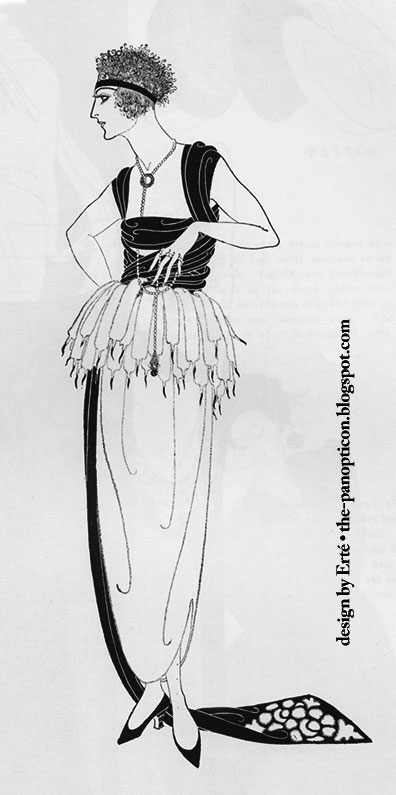
I'm also grateful to Jane for having arrived with gifts. Among them was a fantastic folio of fashion drawings by Erté, a man who was an idol to me growing up even though (especially because?) he was not supposed to have been. Young American males were not supposed to idolize fashion designers, we were supposed to idolize the various drug addicts, philanderers, dog fighters, and wife beaters who populate professional sports and popular music.

But I loved Erté, whose wild imagination and flowing line were so of-the-moment in the late teens and early twenties of the last century that they became emblematic of it. Erté was still actively cranking out work in the 1980s. By that time, of course, his style had become a caricature of itself; but the demand never flagged and he died (so I have read) with pen in hand, at work. I can only hope to face a similar fate.

The folio from Jane covers Erté's years as a fashion illustrator for Harper's Bazar (this was before they added the third "a" in "Bazaar"), 1918-1932. It's a book to fall into. This was the period during which the artist hit his stride for the first time, and you can sense him struggling to rein in his creativity. The sketches for Harper's were supposed to be practical–in the very broad sense that you could conceivably take one to your dressmaker and have her make a dress from the sketch–but some of them...

Well, I'll put it this way. There's one page titled, "Novel and Unusual Designs in Fur and Chiffon." Get the picture?

Here, I'll give you a picture.

This is an evening gown from December 1920.

erte-gown-02

The original caption read,

Erté wraps a long scarf of black satin about this lovely lady's shoulders and it forms the draped corsage, allowing one end to escape as a train. The skirt is of ermine.

Here's another, from March 1918.

erte-gown-01

This is described thus,

A suit of black satin that is easy of construction and very wearable is this Erté model. A cord, drawn through rings, makes a surplice closing and defines the waistline of the straight coat.

So, you know–practical. But not practical in the sense of, "What can I throw on to go down to the shops and pick up shoe polish and carrots?"

These are two of the more restrained designs.

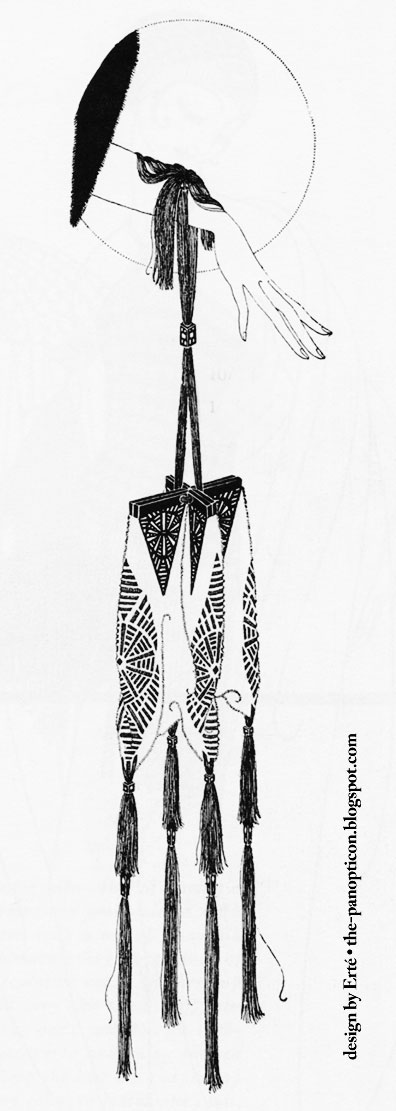
But imagine my screaming joy–I mean it, I screamed–to find out as I pored over Jane's gift that along with "Novelties of Eastern Inspiration" and "Gowns Made to Do the Unexpected," Erté threw in designs for...

knitting bags.

Knitting bags.

And I do not mean bags that could contain knitting, I mean he intended them in no uncertain terms to carry around works in progress. They all appeared in 1918–the tail end of the first World War, when women of all stations were urged to knit their bit, so that may have had something to do with it.

Wanna see? Yeah, I bet you do. Here we go. (The captions, by the way, are the originals–verbatim.)

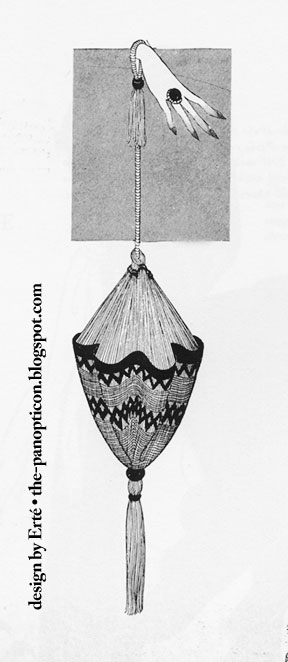
Design One, June 1918.

erte-bag-00

As knitting goes to every party, it is important that the bag that takes it be appropriate for the occasion. So with a summer frock, carry Erté's bag of silk tricot that is trimmed with straw.

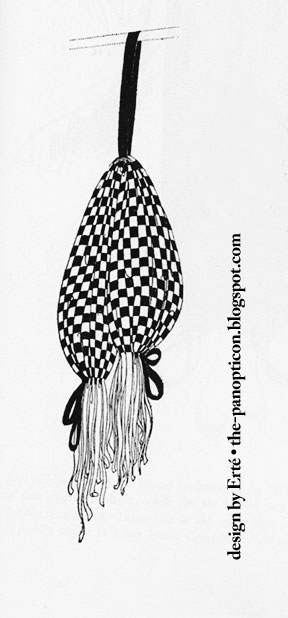
Design Two, May 1918.

erte-bag-01

Erté was indeed inspired when he laced black and white ribbons into a knitting-bag and then pulled one black ribbon to serve as a handle.

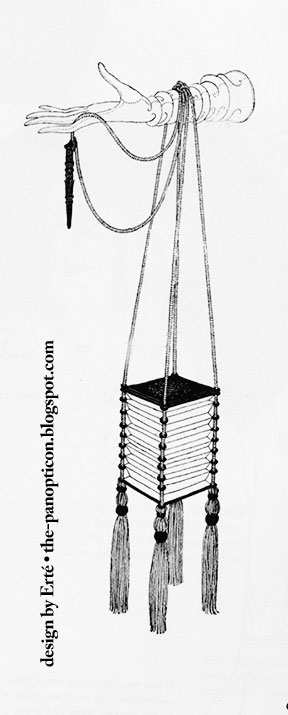
Design Three, May 1918.

erte-bag-02

Again he gives a practical suggestion in the lantern bag, for plaited silk is caught upon rings that slip up and down on silken cords and stretches like an accordion, making it equally simple to accommodate either a bulky sweater or diminutive wristlet.

Design Four, October 1918.

erte-bag-03

A sock will begin its life in luxurious surroundings when it is kept within a suede bag effectively embroidered with black silken threads and those of dull Indian red. The frame and beads are of ebony inlaid with ivory.

I didn't begin life in luxurious surroundings–but my socks might. Can somebody please rush these into production? Thanks ever so.

Monday, October 07, 2013

You Never Can Tell

It's not enough to have finished a couple skeins of yarn during the Tour de Fleece. Now that the yarn's finished, I want to play with it.

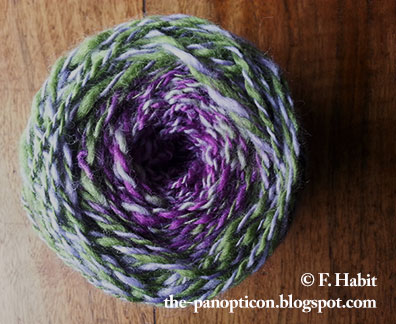
When I say "play," I mean play. I don't mean hunt around on Ravelry for a suitable pattern and knit that pattern. I mean wind up the skein...

handspun-wound

...and get excited all over again about the gradual color changes. Then pick needles that look like they might work well enough, cast on some stitches, and see what the hell happens.

I can hear teeth grinding out there. I understand. Setting sail without a destination isn't everybody's idea of a swell time. Some folks prefer to pick a destination, then get to it via the most direct route. That's fine. Knitting's a big tent. There's room for everybody.

Me, I like to play.

I have a vague notion for this yarn: a hat. Worked top down without much detail, since the yarn is the point. I want to watch those colors change. I want to see what my amateur's thick-thin-thinner-THICK-thin-thicker-thick-THIN-thick two-ply looks like in plain stockinette.

Judy's Magic Cast On makes top-down circular hats a treat, so that's how I began. I chose US size two needles, and produced a scrap of fabric so incredibly dense it could have run for Congress on the Tea Party ticket.

I ripped back and tried again with a pair of size four circulars. Much better fabric–firm, but supple. Since I'd begun at the crown, I knew I needed to increase a great deal and quickly to get the proper shape.  I probably ought to have sat down and reviewed the formula for these increases–how much and how often–but I didn't. I was playing.

I was also talking to people.

In a dark sports bar.

With loud music.

At night.

During a bingo game.

You sense where this is going, perhaps.

At the very beginning of a top-down crown it's good to throw in fifty-percent increases every other round. You knit a round, you double the number of stitches, you knit a round, you double the number of stitches.

Then, if you intend to do things in a sensible fashion, you tap the brake and slow down either the frequency or the rate of your increases. I know this. I have known this for years.

 But I was not feeling sensible. I was feeling annoyed, since two of my tablemates had achieved a bingo and I had not. I don't even like bingo, and there's nothing that frosts my cookies like losing at a game I didn't want to play in the first place.

I kept knitting, and increasing, and knitting, and increasing, and didn't notice until the next day that my stitch count per round had grown from

eight

to something in the area of

three hundred.

That is rather more stitches around than you probably want in a hat for a human being.

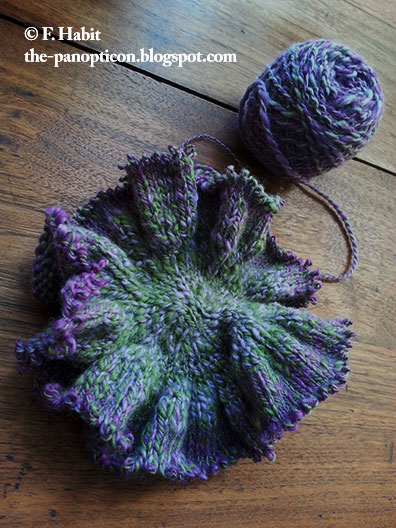
Not to mention that the work was extremely bunchy on the needles. It looked like a bruised cauliflower.

So I slipped it off to see what I'd got. Here it is.

experimental-hat-ruffled

Not what I have in mind for this hat. Disturbingly reminiscent of the ruffled table mats my grandmother's friends used to churn out. But the color changes–those are pretty. And the ruffling–I don't want to use it now, but I'd be surprised if I won't find a reason to use it some time.

Still don't have a hat, but I'm having fun. And I learned something. Which for me is often the same thing.

Friday, September 27, 2013

Twenties Real, Twenties Fake

Like fifty billion other Americans, I first read The Great Gatsby in high school.

I went to two high schools–one horrible, one merely mediocre. During my first of two years at the former, I was force-fed the Irish Christian Brothers' approved course of literary blood and guts. In keeping with the rest of the curriculum, it was intended to mold boys into men. Nasty, brutish, woman-thumping men.

We read the Odyssey, in a ridiculous prose translation that reduced Homer's epic to something less compelling than a Hardy Boys adventure. I still remember the blurb on the back cover insisting that "...no boy who reads it can ever fail to be thrilled." (I failed.)

We read The Red Badge of Courage, which was full of battle scenes we were meant to find alluring, not revolting. (Real men, we were told, love shooting and being shot at.)

And we were allowed one "free choice" book. As this was a Christian Brothers school, "free choice" was of course relative.

I picked Emma. Choice denied. Emma, said the teacher, was written by a woman. Men didn't choose to read books written by women. What was I, a pansy? (Um.)

I picked A Passage to India. Choice denied. E.M. Forster, said the teacher, was a sick homo. What was I, a pansy? (Um.)

I picked The Great Gatsby. Choice denied. It was for the juniors, said the teacher. You're not allowed to read it yet. You'll hurt yourself.

I honestly don't remember what I picked for the class. I do remember that I bought a copy of Gatsby with my babysitting money and read it as a silent Fuck You to the teacher.

I will not lie and say the experience turned me into a Fitzgerald fan. It didn't. I admire Fitzgerald in a chilly way, but if you banished me to a desert island with limited space on the raft for books I doubt that Daisy Buchanan and pals would make the cut.

What I did (and do) love about Gatsby was the parties, the houses, and the clothes.

This summer, after swearing I wouldn't, I went to see Baz Luhrman's film. I fell asleep during the second half, but before that I was surprisingly contented to just stare at the parties, the houses, and the clothes. They reminded me of why the book had sporadically carried me away

Luhrman's sets and costumes weren't "correct," but they felt correct. They felt like Fitzgerald's descriptions of the roaring twenties, which in time became the American popular imagination's sketchy idea of the roaring twenties.

It was this sketchy idea that I recently had to evoke in doing a piece of work for Babs Ausherman–known better to knitters all over the damn place as Miss Babs.

Miss Babs is a dyer, one of the best; and she has a yarn club. Lots of dyers have yarn clubs, but Miss Babs runs the only club that sends you places. Not literally, but in the comfort of your favorite chair. Each installment guides you through a different destination. As a souvenir you're given a yarn and coordinating pattern evocative of that place.

Or, in the case of my tour, that time and place. "What I want from you," said Babs, "is time travel."

Okay, sure. Why not?

So for my leg of the tour, which embarked this month, the knitters and I went to Chicago in 1923.

The tour part was easy. I live in Chicago, so I know my way around. And I borrowed a friend's time machine.

transporter

No, it's not that blue thing from Doctor Who, but it has reclining leather seats.

Getting all those knitters back to 1923 was a piece o' cake.

The tough part was the knitting pattern.

Because here's the thing: the past doesn't always look the way you think it did. The past doesn't always look the way you want it to. Rifling through my not-insignificant collection of 1920s knitting books, I realized that an authentic pattern wasn't going to cut it.

What folks often forget is that the world didn't remake itself to look like Radio City Music Hall on January 1, 1920. Art Deco was a machine-mad movement that started in France, and gradually–very gradually–began to exert an influence on international architecture and design. Lots of iconic American Deco wasn't even around in the twenties–including Radio City Music Hall, which opened in 1932.

In most of America, the 1920s simply didn't look the way we imagine the 1920s to have looked.

Knitting looked even less so. Knitting, I'm sorry to say, was undergoing a period of relative eclipse at the time. Not that nobody was knitting; but the people who were tended to be the people who are still, now, popularly imagined to be doing most of the knitting: spinsters, matrons, grandmothers, maiden aunts, little girls.  This was not the smart set. The patterns produced for this market tended to be, at best, lukewarm. At worst, they all looked like tea cozies–even the sweaters.

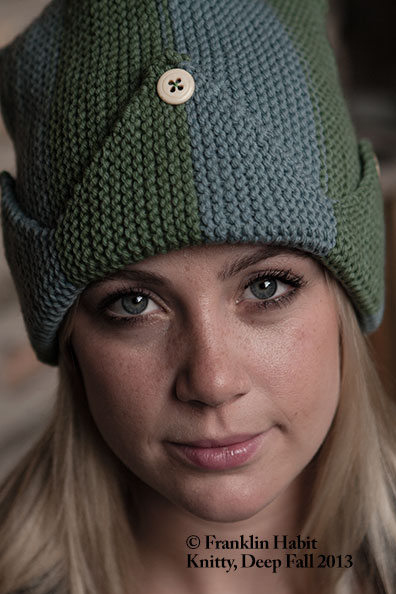
You can imagine my dilemma when Babs told me she wanted a project for her subscribers that would really roar, and all I could find were hats that looked like tea cozies. I fell in love with one of those hats, by the way, and though it wasn't right for the Knitting Tour I couldn't resist re-working it in Quince and Co. Lark for the Deep Fall 2013 issue of Knitty:

wedge-front-blog

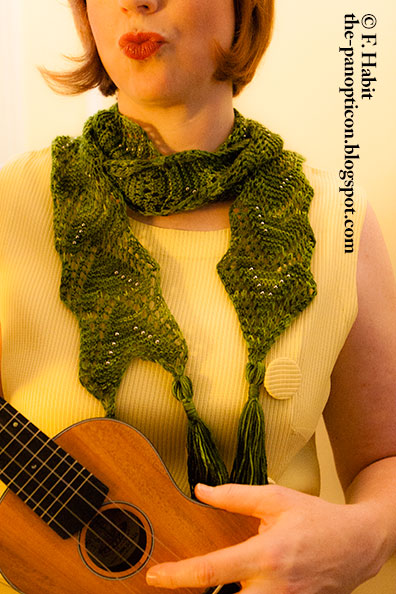
For Babs, ultimately I took as my inspiration a real piece of period clothing: the very long, very thin "lavalier" scarf. But whereas a period scarf would have been woven–likely a fine silk chiffon–mine had to be knit.

I asked for colorway that would mimic jade, and boy did I get it. I mixed it with silver beads, silver and jade being a classic Deco combination. Babs knows her way around a dye pot.

closeup-pout-web

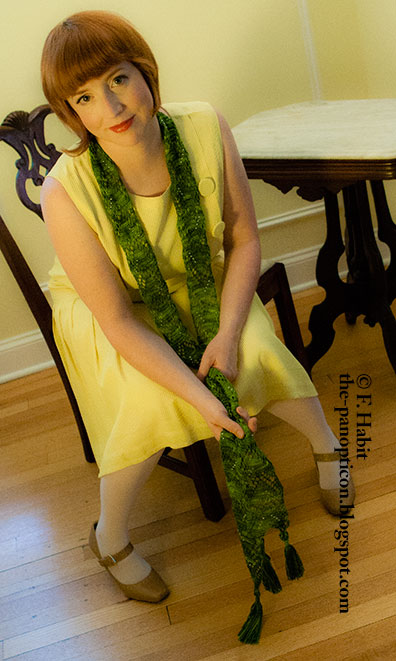
Deco motifs are tough in lace–I've never seen one that satisfies me completely (including mine). But I did my level best, and worked up an arrow that shoots from one end of the scarf to the other.

full-length-birdseye

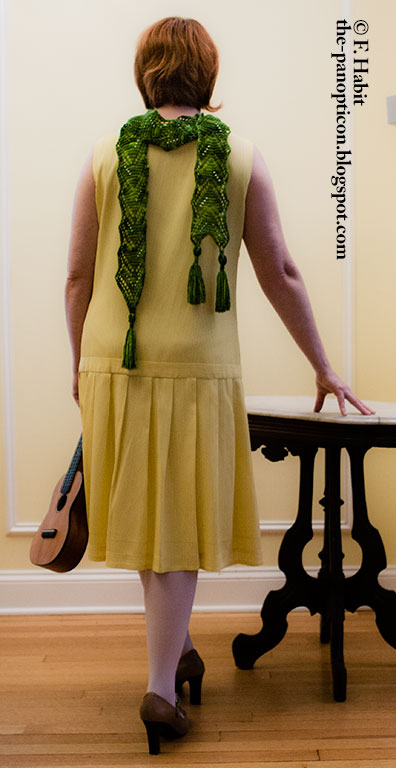
The result is a contradiction. I attempted to evoke period knitting...in a manner wholly inappropriate to the the knitting of the period.

Vo-de-o-do-do.

rear-view-web

Sunday, August 18, 2013

Tender Buttons

I've been working on a project that needs buttons. I wish I could show it to you, but it's for Knitty. If you leak a pattern for Knitty before the issue is published, Amy Singer drives by your house and shoots out your kneecaps.

I may have already said too much by telling you the thing needs buttons.

Excuse me for a moment while I go pull down the shades and cover my kneecaps.

So, this thing needs buttons. Rather than buy buttons, I chose to raid my button stash. My button stash became my button stash when my grandmother died, and her button stash became my button stash.

Let me tell you a little bit about my grandmother.

She was born in 1919 to a Pennsylvania coal miner and his wife. She learned to sew as a small child. Her mother had a cast-iron treadle sewing machine; but she also had four daughters with able hands so she felt the sewing machine was best kept for special occasions. Plain sewing, everyday sewing, was done by the daughters.

Plain sewing included things like bedsheets, which required a flat-felled seam up the center. Flat felled seams require not one, but two lines of stitching. When the seam in a sheet wore out, my grandmother would un-pick her old work, fold the sides of the sheet to the middle, and sew a new seam. When the sewing was finished she was allowed to do something else really fun, like wash coal dust off the kitchen windowsills.

I think of this every time I feel resentful that bath towels don't fall out of the dryer already folded.

My grandmother told me she first got paid for sewing–a penny for a whole mess of handmade buttonholes–when she was seven years old. That marked her début as a professional seamstress. When she had the stroke that was the beginning of her end, at ninety-two, she was still taking in sewing.

She sewed for her family until she became a housemaid in Pittsburgh and sewed for her employers. Then she left domestic service and married my grandfather, and sewed for her husband and her children.

Then my grandfather–who survived the entire Second World War as a paratrooper in Germany without a scratch–came home and got killed a couple years later in an industrial accident. So my grandmother, who had three children under five and a fourth-grade education, went back to sewing for the whole world.

Sewing doesn't pay very well. It doesn't now, and sure didn't in the 1950s in a small Pennsylvania coal town.

When you are raising three kids with your a sewing machine you don't have a lot of extra cash to throw around. My grandmother's childhood coincided squarely with the Great Depression and her young adulthood with war rationing, so she already knew how to be thrifty. All through the post-War prosperity (which passed her by) and into the crazy sixties and wasteful seventies and the even more wasteful eighties and the profoundly wasteful nineties she continued to be thrifty. The arrival of a new century didn't faze her in the least.

She died with eight hundred tons of fabric in her cellar.

Some of it was new, but much of it was things like faded curtains that could, maybe, be made into something else some other time. You never know, right?

Upstairs, in a motley collection of containers in a closet in the back bedroom, were the buttons.

They sell buttons in stores, but you can get buttons free without even trying too hard. If something wears out and cannot become something else, before you get rid of it, you cut the buttons off. If a customer wants a dress or coat freshened with new buttons, you keep the old buttons. When other people stop sewing because who sews these days anymore, you take in their buttons.

Then you die, and your grandson takes possession of your buttons.

I was pawing through the biggest button tin and suddenly I got the urge to photograph some of the buttons. The tin is entirely disorganized but I pulled out these little button families to share with you.

You never know what you're going to get when you visit this blog, is what I'm saying.

Also, I miss my grandma.

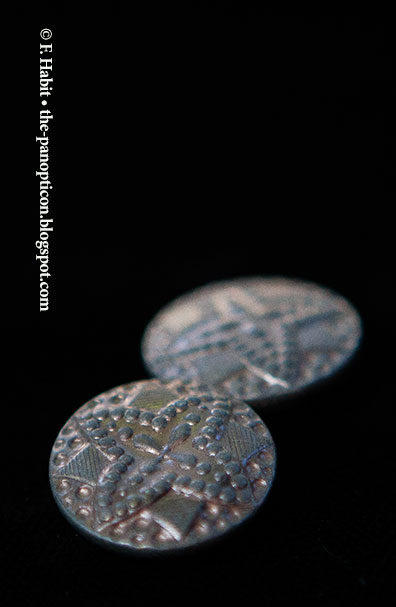
metal-buttons

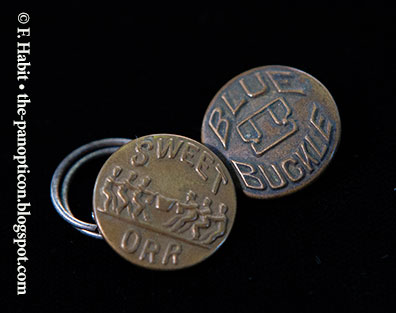
These are made of tin.

flower-buttons

Black flowers, plastic. Sunday best, circa 1977.

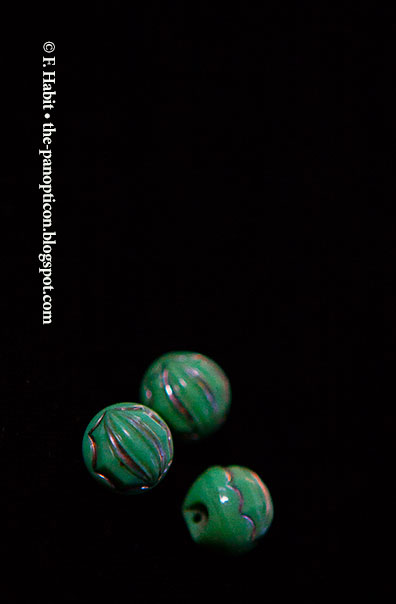
green-bead-buttons

Tiny green porcelain bead buttons. Much smaller in real life.
I might have these made into earrings.

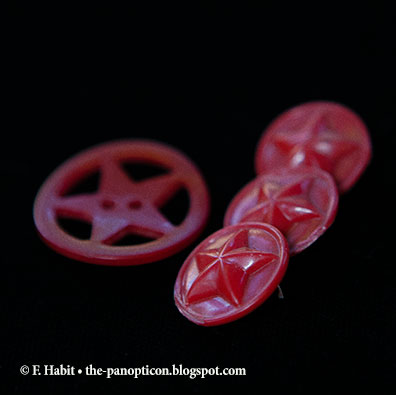
star-buttons

Are you now or have you ever been a button of the Communist party?

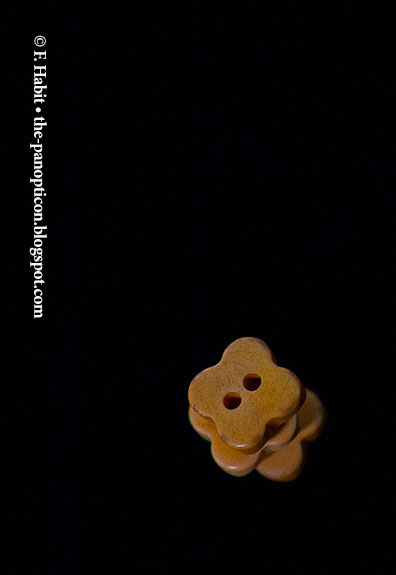
yellow-flower-buttons

Buttercups. Dainty.

overall-buttons

Built to last.

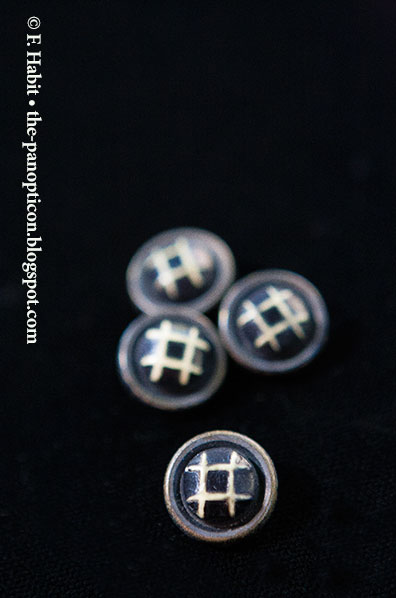
hashtag-buttons

#buttons


60s-button

And the lone survivor of a vibrant tribe remembers the fabulous 1960s.

Wednesday, July 31, 2013

I Am Ply-Curious

It tells you something about the circles I run in that when I mentioned I was about to try making a three-ply yarn for the first time, somebody said, "You haven't done that yet? At your age?"

What can I tell you? I was an odd kid. While all my little cohort engaged in classic teenage behavior–watching Sixteen Candles, kissing under the bleachers, perfecting their plying technique–I was probably stuck in my locker shouting for help. Please don't even ask what it was like being the only boy in class who couldn't finish a bouclée without snarling.

Here, on the lazy kate before plying, are the three bobbins of the green merino (look! up in the sky!).

green-bobbins

The roving was already divided into three even balls (I weighed them before spinning to be sure). Yet I wound up with two bobbins of roughly equal size and a third that's much fatter. What can we tell from this? We can tell from this that Franklin needs to focus a smidge more on consistency.

In my defense, long draw is so much fun I forget to pay attention to the fine points. As my arm swings back and the yarn flows from my fingertips, I am prone to shout "ta-daaaaaa," "wheeeeee," "cowabunga," and other ejaculations to that effect.

The plying went well, and here is the yarn on the niddy-noddy waiting to be wet-finished.

green-niddy

I am pleased. Giggly, even. Far from perfect, but it's my first yarn that really looks (to me) like yarn instead of "yarn."

Also...

I've been working on a collaborative project with John Mullarkey (my friend, the noted card weaver and loaner-to-me of spinning wheels) using Skacel's CoBaSi (a blend of cotton, silk, and bamboo).  It's a messenger bag. John has finished the strap, which is card-woven.

finished-band

I'm working on the bag, which will be knit.

I've decided to do it in mosaic knitting, for the same reason I decide do so many things: it looks cool and I hadn't tried it yet. Here's an early swatch of what has become (with refinements) the finished pattern for the sides and flap of the bag.

mullarkey-collab-swatch

Designing and working mosaic patterns is proving to be a smidge addictive. Usually when I feel this way about a new-to-me technique, I wind up teaching it in a class about a year later. Who wants to place bets?

Saturday, July 27, 2013

Finish Line

I've set the timer for ten minutes. That's how long I have to write and post this entry.

I must apologize in advance for the perfectly crummy photographs in this post. I'm always telling students in "Photographing Your Fiber" that it's all about light, light, light. Today, my available light is revoltingly inappropriate and there is no time to make it better.

My equipment is also lacking. Part of my Tour de Fleece challenge this year–which I don't think I've mentioned here in the blog–is that I'd use only my phone camera to photograph anything related to the challenge. I have so many students coming into photography classes with a phone as at least one part of their kit that it behooves me to get more phone shooting experience under my belt.

It's a poor craftsman who blames his tools, but although the camera in my phone has surprised me with how much it'll do, when the chips are down it lacks the fine control that allows one to grapple with truly challenging conditions. So that's good to know.

Anyhow, what I meant to say is these photos suck and I'm sorry.

Here's a representative sample of my output on a plate shaped like a cabbage leaf, just because.

final-tdf

You've already seen the Corriedale from Lunabudknits, and the muddy brown mystery bobbin on the niddy-noddy.

I spent the last part of the Tour de Fleece on the road for work, and my wheel doesn't travel. But my host–my good friend John Mullarkey, who asked me to help him make final preparations for a video shoot–is a spinner. A far better spinner than I, in fact.

He surprised me with the generous loan of two spinning wheels I'd never tried before–a Schacht Sidekick (fully portable) and a Lendrum Upright (somewhat less so).

I'm not enough of an experienced spinner, honestly, to give you a worthwhile review of either. All I will say is I admired the way the Sidekick came to pieces for travel; and the way the Lendrum, though not strictly made for travel, folded for storage and was quickly set up when wanted.

Both wheels were enjoyable to spin on, easy to adjust, and allowed me to turn out pretty decent long draw singles after only a brief acquaintance.

When John and I weren't at work, I played with both wheels using his other surprise–perfectly gorgeous Polwarth roving dyed in brilliant blue by the always brilliant Briar Rose.

Before I left, he wound my output on both wheels onto a single bobbin. We wound that bobbin onto a ball, and from the two ends of that ball I used the Lendrum to make a two-ply. I'd never done that before–John threw in the lesson as lagniappe.

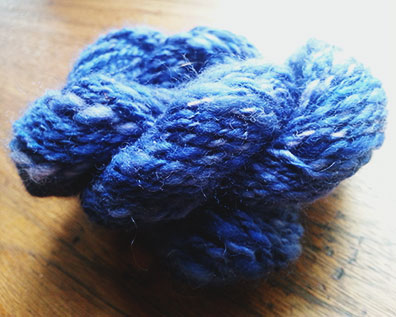
polwarth-yarn

We discovered during plying that I'd inadavertently spun almost exactly the same amount–to within an inch–on both wheels during the weekend.

 The wet finishing of the mystery yarn was a hoot. Upon contact with the hot water it fluffed instantly into the most alarming frizz and I figured I'd lost it. But no–in the cold water it relaxed back into something like a skein. When I thwacked it–mostly because I've heard you're not supposed to thwack worsted-spun skeins, and I wanted to see what would happen–it changed very little. As it dried, it settled into a finished state that looks remarkably like dreadlocks.

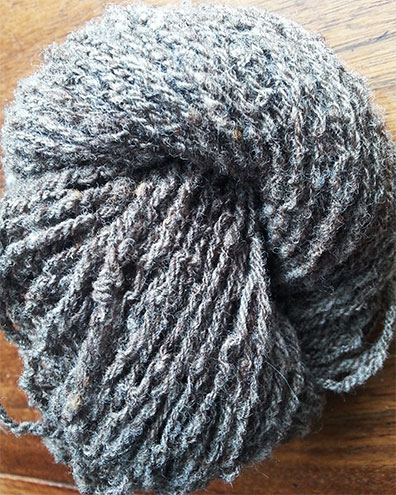
dreadlocks-yarn

So, yeah.

I have no idea what the hell I will do with it, and of course I still have no idea what the hell it is. Wool, sure–but what wool? From where? I still don't recall spinning it. Weird.

And then we have the green merino (it's a bird, it's a plane, etcetera). That's the thing on top in the first photo, with the plate shaped like cabbage.

The green merino (for truth! justice! and the American way!) is resolutely refusing to be photographed from any angle or under any light that does not make it look like first-quality shit. And yet, even if I say it myself, it's not. It looks quite presentable, thank you very much, and I have three bobbins of it.  They are marked to become my first three-ply yarn.

I'll photograph it again this week, when it's plying time. Since it won't be Tour de Fleece photography, strictly speaking, I'll aim to get some beauty shots of it with a better camera under appropriate lighting.

ButnowIhavetogo.

DING!

Wednesday, July 24, 2013

Lush Life

Through no merit of my own, I've been sprawled in the lap of luxury for the past several days. This is one of those spa hotels where the spa is a real spa, not a couple of beige, palm-infested rooms containing a second-rate manicurist and a broken jacuzzi.

The service is polite, prompt, and discreet. The food is excellent. There's an art gallery, a meditation garden, and the floral arrangements are superb.

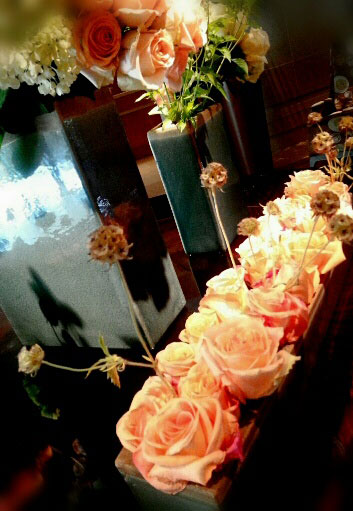
lobby-flowers

The lounge affords a table–I'm sitting at it right now–that's the perfect size and height for work, with a view of the terrace and the little lake.

It would be paradise enow if it weren't for some of the other guests.

Most days I've been surrounded at this table by Ladies Who Lunch, though to be perfectly accurate I should write Ladies Who Drink. Another vodka stinger? Oh, Mister Sondheim–truly, you have no idea. You could float the Queen Mary on the joy juice this lot runs through before noon.

Just now I was unwillingly privy to a trio who were discussing the reasons an applicant to their garden club–newly arrived from another state–would not be admitted. Her sins included wearing the wrong shoes to a party, and using the Latin names for flowers when the conversation turned to gardening.

I'm a raging capitalist, yet I keep drawing little guillotines in the margins of my notebook.

Nevertheless, work progresses. I'm not here to drink and gossip, I'm hear to do what I usually do in the workroom and the coffee shop in a room with live plants, a harpist who takes requests, and what I'm pretty sure is an actual Chihuly.

The Tour de Fleece has ended, but my wrap-up for that will have to wait for my return home since that's where all the stuff is.

But the Victorian bathing drawers are here, and I've reached the point of adding the crochet edging to the leg openings. A glimpse, below.

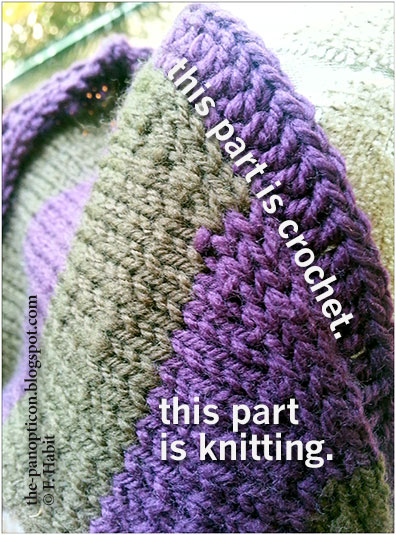
bathing-drawers-crochet-edge

The crochet edge makes perfect sense. The design of this piece attempts in every way possible to combat the inevitable, horrid stretch that will occur when the drawers hit the water; and of course crochet stretches far less than knitting. This also helps to draw in the leg openings a bit and prevent the peekage I was worried about in the last post. Not to mention that it looks good.

Knitting and crochet: perfect together. When I wrote this for the Lion Brand blog I damn well meant it.

I've now been able to do a real fitting of the drawers, and I'll be  if they don't fit well and look rather cute.

No pictures of that just yet. And no pictures of me wearing them until the Nautical Knitting cruise. If you want to see them first, sign up to join Melissa Leapman and me in December...

Thursday, July 18, 2013

Fiber Factory of One

It's a good week when I look at current projects and there's been some progress on most of them.

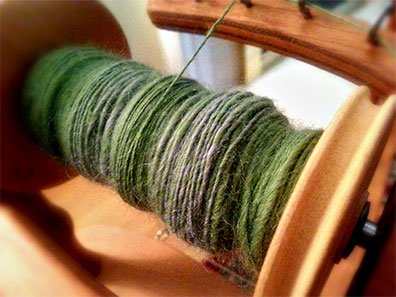
The Tour de Fleece continues, and to my great surprise I've managed so far to meet the challenge of doing something spinning-related every day. After the Corriedale was finished, I dove into the two almost-forgotten tubs of unspun fiber and came up with a bag of green-and-brown roving made from what must be superwash merino, because the little slip in the bag says "100% superwash merino." I have no idea who made it or where it came from. For all I know, it was already in the tub when I bought it.

The lucky thing for me is that the roving is already divided into three equal pieces–and my next challenge is to make my first three-ply. I've been spinning long draw still–not because I think it's necessarily the best way to spin this fiber, but because I am enjoying the sheer hell out of it.

There have been no pictures, because as any Tour de Fleece rider will tell you, pictures of gradually filling bobbins are of only moderate interest to the spinner and hold no thrills for the general public. However, I probably should show you the fiber, shouldn't it?

I just realized forgot to photograph it.

Damn. Next time.

The green merino (that sounds like a niche-market superhero, doesn't it?) is on hold anyhow, because after filling two bobbins I went in search of a third only to discover it was already full of something. I don't know what. Yet there it was, filled with worsted spun...something. Either I spun a bobbin and completely forgot about it or elves have been at work. And, with apologies to my Icelandic friends, I don't believe in elves.

I needed the bobbin, so I pressed pause on the green merino (a sheep who travels around the world preventing ecological disasters?) and decided to chain ply whatever it is just to get rid of it.

chain-plied

I am the first to confess that this is, to put it mildly, an indifferent job of chain plying. I tried and failed to welcome an unforeseen opportunity to brush up an old skill. I rushed, with half my attention on old episodes of Absolutely Fabulous, glancing back at the remainder on the lazy kate every few minutes and thinking, "Dang it, are you still here?"

Old boyfriends reading this will be reminded of the last two hours of any given date with me.

I Swatched a Yarn and I Liked It

Lorna's Laces sent me a nice supply of one of their new yarns, Haymarket, and I'm turning it into a baby sweater pattern/sample piece in aid of my Snip 'n' Zip (Steeks and Zippers) class.

lornaslaces-haymarket

Cannot say enough things about this yarn. It's knitting up very much like Léttlopi (which I used in my Icelandic sweater), but it's extremely soft and feels sweet as it runs through your fingers. The colors, as you would expect, are luscious. It doesn't seem to pill much–what you see above has been knit and raveled six times and carried around in a bag for months. It still looks new.

I've finished the trickiest part–designing the yoke pattern–after only four tries. Put out the flags.

Crotch Shot

And the Victorian bathing drawers for the Nautical Knitting cruise proceed apace. These are gonna be the talk of Belize.

bathing-drawers-middle

Preliminary fittings indicate that the proportions in the original pattern are spot-on. That being said, the fit is startlingly revealing. That's in keeping with period images of this sort of swimwear, but it really hits home when I've got them on. One false step and HELLO EVERYBODY!

The things I do for art.

Thursday, July 11, 2013

I Have Four Conversations with Four Total Strangers About One Piece of Knitting


This is the piece of knitting.

bathingdrawers-firsthalf

Gentleman's Bathing Drawers (c. 1880) in Quince and Co. Chickadee
for the Nautical Knitting Cruise
with Melissa Leapman

First Conversation
Stranger: What are you making?
Franklin: A pair of Victorian bathing drawers.
Stranger: What?

Second Conversation
Stranger: Is that knitting? What are you knitting?
Franklin: A pair of Victorian bathing drawers.
Stranger. Oh. What?

Third Conversation
Stranger: May I ask what you're making?
Franklin: A pair of Victorian bathing drawers.
Stranger: ...

Fourth Conversation
Stranger: Wow, what are you making?
Franklin: A sweater.
Stranger: Cool.

Tuesday, July 09, 2013

I Think I'm Beginning to Love This

It is finished.

skeined-corriedale

Not the Tour de Fleece–that's still going on, and I have to pick the next fiber to spin–but this yarn, this yarn I didn't figure I'd even be able to ply before the race was done, is finished.

As planned, I subjected the Corriedale yarn spun from the Lunabudknits "Smoothie" batt to a wet finishing. While it was still on the niddy-noddy, I secured it with four lease ties to keep it from tangling.

Then I filled the two halves of the kitchen sink with water. On the left, very hot with a bit of wool wash in it (I used Soak). On the right, very cold water, including a couple of ice cubes.

The procedure* was pretty simple.

  1. Put the skein into the hot water and agitate it for a bit–about thirty seconds. I used a big-ass wooden spoon as an agitator.
  2. Pull it out (supporting it carefully–don't let it hang and stretch) and plunge it into the cold water.
Repeat Steps 1 and 2 several times. I think I did five. Maybe six. Keep on eye on the yarn–it'll start to kinda fluff up. When it's fluffed, you're done with the plunging.

Remove the yarn from the cold bath and put it into a waiting towel. Squeeze out the water. You won't get it all out by squeezing, you just want it to not be sopping.

Now, and this is the fun part, grab the skein at one end, swing it forward and THWACK the free end hard against a table or (if you're me) against the (clean) kitchen counter.

Switch ends and THWACK it again.

THWACK several times. You're fulling the woolen-spun yarn–making it rounder and fluffier.

This is exactly as much fun as it sounds.

Don't thwack worsted-spun yarns.

If the yarn is for knitting, after you're done thwacking, lay it flat and let it dry completely.

I was biting my nails to the very end, wondering if the yarn would be balanced. A balanced yarn, to oversimplify, has the same amount of twist in the spinning singles and in the plying. Or at least amounts of twist in each that complement each other.

If you have too much twist in your singles, the finished skein will twist up on itself. If you have too much twist in your plying, the finished skein will twist up on itself.

If you have balanced twist, the finished yarn will hang in a nice, open loop.

balanced-skein

Hot damn.

*Mind you, all I'm just telling you what I did. If you really want to learn how it should be done, go to Alden Amos or Judith MacKenzie McCuin or somebody who actually knows what the hell they're doing, okay? If you ruin your yarn in the finishing, don't come running to me.

Sunday, July 07, 2013

And Then There Was Yarn

I can't stop looking at it.

swift-01

There were a few concerned suggestions that I must not, must not turn the two Corriedale bobbins into a two-ply. The reason? The singles were (thanks to the arrangement of the batt) possessed silky-smooth transitions from the deep purple to paler purple to green, and only a chain/Navajo ply would preserve those transitions in the finished yarn.

I appreciate the concern, but I didn't want to chain ply. As I explained in the previous entry, chain plying is the only sort of plying I've ever done. Joining the Tour de Fleece isn't about doing what I've already done, it's about trying as many new things as I possibly can.

Plying happened a day later than planned. I sat down to work on schedule, but then–as might happen in the real race–I immediately got a flat. The little dome-shaped wooden whatsit at the orifice end of my flyer came unglued. Not that I should be surprised–this wheel is probably a year or two older than I, and bits of me have also started coming unglued.

The mend was easy, but I am my father's son and you do not fiddle around with a glued join until the glue is completely dry. That's a lesson from day one of Making Stuff in the Garage with Dad class.

Twenty-four hours later I tried again. My guiding lights–Alden Amos's Big Book of Handspinning and The Intentional Spinner by Judith MacKenzie McCuin–were once again enormously helpful. I like to see what Alden says, compare it to what Judith says, then lay out a battle plan.

Both advise that the set-up for plying ought to allow for plenty of room between the bobbin rack (in my case, a Lendrum lazy kate from The Fold, in Marengo, Illinois–contender for Best Spinning Shop in North America), the spinner's hands, and the orifice.

Plenty of room, for me, meant seven feet from the lazy kate to my hands, and about 18 inches from my hands to the wheel. That is the utmost my apartment will accommodate without removing all the furniture from the room.

Before beginning, I made a general announcement that the strands being plied were not to be used as a jump rope,  clothesline, limbo stick, or tripwire.  Then I posted Harry as guard, which gave him an excuse to wear the butch little "SECURITY" ball band he wore while working the door at the Yarn Pride dance this year. So everyone was happy.

The long, long set-up allows the twists in the singles to re-distribute themselves as they approach the wheel. It helps even things out, said the experts–and it certainly seems to have worked. My singles didn't magically morph into perfection, but the tighter kinks that had me worried did vanish. That was magic enough for me.

Alden's method for holding the yarns seemed more straightforward (if you want to know about it, get the book–it's worth it), so I went with that. Judith's description of the actual hand motions (in which the hand nearer the orifice moves and the other hand does not) made more sense, so I went with that. I also liked her take on counting while you draft (yes, you should–at least at first).

Here's how I counted. This will be of no use to anyone except me, next time I need to remember what I did.
One: Treadle. (Orifice hand holds back the twist.)
Two: Treadle. (Orifice hand holds back the twist.)
Three: Treadle and release twist into the strand.
Four: Treadle and feed the plied yarn to the wheel.
Repeat.

I started slowly and focused on the counting and on spinning the wheel counterclockwise rather than clockwise. When that was going well I added in Alden's "rolling release" (again, see the book) which does, in fact, seem to help smooth the plying twist.

Much more quickly than expected, I had this.

full-bobbin-tdf-13

Not perfect. Not even close. But it is plied.
 
I confess that I carried the bobbin around like a teddy bear so I could turn it over in my hands and just look at it. It may have spent the night on my nightstand, but you'll never know.

Then, today, I wound it off to the niddy-noddy. As with plying, I made sure to keep a good distance between myself and the flyer–another chance for the twist to even itself out.

swift-02

This niddy-noddy was hand-turned. I got it (on the same day as the the lazy kate) at The Fold. If you've never been The Fold, you need to put it on your life list. Toni should be sent on an all-expenses-paid world tour so everyone can see what the owner of a fiber business ought to be.

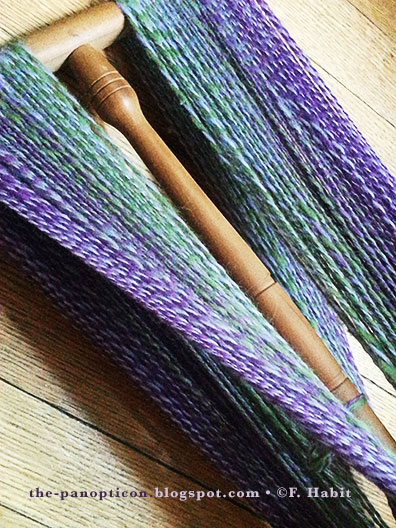
As I write, the yarn is still on the niddy-noddy awaiting lease ties (the little strands that keep it from tangling) because, as I said before, I can't stop looking at it. I'm mesmerized by what the colors in the original batt did when I plied them together. It's barber pole all the way, but echoes of the original transitions persist.

I want to order another "Smoothie" from Lunabudknits, spin the colors in a different order, and see what happens with those.

But first, this lot has to been skeined and then wet finished. More after that's complete...

Friday, July 05, 2013

Faster Than a Speeding Pullet

I was told that once I started to get the hang of woolen long draw, I'd find it somewhat faster than the worsted technique I've always used before–a technique so slow it is not infrequently referred to as the "inchworm" method.

You who said this to me, you were not kidding.

When I first got the Ashford and was all gung-ho about spinning, I was content to do it two or three hours a night, every night. That investment of time–once I got up to speed–yielded one small bobbin of thin singles in three months.

Three months. You can gestate one-third of a human baby in three months.

And when I was finished, what did I have? One bobbin of singles. A small bobbin. Do you know what you can knit with one bobbin of thin singles? Bugger all, is what you can knit. Which is why most basic spinning books have a section called, "Yes! You Can Knit with Singles!" It's there to keep you from killing yourself.

So you read "Yes! You Can Knit with Singles!". You look at the pictures of the, um, "arty" suggested projects. And you say to yourself, "Yes! I can knit with singles! But I'm certainly not going to!"

What I did instead was chain-ply my singles. Chain plying (which you'll also find referred to as Navajo plying) allows you to make a three-ply yarn from one bobbin of singles. It's supposed to be terribly advanced and tricky; but nobody told me that, so I was able to do it without much fuss.

I had enough finished yarn to make a small hat. I did. It was an okay hat.

Then I had an empty bobbin again. I started spinning again. But not as frequently. I was discouraged. It took me a year to fill the bobbin. I'm not an adrenaline junkie, and I don't knit in the first place because I get kick out of instant gratification. But I realized that it if I wanted to spin enough two-play yarn for a pair of mittens I was looking at a year (at least) of dedicated, nightly spinning.

I began to wonder what my wheel would look like if I converted it into a planter.

Then I just stopped spinning.

All of the above is just prelude to help you understand the blinking stupefaction I experienced last night when I realized I had spun the entire batt. I honestly figured the Tour de Fleece might give me enough oomph to get through half of it in a month. Instead, we're on Day Six and I am finished with Stage One of the spinning.

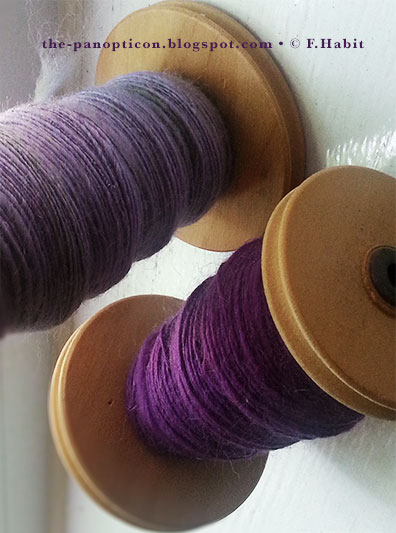
I have two bobbins, not full but fullish, roughly evenly. Look.

tdf-lunabud-bobbins

So, yeah. Long draw is somewhat faster than inchworm. Also, e-mail is somewhat faster than learning ancient Greek, using it to write a letter to your mother, stuffing the letter in a bottle, pitching the bottle into the ocean, hoping the bottle will wash up next to your mother's beach chair, and then remembering your mother can't read Greek.

And now, at last, I can try my hand at a two-ply. That's today's challenge.

Bathing Drawers News

The yarn for the Victorian bathing drawers that I'll unveil (for better or worse) on the Nautical Knitting Cruise arrived this morning.

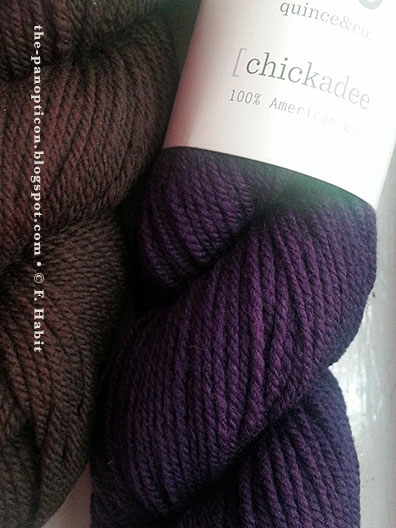
It's Quince and Co. Chickadee–stout, pure American wool, worsted spun. (I love worsted spun yarns, if someone else is doing the spinning.) I haven't wound it into balls yet. I'm just staring at it. It's perfect. I would use unaltered hanks of Chickadee to decorate the Christmas tree or the top of my wedding cake.

chickadee-skeins

The colors are "Bark" and "Frank's Plum." I've decided to take the advice of the original pattern and jazz up the drawers with stripes–but not the Weldon's editor's suggestion of white and navy. For one thing, I fear the white will turn transparent when wet and stretched. For another, my curvaceous posterior does not require assistance from broad, high-contrast stripes. From behind, I would look like a crosswalk. As you can see, these two colors are very similar in value, so the effect will be extremely muted.

I was tempted to go with a somewhat lighter brown, called "Twig," so that I could say I knit myself a pair of drawers in "twig" and "plum."

Giggle.

Tuesday, July 02, 2013

Woolly Pully

The bathing drawers yarn is still in transit. I'm so excited about it that I've begun to palpitate slightly at the sight of delivery vans. Is my yarn in that one? It could be! Is it? No? Well, what about that one? Is that one for me? No? Yes? No?

This must be what a labrador retriever feels like every day.

I'm turning out a pattern, three articles, and two illustrations that have somehow all ended up with the same deadline; but a boy must take occasional breaks, and when I get one I've been spinning.

The Tour de Fleece 2013 is now well under way. After the angst of my bumbling beginning, I find to my surprise that I'm starting to enjoy myself.

Before I write about that, though, I want to meditate for a moment on the angst.

Let's be honest: Until you know what you're doing, spinning can be a rollercoaster to Hell. In knitting and crochet, you work one stitch at a time at your own pace. A novice knitter might spend an hour creeping across a row of twenty stitches, but he'll get there and nobody will know the difference.

Spinning, even when you're learning by way of park-and-draft, requires a certain minimum momentum. You nudge the treadle, the whorl goes round, and suddenly the twist starts to fly up your fiber like a zombie chasing a plump child dipped in butter. You either keep up, or you don't. At the beginning, more often than not you don't.

For me, this does not feel okay.

I can't tell you why I feel this way, or what's responsible for the feeling; but from very early childhood I've felt compelled to conquer every new challenge immediately and with minimal assistance. What's more, I've needed to not only pass but to pass with flying colors. When I don't the guilt is overwhelming.

This is not necessarily a bad thing. Without the desire to excel, it's easy to go nowhere and do nothing with your life. I'm not a fan of the current fashion for always telling children, "You did your best, and that's good enough." No, sometimes it's not good enough and you need to try harder. Life won't hand you a trophy just for showing up, and neither should the Little League.

On the other hand, the crying need for instant mastery has kept me from taking a lot of leaps that, in retrospect, might have led to adventure, joy, and prosperity. The funny thing about fear of failure is that it can keep you from trying anything–which ultimately leads to failure.

That's why my Tour de Fleece nearly ended before it began, after I wrecked  a twentieth of an ounce of Corriedale.

I've never spun from a batt before and I've never, ever spun with fiber as gorgeous as my Lunabudknits batt. You know what's especially horrible? I have a large bin in the workroom filled entirely with spinning fiber, and most of it is gorgeous. Fiber artists have been more than generous to me–there's silk, cormo, wool, bison, and blends thereof, heaps of it. Mostly gifts. All unspun. Unspun because I have been terrified of messing it up.

Until I know how to spin well, I'm almost certainly going to mess it up. But I can't learn to spin well without first spinning badly.

You see my difficulty?

Perhaps it sounds familiar?

Progress

With your encouragement, however (for which I thank you) I have pressed forward. When I first got a spinning wheel I went slightly bananas with the book buying, so I have been consulting a three-foot stack of spinning books (good, bad, and indifferent) on the proper technique for woolen long draw.

Of course there are now also videos (good, bad, and indifferent) to be found online, and those have been enormously helpful.

My favorite piece of advice, commonly offered by all sources, is to handle the unspun fiber as though it were a little bird. Which it turns out does not mean you scream, "Auuughhhh, yuck! Is that a bird? What the hell is a bird doing in the house? Does this thing have fleas?" and drop it like it's hot.

Frankly, that's what I'd do if somebody stuck a little bird in my hand.

The beginning of my bobbin looks like utter poo, but it's gradually disappearing beneath layers of better and better woolen drafting. Gloria in excelsis deo.

bobbin-day-two

The first moment that I was able to treadle and simultaneously draft against the encroaching twist was a big moment for me; a "eureka" moment in which I actually shouted, "Eureka!"

Because my twist may not yet be consistent, but my pomposity is.

Here's a picture of me spinning, as proof that I am not having Dolores do all the work. (It was enough of a strain for her to take the picture.)

spinning-day-two

Sunday, June 30, 2013

Tour de Fears 2013

I live with two spinning wheels, but I live with them in the way that I once lived with an empty-headed, perky-nippled go-go boy. He had his space, I had mine. No touching.

The difference is that I would like to spend more time with the wheels. I have spun on them and enjoyed it. I was given some merino roving and turned it, ultimately, into a decent hat. Here's what I did: I spun one bobbin of singles and chain-plied it. Chain plying allows you to turn one spun strand into a three-ply yarn. I was too lazy to spin two more bobbins to get a three-ply. I didn't know at the time that chain plying is supposed to be scary and difficult, so it wasn't.

Then came a dormant period, during which work picked up and spinning receded to the deep background. People would ask, as they do in this business, whether I was a spinner. "Yeah," I would say. "Kinda."

I became kinda a spinner the way I am kinda a go-go boy, which is to say not at all any more.

Then along came the Tour de Fleece, one of those lovely grass-roots events that has become possible in our electronically interconnected age. The idea is this: You set yourself a spinning goal, and you spin every day that the Tour de France bicycle race is racing. When the cyclists have a day off, so do you. You don't have to spin during every minute of the race, just every day. What you try to do with your tour is up to you. You could aim for endurance, production, skill building–it matters not. It's a self-guided tour.

I "did" the Tour de Fleece a couple of years ago. Kinda. What I did was decide that the partial bobbin on the wheel, which had been sitting there for eighteen months, was bugging me. So I took it off the flyer and stuck it on the bobbin rack. Then I had a glass of champagne.

Even without the half-empty bobbin the wheel continued to bug me. It sits in the dining room, and I pass it many times a day.

Then my friend greensideknits sent me note via Twitter (hi, I'm @franklinhabit) that the Ravelry fan group devoted to the BBC radio serial The Archers was forming a Tour de Fleece team. This is the team badge.

8952666949_acce72402b_o

I never miss The Archers and I love that badge. The Latin motto translates to "Yeah, whatevs." Which has basically my attitude to spinning during the recent fallow period.

So I signed up.

The Tour started yesterday. I was ready. I had procured a batt of Corriedale from one of my favorite dyers, Lunabudknits. It's from her "Smoothie" line.

batt-rolled

Unfurled it looked even better. Almost too pretty to tamper with.

batt-unrolled

But I tampered.

I began spinning it the only way I know how: with a worsted short draw. I made a sample, as Judith MacKenzie McCuin (in The Intentional Spinner) advises. I was not pleased with the results. Wiry, hard. Nasty to touch. Off the bobbin they came.

snarled-singles

There is no point in spending a month spinning yarn you don't like.

So after Day One of the tour, I have changed course. I have decided that rather than the ho-hum goal of taking something pretty that is not yarn and making it into pretty yarn, I will instead pursue what is, to me, the frightening goal of using very, very good fiber to learn a new technique: woolen long draw.

In one day, this has unearthed a small mountain of deep-seated issues related to feelings of guilt, anxiety, unworthiness, inhibition, and perfectionism. If that sounds highly unpleasant, it is. But I'm staying on the wheel, because I think I may end up getting far more out of Tour de Fleece 2013 than I bargained for. Even if I don't end up with any yarn.

More about that tomorrow. Gotta spin.

Wait...One More Thing

Brief bathing drawers update. I found the perfect yarn and it's on the way. More on that when it arrives.

Wait...One Other Thing

Spinning celeb Jacey Boggs has launched a new magazine, Ply. The first issue is just out and is apparently selling like mad. It's an awfully good magazine. I have a regular cartoon feature in it.

We call this "irony."

Tuesday, June 25, 2013

Getting Deeper Into My Drawers

My life, it sure is hot stuff.

In case you missed the previous installment, I'm setting out to knit myself a pair of late nineteenth-century gentlemen's bathing drawers whether you like it or not.
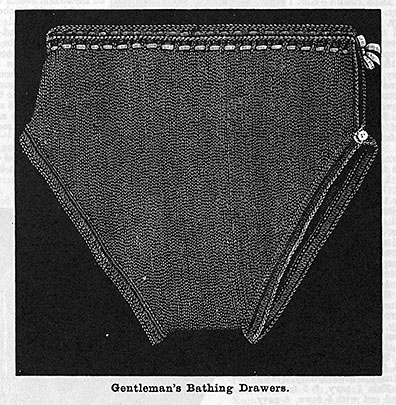
bathingdrawers

It's a bit of advance fun for this: a Nautical Knitting Caribbean cruise with Melissa Leapman. Melissa has caught the fever and is pelting me with illustrations and photographs of vintage knitted suits, though none quite so old as my intended.

We're having such a good time that we've decided to make this a challenge for all the cruisers. (If you're not yet on the passenger list, the link above will tell you how to become one.)

If you're one of the happy souls who will be sailing with us in December, knit or crochet yourself a piece of cruise wear. It can be any sort of cruise wear–not necessarily a bathing suit.

We're easy–it can be a cover-up for over your bathing suit, something to lounge in on deck, something to wear that's got a nautical theme to it. And we're going to award prizes.

Here in the workroom, I have been puzzling over what level of historical accuracy is called for with this piece. Chief among my concerns is the choice of fiber, which at the time would have been wool. Period. Until the arrival of springy, waterproof artificial fibers, most bathing costumes were made of wool–knitted or not.

It was the best choice–but that doesn't mean it worked perfectly.

Since I announced this project, I've been deluged with tragic tales of wool bathing suits. They sag. They itch. They fill up with sand. They refuse to dry out. They were replaced by synthetic suits quickly, completely, and for good reason.

In 2013, wool's not my only option. I could, for example, choose a yarn like Cascade Fixation that blends cotton and elastic. With elastic, I might create a suit that won't sag to my knees and expose my goodies the minute it hits the pool.

But it won't be a Victorian suit. It won't even be close.

The point of this, and there is one, is that I want to experience an original suit as nearly as possible, and that means wool. Furthermore: unlined wool. If I find the knitting of this suit is enjoyable, and decide to knit another, I'll see about trying something more modern next time.

With that question settled, I had to determine what weight of yarn to use. Nobody carries the "Baldwin and Walker's super fingering" the pattern specifies. Ain't it always the way? You pick out the pattern and find the yarn is discontinued.

I thought I'd write here about how I've determined what yarn to use, but with a caveat: mine is not a nice, tidy, organized brain. I seldom go from Point A to Point Z in a line of reasoning without detours and switchbacks. I thought about trying to make it seem otherwise, for pedagogical purposes, but I realized very quickly that worrying too much lately about making these entries polished and pretty is the number one reason you haven't heard from me.

So if you want more, and you seem too, I'm afraid you'll have to put up with the eccentric paths my projects always take.

I didn't know much about the yarn, but I did have a needle size: seven. Remember, of course, that we're talking about a British publication from before the turn of the twentieth century–so their seven is unlikely to be anything like a modern US seven.

However, I own three English needle gauges contemporary with the pattern. I checked out what a seven meant at the time–roughly, a modern 5 or 6. Roughly, because when an old size corresponds exactly to a modern size you may count yourself fortunate.

With a five or six, what sort of yarn would I need to produce a fabric that looks akin to what's shown in the engraving?

Also, with a five or six, what yarn would give me a garment of approximately the correct size?

We can only guess at the size the Weldon's suit came out, because the editors only tell us this:

For a medium, cast on 96 stitches.

That cast on is at the waist. How far around do those 96 stitches have to go? Halfway. I know this because I sat down and worked the pattern in my head, start to finish, scribbling an annotated schematic as I went. Here it is.
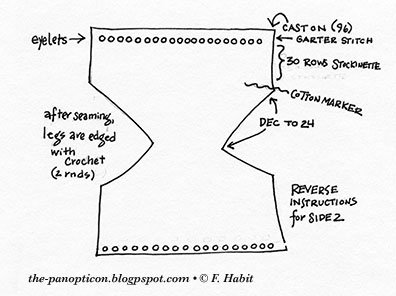
bathingdrawers-schematic

Not exactly complicated shaping, which I appreciate.

So for a men's medium, we need 192 stitches to wrap around the medium waist. We don't know how big the waist is, as there's no measurement given for that designation. Anywhere. Ever. Nor do they give us a desired gauge–they never do. The earliest mention of specific gauge I've ever run across was from the 1930s.

Let's say, for the sake of argument, that a medium waist was considered 32 inches. You have to start somewhere. That's a medium waist in modern men's clothing construction, though more often than not it'll be vanity sized as a 30 or even a 29 waist. (Men: If you haven't actually measured your waist lately and think the number on your Levi's tag is your true measure, you're in for a nasty shock.)

And yes, yes, yes, "people were smaller in those days." Smaller, yes. What they were not, in general, is miniature. The amount of growth from then to now is often greatly exaggerated. Judging from extant examples of men's fitted garments and tailor's drafts, a waist of 32 inches would not have been either very large or very small. It would have been sorta average. You know, medium.

192 stitches divided by 32 inches equals...six stitches per inch.

Six stitches per inch is a little large for a yarn designated as "fingering," but this yarn was called "fingering" more than a century ago. Definitions change. And as you know if you've been knitting longer than a week, even now they frequently mean nothing.

A quick check of my trusty 1882 Dictionary of Needlework reveals an entry about "fingering" that confirms this was a stocking-weight yarn. Okay, fine. We recall that our particular defunct yarn was actually called "super fingering." Super, at the time, was often a designation meaning "more" or "larger." It's not out of the question, in fact it seems likely, that Baldwin and Walker were producing a yarn that was kinda like fingering, but fatter. I would have called it Baldwin and Walker's Fat Fingering, but they didn't consult me.

Here's where things get confusing. I have been able to establish with reasonable certainty the size of the needle–at smallest, a size five. A modern heavy fingering knit with a size five, even in the hands of knitter so uptight that he bends steel needles like marzipan, is going to produce loose fabric.

Loose fabric is not what is shown in the engraving, loose fabric is not theoretically desirable unless one is a late-Victorian flasher (and one is not), loose fabric is certainly not advisable in a garment that we know is going to stretch like mad anyhow.

This is where I decided to stop thinking and start knitting. With a size six needle, what would I get if started knitting with, say, a light worsted-weight wool? As luck would have it, I had some in stash.

I got a loose fabric of five stitches to the inch. Too big for the medium-sized suit, and positively transparent with even a little stretching.

So I went down a needle size, to our other possibility, a size five. I got a noticeably firmer fabric, and a gauge of five-and-a-half stitches to the inch.

I am a loose knitter. When looking to achieve the suggested gauge for a pattern, I usually go down a needle size. So I did.

I got six stitches to the inch and a very, very firm fabric. Still supple enough to wear comfortably (comfort being relative, of course) but not droopy.

Bingo.

If I go by needle size, the yarn I need ought to be worsted or perhaps sport weight. Any lighter, and I'll have to significantly reduce the needle size or face the possibility of indecent exposure the minute I put the drawers on. I can only assume that the super fingering was fat enough to qualify, in our time, as a sport weight. Either that, or
  • the Weldon's sample knitter had the tightest tension ever recorded;
  • the pattern gives an incorrect needle size;
  • or all three of my needle gauges, one of which is identical to the model printed in an earlier issue of Weldon's, are incredibly wrong.
Still with me?

And Finally (For Now)

Some of you were rather insistent that these could not have been meant as drawers for swimming. They're too revealing, you said. They must have been made to wear under a swimsuit or to wear while you were being bathed (as in, given a bath) by a servant, for reasons of modesty. No Victorian would ever have worn these alone to swim, it was suggested, because they didn't cover the swimmer from neck to knee.

Well, no. These were meant for swimming. I was planning to post this link to the Brighton Swim Club by way of illustration,* and was amused to see that commenter "Backyard Notes" beat me to it. We have some peculiar, popular misconceptions about "the Victorians" these days, often quickly dispelled by a look at the historic record.

These may not have been intended for mixed sea or pool bathing (you don't see any women in the Brighton group photo), but they certainly weren't for the bathroom.

Weldon's was a magazine for the middle class, not for the upper crust. It may seem in our servantless era that having a live-in maid must have made you superfancy; but it didn't. It made you solidly middle class. To retain a valet or gentleman's gentleman, you'd have needed a level of income above that. Your wife and daughters might have knit, but they probably didn't look to Weldon's for practical knitting patterns.

Only an odd and anomalous nineteenth-century man who would have put on knitted drawers so his valet could wash him.

That level of attendance would, in the first place, have been unusual. A servant (most likely not the valet, but a scullery maid or housemaid with access to the boiling water) might have filled the bath, if the house were not equipped with running water or fitted bathtubs. He might have attended the bath, in the sense of being ready, nearby, with a towel and dressing gown.

The valet might well have shaved the gentleman. Not uncommon.

But, if everything I've read is true, the valet would not have flung around the soap and cloth unless his employer were very young, very elderly, or very infirm.

Moreover, by definition a personal servant saw you at your worst and at your most naked/vulnerable. They laid out your clothes. They got you into and out of them. They packed and unpacked your cases, handled your jewels and watches, and in some instances assisted in your extra-marital (or pre-marital) philandering. You would not knit and wear special underwear to keep your valet from seeing your winkie unless you were a decidedly odd fellow indeed.

And listen, I know from odd. I'm knitting a damned pair of bathing drawers.

*Note to self: Must buy top hat.

Tuesday, June 18, 2013

I Will If I Wanna

And we're back.

And you won't believe what I want to make. Let me show you the engraving.

Yes, engraving. Because you know how I am.

bathingdrawers

Gentleman's Bathing Drawers, as offered by Weldon's Practical Knitter in the 1880s/1890s.

You may well ask what I'm going to need these for. For bathing, silly. Specifically for bathing on the "Nautical Knitting" cruise with Melissa Leapman aboard the Royal Caribbean Liberty of the Seas in December. We leave from Ft. Lauderdale, and stop in Belize and Cozumel. There will be lots of water in between.
(Booking is going on now–more details are here.)

You can't very well go to the Caribbean in December on a boat with ten swimming pools and not have a pair of bathing drawers.

I've had little fond silent dreams of knitting my own swimming costume since the first time I saw one. I think it was in Rutt's A History of Hand Knitting. Or maybe not.

I haven't said much about that particular fond silent dream because people don't take it too well when you say you plan to knit something and then wear it into the water. They don't give you the ol' thumbs up and shout, "Godspeed, you crazy bastard!"

They act, instead, as though you've just announced that you intend to row across the Atlantic Ocean in a teaspoon, or shoot an apple off the cat's head with a BB gun, or watch Keeping Up with the Kardashians un-ironically.

It will itch! they cry.

It will sag! they cry.

You will look stupid! they cry.

You will waste time! they especially cry.

Allow me to address these questions one at a time.

1. I know.

2. I know.

3. Have you seen me?

4. I'm a man who knits lace shawls. Tell me more about this "wasting time."

I'm going to knit them because I wanna see what they're like. If they're terrible to wear, I want to know that for myself. I want to put myself into not the shoes, but the drawers, of a man of the 1890s who didn't have the luxury of going to Mister Fred's Sassy Swimwear and Video Salon on Halsted Street and picking up lycra shorts in a retro palm print. I expect to learn something–both about history and about garment construction–and if that's wasting time, well, that's how I most love to waste my time.

Will I regret it? Possibly. Especially since Melissa is insisting that she be allowed to photograph me modeling them for the knitters on the cruise.

So yeah, I may regret that; but you may regret it more.

We'll see.

Meanwhile, Mittens

The new Knitty is up (First Fall 2012) and for the first time, my "Stitches in Time" column features a new pattern instead of a translated antique or vintage pattern. It's for mittens, but the mittens do have one historical tie–the use of nineteenth century French embroidery charts to create the floral motifs on the hand and thumb gussets.

sajou-mittens-front-back

Because I am so very, very tired of winter gear with snowflakes on it. Florals in spring are a cliché. Florals in February, less so.

The yarn is Zitron Lifestyle from Skacel. I seem to have become slightly obsessed with it. I used it for these, for all the demonstration pieces in my "Heirloom Lace Edgings" Craftsy class, for this new design...

pleasant-morning-web-shot

The Pleasant Morning Baby Bonnet

...and for one more design that's coming out in an e-book about which I shall yell and scream when the appropriate time comes.