Thursday, February 28, 2013

For the Sheer Hell of It

When I mentioned the ship Lurline after writing about the edging "Lurline" I did not expect to get multiple, thrilling comments from readers who had sailed on the ship; or had seen the ship in its prime, or who had relations who'd sailed on the ship; or who actually knew a Lurline who was directly descended from the Lurline who had given her name to the ship. And, fine, yes, I will be learning to play the goopy sweet song about finding love on the Lurline on my ukulele.  I eat that sort of thing up with a spoon, you know I do.

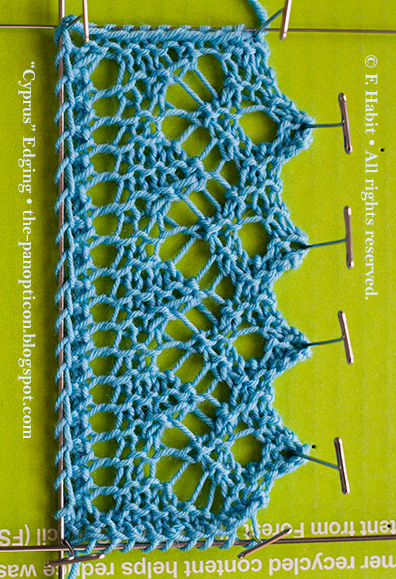
Here, just for kicks, is another nineteenth century edging from Weldon's Practical Knitter (Fourteenth Series). It's called "Cyprus."

cyprus-edging

Not so unusual as "Lurline," but handsome and easily memorized. Like "Lurline," this edge is worked in garter stitch so it doesn't curl. It's heading for not one, but two upcoming projects I am otherwise not supposed to talk about right now.

Notes:
yo2. Double yarn over–yarn wraps twice around right needle.
sl 1. Slip stitch as if to purl, with yarn in front.

Pattern:
CO 12 stitches. K 1 row.

Row 1. Sl 1, k5, k2tog, yo, k1, k2tog, k1.
Row 2. K4, yo, k2tog, k2, yo, k2tog, k1.
Row 3. Sl 1, k3, k2tog, yo, k1, k2tog, k2.
Row 4. K7, yo, k2tog, k1.
Row 5. Sl 1, k4, yo, k2tog, k1, yo2, k2.
Row 6. K3, p1 (2nd wrap of yo2), k2, yo, k3, yo, k2tog, k1.
Row 7. Sl 1, k6, yo, k2tog, k4.
Row 8. BO 2, k2, yo, k5, yo, k2tog, k1.

Repeat from Row 1 as needed.

The yarn, by the way, is Zitron Lifestyle from Skacel. I have fallen deeply in love with it. It's wool, it's superwash, it's lightweight, and it has so much spring that if I'd been in charge of branding at the Zitron mill I would have called it BOING. An absolute joy to handle.

Today is a bit overscheduled, so I must dash, but if you want more of me I just did an interview for the gorgeous people at Squam Art Workshops. Oh my yes, I will teaching at Squam again this year. I guess they took me seriously when I said if they didn't invite me back I was going to sneak in anyway, sleep in a tree, and eat moss.

Tuesday, February 26, 2013

The Joy of Edging

It's no secret that I love edging. I could edge for hours. Hell, I teach classes about edging. If you want to edge, I'm your guy.

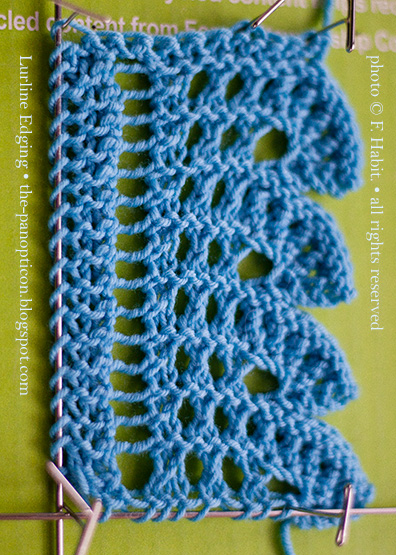
Here's one I've enjoyed particularly. In fact, it made me giggle. Sturdy little thing, suitable for blankets and bedspreads. It's from the Fourth Series of Weldon's Practical Knitter (1880s) and it's called "Lurline."*


lurline-edge


Notes:
yo2. Double yarn over–yarn wraps twice around right needle.
sl 1. Slip stitch as if to purl, with yarn in front.

Pattern:
CO 14 sts. K 1 row.
Row 1. Sl 1, k1, k2tog, yo2, k2tog, k1, yo, k2tog, yo, k2tog, co 4, k2tog, k1.
Row 2. K13, p1 (first wrap of yo2), k3.
Row 3. Sl 1, k1, k2tog, yo2, k2tog, k5, k1 and p1 into each of next 4 sts, k2.
Row 4. K17, p1 (first wrap of yo2), k3.
Row 5. Sl 1,k1, k2tog, yo2, k2tog, k1, (yo, k2tog) 6x, yo, k2.
Row 6. K18, p1 (first wrap of yo2), k3.
Row 7. Sl 1, k1, k2tog, yo2, k2tog, k16.
Row 8. BO 8, k9, p1 (first wrap of yo2), k3.

Repeat as needed from Row 1.

You may have noticed that it's pinned out on the top of a cardboard paper box. I do that all the time. Then the piece is easily shuffled around–this is a small workroom–and I don't have to worry about stepping on pieces while they dry.

Rough Neck Sweater Progress

I'm well into the collar on the Rough Neck sweater. I do believe the structure is making sense and will work–although the instructions present one of those obstacles that you find fairly often in old patterns. It's not an error, exactly–just a lack of perfect clarity. Suffice it to say that if I hadn't already gathered that the entire collar is double-thick, and then confirmed my hunch thanks to a phrase referring to the finishing of the front bands, I'd be in for a helluva lot of ripping.

I would show you photographs if the sweater didn't defy clear shooting at this point. No matter what I do, all it looks like is a mass of stockinette shooting out incomprehensibly in three directions. Once I've finished the collar, I'll see what I can do by way of an update.

*I'll forever associate that name with Matson Navigation, whose ships I helped to load and unload in Honolulu during a summer job as a stevedoring clerk. The Lurline (named after a lady of the Matson family) was one of the line's signature vessels–a pretty little ship that had once carried passengers from California to Hawaii and back, but after the advent of jet travel had been gutted and turned into a cargo ship. Pity.

Saturday, February 23, 2013

The Child Is the Father of the Man

I've been ruthlessly clearing out boxes and bins for the past several months. I don't wonder why.

In August, after my grandmother died, we discovered that for years she had been treating her tiny house as a four-roomed, three-dimensional game of Tetris. Every inch of every closet, drawer, and cupboard was packed, neatly, top to bottom and back to front.

We–four adults–began our cleaning out by emptying closets. There were three. At the end of two days, we still hadn't got to the back of all of them.

The things we found. Oh, the things. My grandmother, proud daughter of the Great Depression, had learned early to never throw anything out because one day you might need it.

A bag of margarine tub lids (just the lids).

Eighty-three representations of the Virgin Mary in materials ranging from plaster to crochet

All the receipts for repairs to a car (I think it was a DeSoto) that probably made its last trip to the grocery store in 1962.

All of her pay stubs, from the 1940s to the day she retired.

A tea kettle with a burnt bottom. A roasting pan with a burnt bottom. A lid for a pot that disappeared, but which might fit another pot.

Thousands of zippers and buttons collected during eight decades of work as a seamstress and tailor.

Her prayer books. Her late son's prayer books. Her late mother's prayer books. Her late brother's prayer books. My grandmother was a religious woman, devoutly Catholic, and so when people died and left behind devotional paraphernalia, people said, "We should give this to Pauline." And my grandmother was certainly not going to chuck a crucifix, a Missal, or a guidebook to apparitions of the Blessed Mother in the trash.

It makes you think, seeing all that left behind. Some of it, I'm happy she saved. The trunk my great-grandfather (her father) brought with him as an immigrant in 1903 is here with me now, holding a heap of my knitted samples. It's a nice thing to have.

Other stuff, we groaned over. Why did you save this? Why? And off it went to the dump or St. Vincent de Paul or the scrapyard.

Back at home, I looked around and felt like opening the front door to the general public and screaming COME AND GET IT! I started asking myself, Why did you save this? Why?

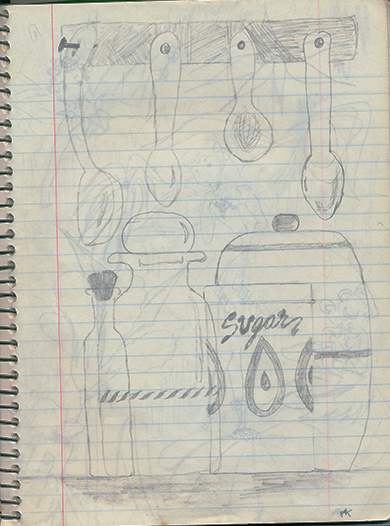
One of the surprises I unearthed was a beat-up five-subject spiral notebook. Two hundred sheets, green cover. An old sketchbook, though with more than sketches inside. I date it to the year I would have been about ten, maybe eleven.

I found a Christmas list inside (I wanted Trivial Pursuit?), the recipe for my Italian grandmother's cookies, the start of a dreadful mystery novel (stolen diamonds), and lots and lots and lots and lots and lots of drawings.

I have to laugh. In this neighborhood, at this time, any kid who shows the slightest inclination to draw or paint is immediately presented with a plein-air easel, a set of oil paints, a tray of watercolors, a personal tutor kidnapped from a picturesque street corner in Montmartre, an agent, and a gallery show.

I drew on lined notebook paper with...whatever. Appears to be mostly Number Two pencils,* which seems about right. Art supplies cost money, and I didn't have any. And my art lessons consisted entirely of checking out art books from the base library and making freehand copies of stuff I liked.

What I drew made me laugh even harder. Looking at these pages, I wonder if I've changed fundamentally at all in the intervening thirty years.

Vaguely nineteenth-century still lifes, mainly domestic, mainly culinary. Our kitchen never looked like this. I just wanted it to. I'd still like it to. (It still doesn't.)

sketchbook-jars

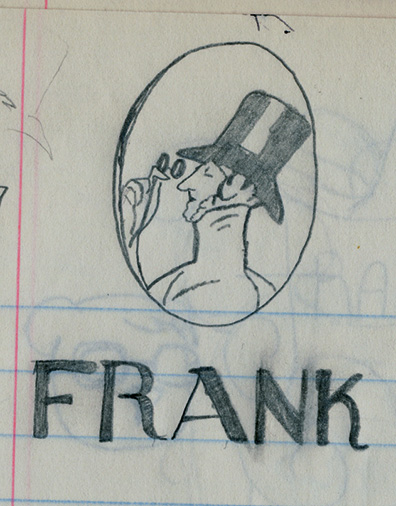
An obsession with Toulouse-Lautrec–again, the nineteenth century, writ large.

lautrec-03

lautrec-02

lautrec-01

I already saw New York City as the Great Elsewhere–more chic, witty, urbane, and exciting than wherever we happened to be stuck.

new-yorker

I didn't understand half of what I read, but I forced myself to plow through everything in The New Yorker from "Talk of the Town" to the back page with the hope that one day it would all make sense. (It did.)

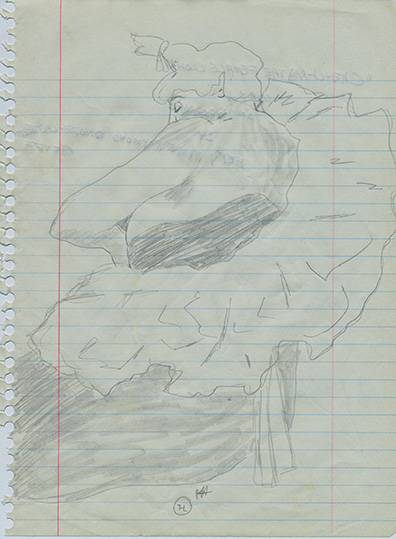
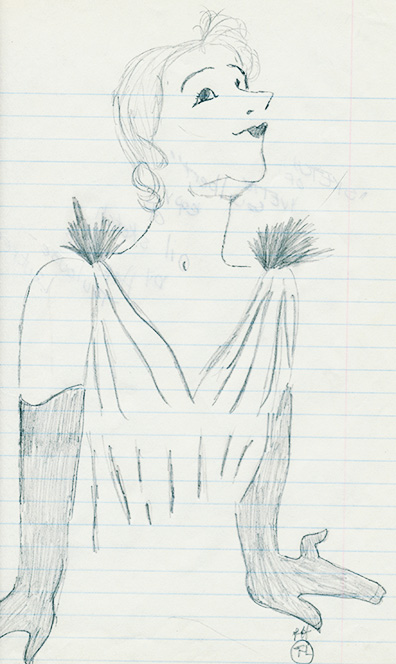
And costumes. Oh, costumes. Pages and pages and pages and pages of bustles, crinolines, lace collars, drapery, trains, capes, tiaras, gloves. I looked at Tintoretto's take on St. George and the Dragon and ignored both the saint and the dragon. What caught me was the fancy chick in the foreground.

tintoretto

I just looked at the original painting again and what gets me now is the muscular nude male in the middle ground. I'm sure I must have noticed him at the time, but I had separate notebook (now long gone) for those sorts of drawings.

I'm not keeping the sketchbook. In fact, by the time you read this, it'll be gone. But it was fun to look it over one last time and see how far I have, and haven't, come.

*Young readers, Google it if you need to. Number two pencils are what we used to use for making erasble marks on paper. There was erasable ink, for a little while, but it never caught on.

Thursday, February 21, 2013

One Plain, One Fancy

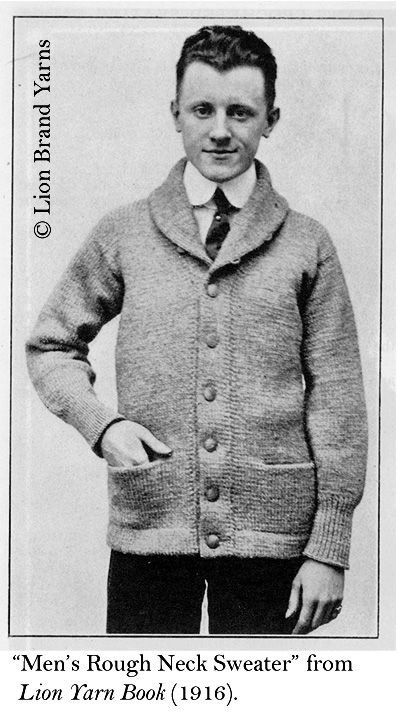
Last month I wrote a piece for Lion Brand Yarns that mentioned an almost century-old pattern that I've had my eye on. This is it:

rough-neck-original

Look at that collar. Gorgeous, and perfectly practical for a pencil-neck like me who is prone to agonies of stiffness if I get even a whisper of draught down my back. I saw it, I want it, I'm going to make it.

Mind you, I'm going to change it. It's too long, for starters. As written,* it would hang to halfway down my thigh. Not pretty. I'm adding shaping in the torso, too–a taper from chest to waist.

It'll be gentle taper, because a sweater like this is meant to be a smidge loose. You put it on at home, in your study, when you've finally taken off your jacket and loosened your tie.  It's not for the office. It's for quiet solitude. However, should somebody drop in on my solitude, I'd rather not have it hang on me like I'm wearing daddy's old bathrobe.

So, the Product Knitter within wanted to knit the sweater in order to wear the sweater. The Process Knitter within–which is dominant–wanted to try out the pockets.

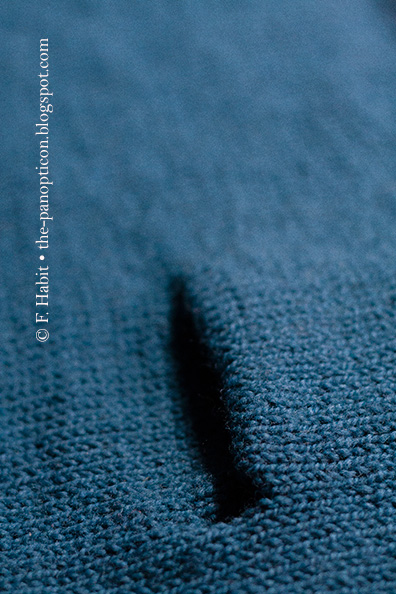
Here's a shot of one pocket.

sweater-bhole

As you can see, not much else happening for acres and acres of stockinette but that pocket. Marvelously smooth opening, no?

You make it by knitting to the point at which you want your pocket opening to lie. Then–without breaking the working yarn–you work only on the stitches that will form the interior of the pocket, knitting and purling back and forth on them until you have a strip that's twice the intended depth of the pocket.

Then you line up the live stitches of this strip with the live stitches you left sitting on your needle and–again, without breaking the working yarn–resume knitting across all your stitches. The strip, now folded in half, forms the interior of the pocket. It's very neat, and just requires seams up the sides when the piece is finished.

Here it is in hasty scribble form.

pocket-method

And here's what the actual pocket (finished except for side seams) looks like from the wrong side.

sweater-pocket-ws

I like it. The opening is, of course, seamless. The method is straightforward. You must plan for your pockets in advance, of course–so the devil-may-care atttiude I enjoy when putting in afterthought pockets is replaced by the smug satisfaction of knowing that part of the work is done, and I can just motor on toward the front-and-back shaping.

The yarn is proving to be a perfect choice–LB Collection Organic Wool. It's soft (without being so namby-pamby that it'll start to pill before the sweater is complete), it's springy, it's cuddly as a puppy wrapped in polar fleece, and the rustic texture is a welcome accent for a piece that's otherwise so plain.

Really, really curious about the collar, since to be blunt I haven't the faintest idea of how it's going to work after reading the pattern fifty times. Sometimes you just have to buckle on the parachute and jump.

How I Got This Way

Speaking of Lion Brand, the most recent essay I wrote for them–"Inheritance"–talks about creativity running in families–though often your creative family tree will include folks who aren't necessarily blood relations. I enjoyed writing (and drawing) this one...and my mother left a comment. That was a good day.

Turning Weaving Into Knitting

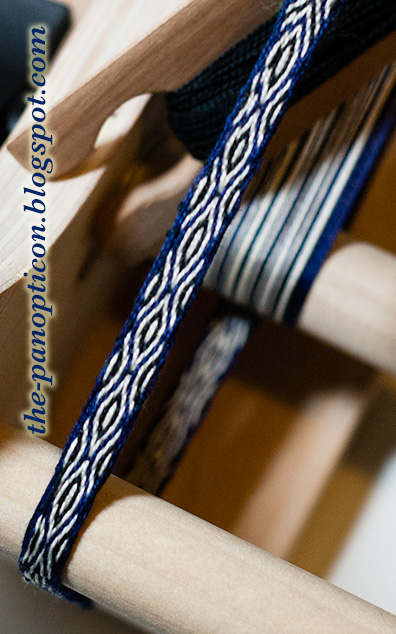
Quick update on the bag that card weaver John Mullarkey and I are collaborating on, using HiKoo CoBaSi. John sent along four band designs to choose from. He'll use the band as the basis for the strap.

bag-bands

I settled on the second from the top. What he wove, I'm going to try to interpret (not necessarily copy) in knitting for the body of the bag. Joy of joys, it's swatch time! I'm thinking mosaic might be the way to go, for the highly scientific reason that I've never tried it and it looks interesting. But first, we chart.

More to come.

*If you want it, the pattern is in the facsimile edition of the 1916
Lion Yarn Book that is available here. Facsimile means it's an unaltered copy of the original–so you'd be working from the period pattern, just as I am.

Saturday, February 02, 2013

I Say, Have You Done Something Jolly With Your Yarn?

Having a frustrating time of it, kids.

I have been knitting and writing and drawing myself into a froth, but most of it is for clients–which means no show and tell until the clients do the showing, at which point I can do the telling.

I can show you yarn, though. I've started a Tumblr feed called Yarn Shaming. I love yarn, you love yarn, but yarn does not always love us back, does it? The feed is a place where the occasionally ugly truth can be aired.

Speaking of ugly truths, I reached a point in my workroom where the options were either to clean the place out or to brick up the doorway and pretend it was never there. City real estate prices being what they are, I settled upon the former.

After two months of digging, tossing, and organizing I can see the top of the desk and the bottom of the Orphaned Yarns bin. I also slotted upwards of 100 million loose knitting patterns into binders.

For somebody who uses patterns as little as I do, I've acquired more than my fair share of them–mostly old, and mostly (thanks to a very, very generous reader in England) British.

The English Bequest (which how I like to think of it, even though the donor is only sweet and not deceased) now has its own set of binders.

If you've been reading this blog for any length of time, you know I'm a museum-quality Anglomaniac and even the scent of these leaflets–a bewitching combination of damp, printer's ink, and coal smoke–was enough to make my heart beat out the bass line of "Jerusalem."

They're all mid-1960s or earlier (I don't collect anything newer than that).

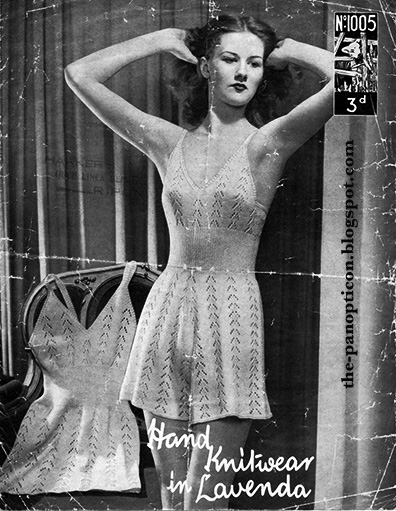
Some of them I love for their very mid-century English take on boudoir allure, like this glamourpuss in handknit lingerie made from Lavenda, a fine wool produced by Lister & Co. of Bradford.

lavenda-vest

Lister's promise at the time was "Distinctive and Charming Results." If you ask me, they nailed it.

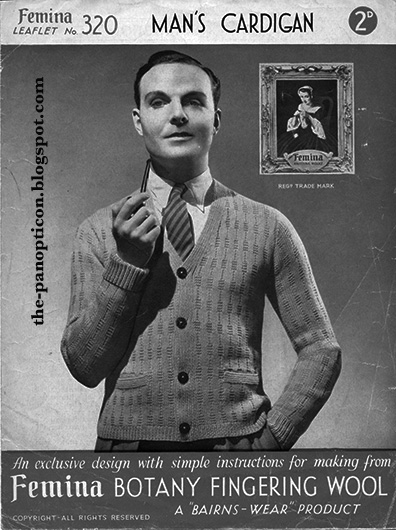
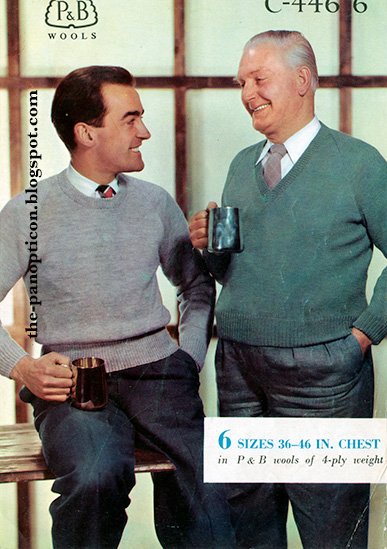
On the masculine side, you have rugged numbers like this:

femina-mens-cardi

Butchy McPipesmoker's cardigan was made from Femina Botany by Bairns-Wear Yarns of Nottingham. The company placed a marvelously reassuring message on the back of the pattern:

bairns-difficulty

There's something about the blue ink and the upright typeface that says, "We're sure to beat Hitler, madam, so certainly we can help you to figure out your sleeve cap."

But my favorite pattern covers are those that display quintessentially English people doing terribly, terribly English things, like sitting on the hearthrug toasting crumpets in the fireplace.

sirdar-crumpets

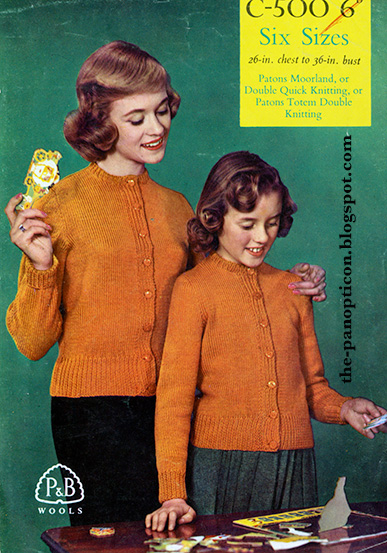
Patons and Baldwins, Ltd. produced my favorite works in this genre. I am unable to so much as glance at them without beginning to spin elaborate Blightycentric fantasies.

These small leaflets ought properly to be viewed while Vera Lynn sings "There'll Always Be an England," so chuck this on the Victrola before you scroll down.

Mrs. Armstrong and her daughter, Judy, put together a jigsaw puzzle because this is not America, Judy darling, and we won't be able to afford a television until the mid-sixties. Judy will be arrested for setting fire to a crocheted effigy of Margaret Thatcher during a Poll Tax riot in 1990.

puzzle-sweaters


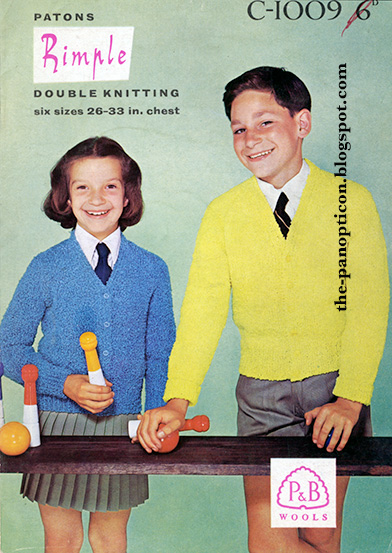
After an exhausting day at St. Winifred's Comprehensive School in Thwack, Enid Ormerod and brother Christopher Robin play at skittles on the green. (See "no television," above.)

kids-skittles


Meanwhile, at No. 16 Canterbury Close, Surbiton, young Susan White-Hamilton and her Aunt Gwladys catch a glimpse of their neighbor, Colonel Anstruther, through that gap in the hedge. The Colonel's rather eccentric routine of morning exercises–a practice he acquired while stationed in Cyprus–are a subject of much neighborhood interest.

garden-sweaters


Lifelong friends Gertrude Antrobus and Edith Moffatt, of Windy Cottage, Muckleford, Hants., rejoice at the successful performance of their champion Setter bitch, Vita's Furry Delight, at the county dog show.

paddock-ladies


Modern technology unites, rather than divides, the generations.  Jane Pilkington of Royal Tunbridge Wells uses her portable wireless to revel in the song stylings of Mr Jagger and his Rolling Stones; while mother Constance listens in to "Mrs Dale's Diary" and learns that Mrs Dale has been worried about Jim lately.


radio-ladies
 

And down at the Fox and Grapes, Alf and Reg exchange the latest village news along with subtle, but meaningful, brushes of arm and thigh.

pub-sweaters

Oh, Britannia. You rule.

Sunday, January 06, 2013

Entanglements, Various

I was in the workroom, trying to fit this year's books into last year's bookshelves, when Harry rolled in and asked whether he could have a yarn cave.

"I beg your pardon?"

"I want a yarn cave," he said. "I was just watching that house hunting show with Dolores and the man didn't like the first seventeen houses because there was no space for a man cave where he could watch television without his wife. I want a yarn cave so I can watch television without Dolores."

"Dolores," I shouted, "stop hogging the television! I am not going to have this argument again."

"I couldn't agree with you more," she shouted back.

"It's not fair," said Harry. "I want to watch the new Learning Channel documentary about Yarn Pixies and she keeps putting on Emanuelle Goes to Maryland Sheep and Wool and telling me I have to leave the room."

"You two are really going to have to work this out yourselves."

"I want a yarn cave!" said Harry.

"We don't have space for a yarn cave. This is a big city. It's crowded. We live in an apartment. And it's a pretty nice apartment, as apartments go. Lots of yarn would be happy to have as much room to roll around as you have."

"Yarn cave! Yarn cave!"

"You know who has lots of room?" I said. "Mrs. Teitelbaum. Maybe you would like to go next door and see if she would let you move in with her and Tinkles."

"Maybe I will," said Harry, stomping off. "Then when I am gone, boy will you be sorry."

Hah. He'll be back. Won't he?

I can't blame Harry for feeling overcrowded. Even though I have a work room, the whole apartment has been a carnival of frenzied fiber activity for the past couple of months. It's good to be busy, but busy + yarn = tangles. By Christmas, after four months of near-constant travel, this place looked like the inside of an old sewing basket that had been shaken by a gorilla.  I conceded that it was time to address the mess when I tripped over a stray strand of merino in the kitchen and it knocked over a lamp in the bedroom.

Happily, a lot of works-in-progress are finished and can be tidied away. There's this, for example.

VKW12MEN_04_medium

My first sweater design (in Cascade 220 Sport) for publication–the Men's Color Band Pullover from Vogue Knitting Winter 2012/13, which goes on sale the day after this writing.

I had a ball with it. We (the three guy designers in the story) were challenged to come up with a sweater we'd wear ourselves on a casual day at the office.

I only wish I looked like the model, but the sweater truly is something I'd wear.

It has very little ease, because I (and most men) look terrible in baggy sweaters. It tapers from the chest to the waist, because unshaped sweaters make me (and most men) look like they're wearing feed sacks. And though it has a basis in the traditional male palette of brown/earth/gray, I added purple and lavender houndstooth because life is too damned short wear nothing but brown/earth/gray.

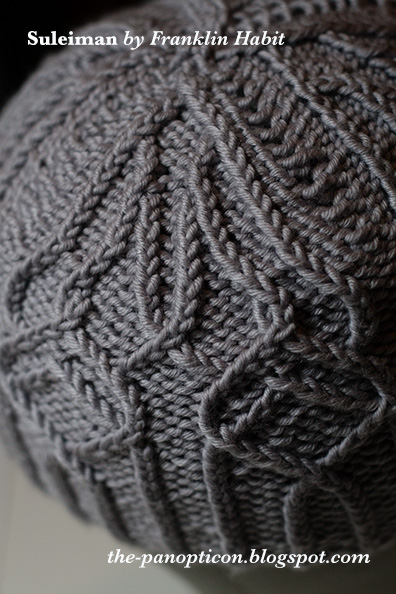
There's this, a hat in so-called Bavarian Twisted Stitch. (Twisted, yes. Bavarian, not necessarily.)

suleiman-beanie

It's a model for one of my new classes, débuting at Vogue Knitting Live! New York in just a little while. (That class is sold out, but a few of my other sessions have seats. Do come and play.)

There's also this.

first-weaving

Why, that's not knitting! That's not knitting at all! 

Nope, it's card weaving. Because I needed one more thing to do with string.

I've felt the urge to weave spring up once or twice, but always ran into roadblocks. A lack of space, for one. Also, the insistence of all my weaving friends and acquaintances that I would have to start with a plain dish towel.

I don't want to weave a plain dish towel. I want to make fabric with patterns. My weaving friends insisted that you cannot start out by weaving patterns, you have to start with a plain dish towel. Apparently this commandment is chiseled onto a stone tablet on a mountain near Taos.

I asked about all those unfortunate children who are forced into weaving patterned carpets. The horrors of their situation aside, if a five-year-old can weave patterns, why can't I?

Because you have to start with a plain dish towel, they said. It is written. Or chiseled, or something.

Then I met this guy when we were both teaching at the same event. He was working with tiny looms. So small they would easily fit on a coffee table. His beginning students were weaving bands covered in patterns.

So I said can you teach me, and John said yeah; and now I have a tiny loom and am making my own patterned bootlaces, which I think is hot.

We've become good buddies (he'll also be at Squam, teaching card weaving) and for the ducks of it we've decided to collaborate on a piece of design: a bag, with a knitted body and a woven strap.

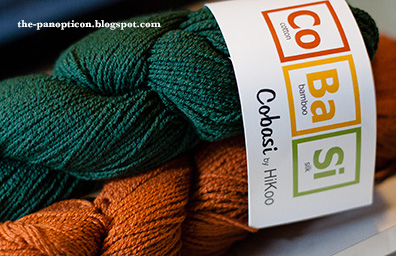
Here's the yarn we're using: Cobasi by Hikoo.

cobasi

Cobasi is a blend of COtton, BAmboo, and SIlk–get it?) distributed by Skacel. It is, in a word, groovy. The impetus was a desire to offer a really good wool-free sock yarn, and what they've come up with works equally well for knitting and card weaving.

Our challenge is to turn out a project that combines weaving and knitting in a beautiful, practical fashion. We're going to chronicle the development of the bag–for better or worse– right here in this space. More to come.

Saturday, December 29, 2012

That Seventies Pattern

I never know how a post is going to affect the reading public, but the last thing I expected after I threw daddy's peekaboo robe at you is that you'd ask for more.

Never let it be said that I don't try to give you what you want.

This is the other woman's magazine from the rack in my now-defunct Living History of the Nineteen-Seventies Bathroom. Woman's Day, April 1974.

wd-74-cover

John F. Kennedy was no longer alive and Jackie Kennedy was no longer a Kennedy; but their faces still sold copies. At least we were spared a portrait of Mama Rose, whose typically gushy, self-aggrandizing memoir is excerpted inside. I will spare you quotes.*

What I will not spare you, because you asked for it, is two specimens from the NEWEST TO KNIT AND CROCHET that's trumpeted below FASHION FINDS and above 50 TIPS  TO MAKE ANY DIET WORK.

(Will the headlines on the covers of women's magazines ever change?)

We have, first, "Mosaic Vest," in crochet.

crochet-vest

All I'm going to say about this is that if I produced a woman's upper garment with beep-beep daisies squarely over each nipple I'd be accused of knowing nothing about female anatomy. (There are great gaps in my knowledge of female anatomy, I admit. But I know where the boobs are located.)

Second, we have "Bare Shouldered Flatterer," in knitting. It's a tube top.

tube-top

Now, I took a look at the pattern and the only thing holding this up is that it's worked in ribbing. That's it. The only thing fighting slippage is k2, p2.  It's the top of a sock, writ large. Reach for anything that's higher than waist level, lady, and nobody will be looking at your bare shoulders.

Just one other thing to point out, and that's her underarms. Unretouched!  Nowadays, even a low-budget magazine with tight deadlines would have taken those out with Photoshop. Even stick-thin models have skin that wrinkles when they move. It's rather comforting to see it, don't you think?

* I don't often edit after the fact, but I've decided to remove the extended Rose Kennedy commentary that was here. I fear it will be prone to provoke tiresome debate, and that's not what this space is for.  Suffice it to say I didn't care for her, or for the Kennedys-as-American-Royalty mythology–in case that wasn't clear from my tone above.

Friday, December 21, 2012

I Remember Trauma

In my childhood, we got four magazines at our house. Two were amateur radio enthusiast publications beloved of my father. The other two were Family Circle and Woman's Day.

My mother was (and is) a prudent housekeeper and not given to spending money on herself, but pretty much any time a new issue of her magazines appeared in the rack at the supermarket she'd add it to our haul of groceries.

I read every one of them from cover to cover, usually before she did. I probably knew more about menopause, infant formula, and time-saving dinner casseroles than any other kid on the block.

I'm cleaning out my workroom and have run across a couple of 1970s-era specimens, bought for a previous apartment that came with an absolutely stunning and untouched 1973 bathroom. It would have been impossible to remove or disguise the mushroom-colored plastic seashell sink, so I decided to make it a feature. Adopting the persona of Cindy, an adventurous but wholesome United Airlines stewardess originally from Grand Forks, I hit eBay and picked up a vintage shower curtain covered in orange daisies, a copy of Valley of the Dolls for the back of the commode, and a pair of "Home Interiors" molded plastic wall hangings so ugly they actually devoured sunlight and happiness.

"Can you believe that somebody bought these unironically?" I said to my mother.

"Yeah," she said. "I had those in the master bath."

And then there were the magazines. I filled the little white rack with one Family Circle, one Woman's Day, and the 1976 JC Penney catalogue. Visitors to my apartment would step inside for a quick pee, and come out weeping from nostalgia.

When I left that bathroom behind I kept the magazines, but hadn't looked at them in quite some time.  Today I shifted the box they were in and realized one was from November–a month I used to eagerly anticipate as being the first to offer instructions for Christmas gifts. November wasn't as breathtaking as December, which was usually a double number with an incredible gingerbread house on the cover, but it was an excellent amuse-bouche prior to the full-blown orgy.

This November issue (from 1975) would have come out before I started reading in earnest–I was four, and still primarily interested in Little Golden Books and Interview–but the projects are exactly what I remember.

wd-1975

A few standouts include the classic, unsinkable granny square poncho.

wd-1975-3

Every girl in my first grade class* looked exactly like that.

And this, also crocheted. It's both a scarf and a litter of tragically conjoined asbestos hot pads.

wd-1975-2

Hey, you youngsters who always want to know how it was possible that knitting and crochet almost died out–here's a big part of the answer.

But this post is not just another excuse to laugh and/or scream at old yarn tricks. No, it's an excuse to laugh and/or at this.

wd-1975-1

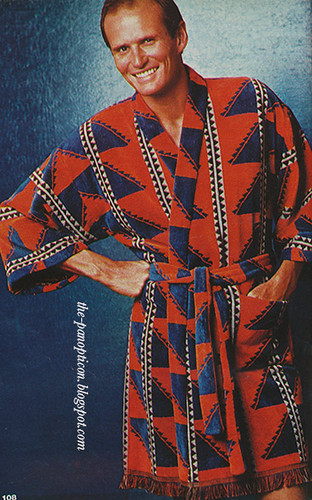
It's made from fringed bath towels. It hangs just below the crotch. It's for your dad.

I bet he was the king of the neighborhood swingers' club holiday party.

* Kate B. Reynolds Elementary School in Tucson, Arizona; and a fine little school it was, too.

Thursday, December 13, 2012

Gobsmacked in Cambridge

A final note from the England trip, an addendum of sorts to the notebooks (one, two, three).

We spent most of the day doing what visitors do in Cambridge. College, college, college, Trinity Street (I bought a beautiful English-made bow tie at Arthur Shepherd), college, college, church, church, church, lunch.

It was mid-afternoon, the clock was ticking, and I had not yet set foot in a bookshop.

Working on a hunch that an ancient center of learning might yet have one or two of these to root around in, I asked Liz.

"Yes," said Liz. "I will point you at two. Tom and I can go have a drink at the pub while you browse."

(Liz has done this before.)

After some negotiation it was agreed that I should have one hour, thirty seven minutes before presenting myself at the pub.

"Now," Liz said. "Over there is the larger shop. Over here is the smaller shop, but they specialize in antique children's books."

I'll repeat that.

"They specialize," said Liz, "in antique children's books."

I think Tom said something after that, but I was already at one hour, thirty six minutes and ten seconds and didn't have time to fool about. I can talk to Tom any time.

The children's bookshop was the size of four phone booths. For those of you too young to remember phone booths, it was the size of those four retro novelty photo booths at Jerusha and Skylar's wedding in Williamsburg, the one your whole dodge ball team went to.

I walked in, and the first thing that hit me in the face was a shelf crammed with titles I have read about but never seen in person. This place is the physical embodiment of my lifelong wish list. Within seconds, I was confronted by four linear feet of what I gauged to be turn-of-the-century Caldecott.

"May I help you find anything?" said the nice lady at the desk.

"Gasp," I gasped.

"Well, do please let me know," she said.

I stared dumbly at the row of Caldecott for a moment. I tried to reach for a book and realized my fingers had gone numb.

Then, much as those who have survived environmental catastrophes say that an inborn, automatic survival instinct pulled them through, I heard a voice that was not quite my own say,

"Listen. I'm from America and only have a few minutes. I see you have piles of Caldecott. I'm also interested in Ernest Shepard, Arthur Rackham, Dulac, and Walter Crane. Oh, and I wonder what you might have in the way of needlework titles–especially knitting."

She sprang into action.

"Needlework. Hmm. Now, that's a tough one." But she had that look in her eye, the one book people get when presented with a novel challenge.

"I know," I said. "There really isn't much."

"Well, have a look at these." They were crochet books from the 1950s, aimed at the plucky post-war girl of twelve to fourteen.

"Sweet," I said. "But I don't really crochet."

"Hmm. Well, I'm afraid aside from those all we have at present would be some Girl's Own annuals with needlework patterns..."

"I like the sound of that."

"...and then there's that."

Up on a top shelf, cover facing  out, leaning casually against a row of who cares what, was this.
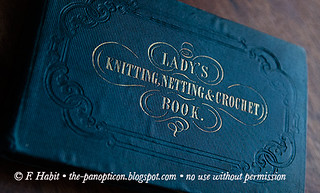
gaugain-cover

It's Jane Gaugain's The Lady's Assistant for Executing Useful and Fancy Designs in Knitting, Netting, and Crochet Work.

Jane Gaugain, in case she's not a household name for you (yet), is the woman you might call the mother of fiber arts publishing. She ran a haberdashery business in Edinburgh with her husband, she wanted to sell wool yarns from Germany, and she realized that you sell more yarns with pattern support. So she began to circulate patterns by request and subscription. (There is a wonderful article about her in this issue of Twist Collective.)

Then, in 1840, Mrs Gaugain produced her first book. This book.

This book, which is the beginning of everything that brought you all those knitting and crochet titles on your shelf. Elizabeth Zimmermann, Mary Thomas, Barbara Walker, Alice Starmore, Interweave, Soho, STC–it all starts here.

Now, please keep in mind that I went to England owning exactly one (1) knitting book that pre-dates 1880. And it's terrible. I mean, absolutely terrible. Fun as a relic, interesting to look at, useless to work from.

So for me, standing face-to-face with the first widely acclaimed, best-selling collection of knitting patterns was a little overwhelming.

But not so overwhelming that I didn't check the price. I was afraid to look.

It was really good. More than I'd normally drop on a single book–but really good. There aren't piles of knitting titles from this era lying around. Think about it. What do you usually do with outmoded books of knitting patterns? You throw them away, that's what you do. Or you donate them, or trade them, so that others may throw them away. And so it has always been.

It means that when you do find Mrs Gaugain for sale, she's pricey. But this shop was not a specialist in this topic, and though they did note "scarce" on the front flyleaf they didn't price it to keep it lying around in space that could be better occupied by, say, a nice first of Wind in the Willows.

So I bought it, with a beating heart and just one sad glance at the big, blue, oblong, I'd-never-even-heard-of-it album of Caldecott illustrations that's still sitting there, probably, and she said they would ship it to me if you haven't yet bought my Christmas present.

When I left the shop, I checked the time. I had been inside for exactly ten minutes.

While strictly speaking I had another hour and twenty-seven minutes allotted to book shopping, I found myself unable to go on. After you find the book at the top of your Life List just sitting there, what's the point of trying to beat that in a second venue?

I didn't know what to do, honestly. I felt like a dog that had spent his life chasing cars, and then caught one.

I stumbled toward the pub, clutching Mrs Gaugain to my palpitating chest.

Liz and Tom weren't there, of course. They weren't expecting me for more than an hour. In fact they were probably expecting me to forget them entirely, then scream NO NO LEAVE ME HERE IN PEACE as they attempted forcibly to extract me from the stacks.

(Liz and Tom have done this before.)

I turned around and ran smack into them on the street. They were startled.

"What happened? Did you find something?" said Tom.

"Mmrrbrblp," I said.

It was all I could do to get the book out of my bag and show it to them. They, being kind people, did not even make fun of me (much) when I started to cry.

The copy's in beautiful shape. Sound and complete, right down to the hand-colored plates demonstrating netting.
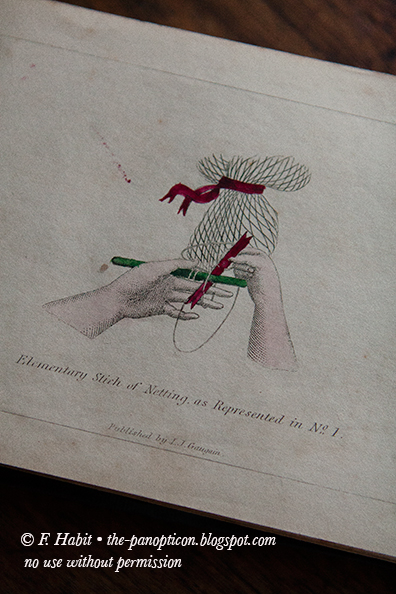
gaugain-illo

Note the errant smudge of red left by the colorist, who was probably a tubercular orphan, aged four, or similar. Poor kid.

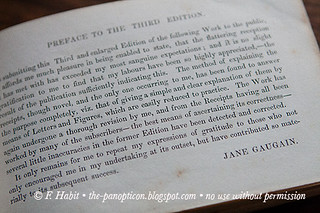
This is not, I hasten to add, a first edition. It's a third edition (1842) as shown by Mrs Gaugain's preface.
gaugain-preface

She notes:

The Work has again undergone a thorough revision by me, and from the Receipts all having been worked by many of the subscribers–the best means of ascertaining its correctness–several little inaccuracies in the former Edition have been detected and corrected.

Inaccuracies corrected? Does this mean–can it be?–that am I holding the corrected version of the Pineapple Bag?! Did she fix the decreases at the bottom?!!

gaugain-pattern

No.

Tuesday, December 04, 2012

English Notebook: Three

Last Bits and Bobs

True to my promise, these photographs from the England trip have no relationship to one another except that what I saw, I liked. And what I liked, I tried to photograph.

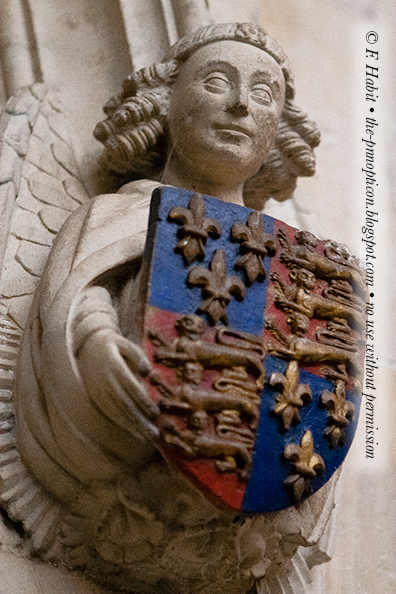
This was especially challenging in a setting like King's College Chapel in Cambridge, where the lighting was extremely subdued. It was tough to get a decent shot of anything without recourse to a tripod, so the haul was very small. I suppose I could have tried lying flat on my back in the aisle, as one misguided tourist did; but as he was politely but firmly escorted to the door I'm glad I didn't.

I'm more for details than sweeping views in a space like that. Sure, the vaults and the stained glass are spectacular. They've also been photographed thousands of times. I spent a lot of time admiring them, but the camera turned on for smaller things.

Kings, Angel

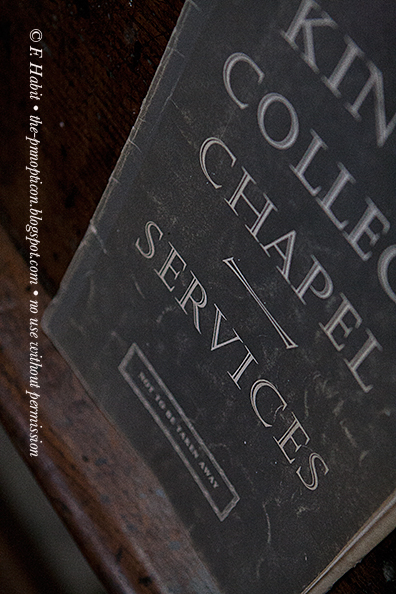
Desk, Kings

The book above was on a chorister's desk. I had to shoot it "blind" by craning my short, peasanty arm over the top of the desk, therefore the odd angle and framing. The note at the bottom of the cover says NOT TO BE TAKEN AWAY. I've been listening to the annual "Festival of Lessons and Carols" live broadcast from the chapel for years, so it was more than a little thrilling to stand where the music is made.

Even walking past London's Greatest Hits (like the statue of Eros at the center of Piccadilly Circus) I tend to be more attracted to obscurities. These are carved into the entrance of a theater spitting distance from the Piccadilly tube station, half-hidden by posters.

Piccadilly, Theater

One of the things I notice, in looking them over, is how much of what I love in the London cityscape boils down to color and pattern.

Portobello

Near Portobello Road. (Click it.)

Kensington

Somewhere in Kensington. (Click it.)

No visit to London is complete without my friend Jane, who is (surprise) a knitter. Jane arranged for us to have dinner at Brown's Hotel. (I had grouse, of which there is no picture. It was delicious.)

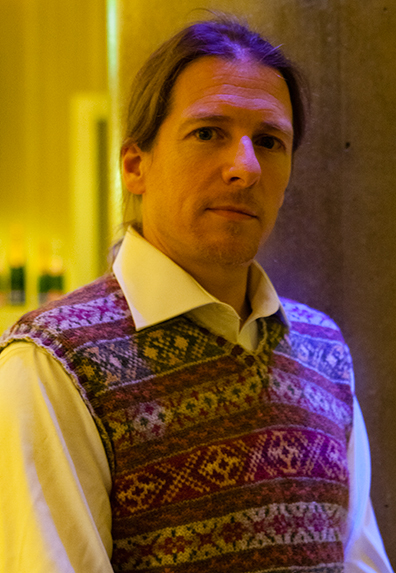
Jane introduced us to her splendid fellow, Nick, who is not only charming but the perfect size to model the Fair Isle sweater Jane had just finished. She took endless pains selecting the colors, none of which shows properly in the photograph because the aggressively trendy hotel bar we were in was lit primarily (and dimly, of course) with purple lights. (Because nothing flatters the human complexion like purple light.)

Still, here is Nick and the sweater.

nick-sweater

The sweater isn't even for him. He just agreed to model it. Jane knit it for somebody else. Is that a cooperative boyfriend, or what?

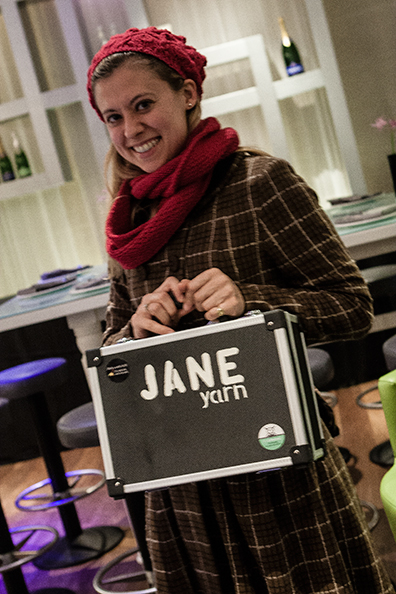
That's not even the most of it. The rank and file of knitters have to carry our work in bags. Not so Jane. Not since she met Nick, who's in a band, and who gave her a yarn road case. A yarn road case. So she can tour.

Jane's Case

Love you, Jane. You'll want to hang on to Nick with both hands, dear. And he to you.

There will be one more England entry. About...shopping.