Sunday, January 06, 2013

Entanglements, Various

I was in the workroom, trying to fit this year's books into last year's bookshelves, when Harry rolled in and asked whether he could have a yarn cave.

"I beg your pardon?"

"I want a yarn cave," he said. "I was just watching that house hunting show with Dolores and the man didn't like the first seventeen houses because there was no space for a man cave where he could watch television without his wife. I want a yarn cave so I can watch television without Dolores."

"Dolores," I shouted, "stop hogging the television! I am not going to have this argument again."

"I couldn't agree with you more," she shouted back.

"It's not fair," said Harry. "I want to watch the new Learning Channel documentary about Yarn Pixies and she keeps putting on Emanuelle Goes to Maryland Sheep and Wool and telling me I have to leave the room."

"You two are really going to have to work this out yourselves."

"I want a yarn cave!" said Harry.

"We don't have space for a yarn cave. This is a big city. It's crowded. We live in an apartment. And it's a pretty nice apartment, as apartments go. Lots of yarn would be happy to have as much room to roll around as you have."

"Yarn cave! Yarn cave!"

"You know who has lots of room?" I said. "Mrs. Teitelbaum. Maybe you would like to go next door and see if she would let you move in with her and Tinkles."

"Maybe I will," said Harry, stomping off. "Then when I am gone, boy will you be sorry."

Hah. He'll be back. Won't he?

I can't blame Harry for feeling overcrowded. Even though I have a work room, the whole apartment has been a carnival of frenzied fiber activity for the past couple of months. It's good to be busy, but busy + yarn = tangles. By Christmas, after four months of near-constant travel, this place looked like the inside of an old sewing basket that had been shaken by a gorilla.  I conceded that it was time to address the mess when I tripped over a stray strand of merino in the kitchen and it knocked over a lamp in the bedroom.

Happily, a lot of works-in-progress are finished and can be tidied away. There's this, for example.

VKW12MEN_04_medium

My first sweater design (in Cascade 220 Sport) for publication–the Men's Color Band Pullover from Vogue Knitting Winter 2012/13, which goes on sale the day after this writing.

I had a ball with it. We (the three guy designers in the story) were challenged to come up with a sweater we'd wear ourselves on a casual day at the office.

I only wish I looked like the model, but the sweater truly is something I'd wear.

It has very little ease, because I (and most men) look terrible in baggy sweaters. It tapers from the chest to the waist, because unshaped sweaters make me (and most men) look like they're wearing feed sacks. And though it has a basis in the traditional male palette of brown/earth/gray, I added purple and lavender houndstooth because life is too damned short wear nothing but brown/earth/gray.

There's this, a hat in so-called Bavarian Twisted Stitch. (Twisted, yes. Bavarian, not necessarily.)
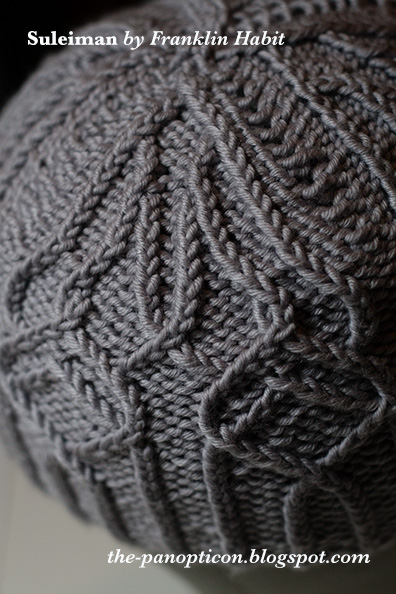
suleiman-beanie

It's a model for one of my new classes, débuting at Vogue Knitting Live! New York in just a little while. (That class is sold out, but a few of my other sessions have seats. Do come and play.)

There's also this.
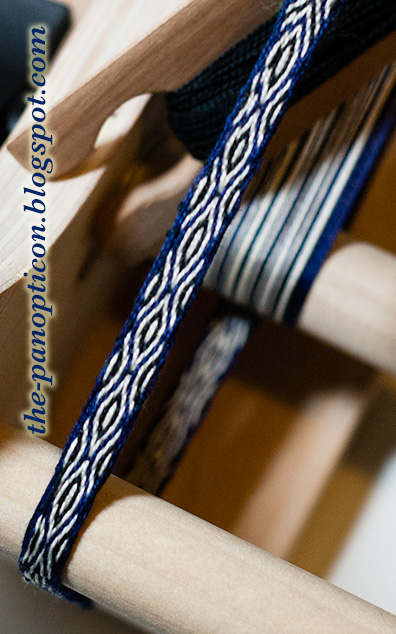
first-weaving

Why, that's not knitting! That's not knitting at all! 

Nope, it's card weaving. Because I needed one more thing to do with string.

I've felt the urge to weave spring up once or twice, but always ran into roadblocks. A lack of space, for one. Also, the insistence of all my weaving friends and acquaintances that I would have to start with a plain dish towel.

I don't want to weave a plain dish towel. I want to make fabric with patterns. My weaving friends insisted that you cannot start out by weaving patterns, you have to start with a plain dish towel. Apparently this commandment is chiseled onto a stone tablet on a mountain near Taos.

I asked about all those unfortunate children who are forced into weaving patterned carpets. The horrors of their situation aside, if a five-year-old can weave patterns, why can't I?

Because you have to start with a plain dish towel, they said. It is written. Or chiseled, or something.

Then I met this guy when we were both teaching at the same event. He was working with tiny looms. So small they would easily fit on a coffee table. His beginning students were weaving bands covered in patterns.

So I said can you teach me, and John said yeah; and now I have a tiny loom and am making my own patterned bootlaces, which I think is hot.

We've become good buddies (he'll also be at Squam, teaching card weaving) and for the ducks of it we've decided to collaborate on a piece of design: a bag, with a knitted body and a woven strap.

Here's the yarn we're using: Cobasi by Hikoo.
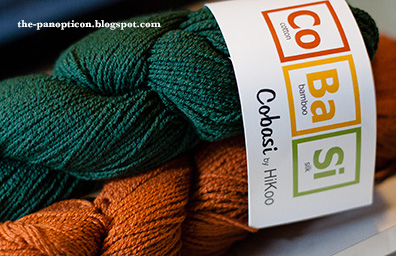
cobasi

Cobasi is a blend of COtton, BAmboo, and SIlk–get it?) distributed by Skacel. It is, in a word, groovy. The impetus was a desire to offer a really good wool-free sock yarn, and what they've come up with works equally well for knitting and card weaving.

Our challenge is to turn out a project that combines weaving and knitting in a beautiful, practical fashion. We're going to chronicle the development of the bag–for better or worse– right here in this space. More to come.

Saturday, December 29, 2012

That Seventies Pattern

I never know how a post is going to affect the reading public, but the last thing I expected after I threw daddy's peekaboo robe at you is that you'd ask for more.

Never let it be said that I don't try to give you what you want.

This is the other woman's magazine from the rack in my now-defunct Living History of the Nineteen-Seventies Bathroom. Woman's Day, April 1974.

wd-74-cover

John F. Kennedy was no longer alive and Jackie Kennedy was no longer a Kennedy; but their faces still sold copies. At least we were spared a portrait of Mama Rose, whose typically gushy, self-aggrandizing memoir is excerpted inside. I will spare you quotes.*

What I will not spare you, because you asked for it, is two specimens from the NEWEST TO KNIT AND CROCHET that's trumpeted below FASHION FINDS and above 50 TIPS  TO MAKE ANY DIET WORK.

(Will the headlines on the covers of women's magazines ever change?)

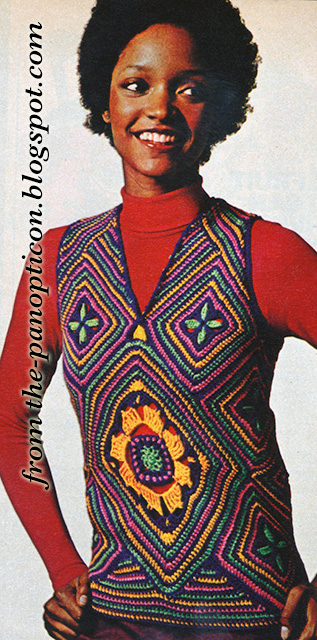
We have, first, "Mosaic Vest," in crochet.

crochet-vest

All I'm going to say about this is that if I produced a woman's upper garment with beep-beep daisies squarely over each nipple I'd be accused of knowing nothing about female anatomy. (There are great gaps in my knowledge of female anatomy, I admit. But I know where the boobs are located.)

Second, we have "Bare Shouldered Flatterer," in knitting. It's a tube top.

tube-top

Now, I took a look at the pattern and the only thing holding this up is that it's worked in ribbing. That's it. The only thing fighting slippage is k2, p2.  It's the top of a sock, writ large. Reach for anything that's higher than waist level, lady, and nobody will be looking at your bare shoulders.

Just one other thing to point out, and that's her underarms. Unretouched!  Nowadays, even a low-budget magazine with tight deadlines would have taken those out with Photoshop. Even stick-thin models have skin that wrinkles when they move. It's rather comforting to see it, don't you think?

* I don't often edit after the fact, but I've decided to remove the extended Rose Kennedy commentary that was here. I fear it will be prone to provoke tiresome debate, and that's not what this space is for.  Suffice it to say I didn't care for her, or for the Kennedys-as-American-Royalty mythology–in case that wasn't clear from my tone above.

Friday, December 21, 2012

I Remember Trauma

In my childhood, we got four magazines at our house. Two were amateur radio enthusiast publications beloved of my father. The other two were Family Circle and Woman's Day.

My mother was (and is) a prudent housekeeper and not given to spending money on herself, but pretty much any time a new issue of her magazines appeared in the rack at the supermarket she'd add it to our haul of groceries.

I read every one of them from cover to cover, usually before she did. I probably knew more about menopause, infant formula, and time-saving dinner casseroles than any other kid on the block.

I'm cleaning out my workroom and have run across a couple of 1970s-era specimens, bought for a previous apartment that came with an absolutely stunning and untouched 1973 bathroom. It would have been impossible to remove or disguise the mushroom-colored plastic seashell sink, so I decided to make it a feature. Adopting the persona of Cindy, an adventurous but wholesome United Airlines stewardess originally from Grand Forks, I hit eBay and picked up a vintage shower curtain covered in orange daisies, a copy of Valley of the Dolls for the back of the commode, and a pair of "Home Interiors" molded plastic wall hangings so ugly they actually devoured sunlight and happiness.

"Can you believe that somebody bought these unironically?" I said to my mother.

"Yeah," she said. "I had those in the master bath."

And then there were the magazines. I filled the little white rack with one Family Circle, one Woman's Day, and the 1976 JC Penney catalogue. Visitors to my apartment would step inside for a quick pee, and come out weeping from nostalgia.

When I left that bathroom behind I kept the magazines, but hadn't looked at them in quite some time.  Today I shifted the box they were in and realized one was from November–a month I used to eagerly anticipate as being the first to offer instructions for Christmas gifts. November wasn't as breathtaking as December, which was usually a double number with an incredible gingerbread house on the cover, but it was an excellent amuse-bouche prior to the full-blown orgy.
This November issue (from 1975) would have come out before I started reading in earnest–I was four, and still primarily interested in Little Golden Books and Interview–but the projects are exactly what I remember.

wd-1975

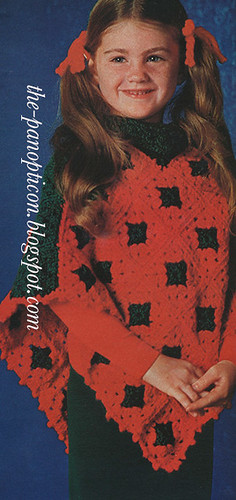
A few standouts include the classic, unsinkable granny square poncho.

wd-1975-3

Every girl in my first grade class* looked exactly like that.

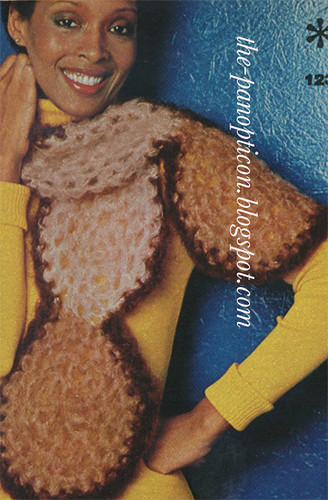
And this, also crocheted. It's both a scarf and a litter of tragically conjoined asbestos hot pads.

wd-1975-2

Hey, you youngsters who always want to know how it was possible that knitting and crochet almost died out–here's a big part of the answer.

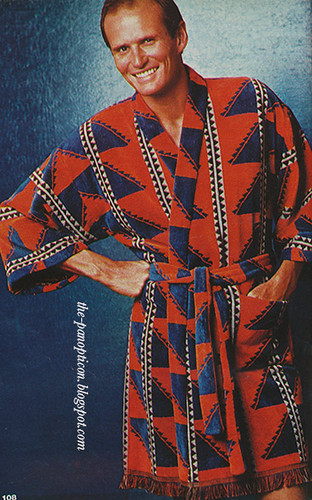
But this post is not just another excuse to laugh and/or scream at old yarn tricks. No, it's an excuse to laugh and/or at this.

wd-1975-1

It's made from fringed bath towels. It hangs just below the crotch. It's for your dad.

I bet he was the king of the neighborhood swingers' club holiday party.

* Kate B. Reynolds Elementary School in Tucson, Arizona; and a fine little school it was, too.

Thursday, December 13, 2012

Gobsmacked in Cambridge

A final note from the England trip, an addendum of sorts to the notebooks (one, two, three).

We spent most of the day doing what visitors do in Cambridge. College, college, college, Trinity Street (I bought a beautiful English-made bow tie at Arthur Shepherd), college, college, church, church, church, lunch.
It was mid-afternoon, the clock was ticking, and I had not yet set foot in a bookshop.

Working on a hunch that an ancient center of learning might yet have one or two of these to root around in, I asked Liz.

"Yes," said Liz. "I will point you at two. Tom and I can go have a drink at the pub while you browse."

(Liz has done this before.)

After some negotiation it was agreed that I should have one hour, thirty seven minutes before presenting myself at the pub.

"Now," Liz said. "Over there is the larger shop. Over here is the smaller shop, but they specialize in antique children's books."

I'll repeat that.

"They specialize," said Liz, "in antique children's books."

I think Tom said something after that, but I was already at one hour, thirty six minutes and ten seconds and didn't have time to fool about. I can talk to Tom any time.

The children's bookshop was the size of four phone booths. For those of you too young to remember phone booths, it was the size of those four retro novelty photo booths at Jerusha and Skylar's wedding in Williamsburg, the one your whole dodge ball team went to.

I walked in, and the first thing that hit me in the face was a shelf crammed with titles I have read about but never seen in person. This place is the physical embodiment of my lifelong wish list. Within seconds, I was confronted by four linear feet of what I gauged to be turn-of-the-century Caldecott.

"May I help you find anything?" said the nice lady at the desk.

"Gasp," I gasped.

"Well, do please let me know," she said.

I stared dumbly at the row of Caldecott for a moment. I tried to reach for a book and realized my fingers had gone numb.

Then, much as those who have survived environmental catastrophes say that an inborn, automatic survival instinct pulled them through, I heard a voice that was not quite my own say,

"Listen. I'm from America and only have a few minutes. I see you have piles of Caldecott. I'm also interested in Ernest Shepard, Arthur Rackham, Dulac, and Walter Crane. Oh, and I wonder what you might have in the way of needlework titles–especially knitting."

She sprang into action.

"Needlework. Hmm. Now, that's a tough one." But she had that look in her eye, the one book people get when presented with a novel challenge.

"I know," I said. "There really isn't much."

"Well, have a look at these." They were crochet books from the 1950s, aimed at the plucky post-war girl of twelve to fourteen.

"Sweet," I said. "But I don't really crochet."

"Hmm. Well, I'm afraid aside from those all we have at present would be some Girl's Own annuals with needlework patterns..."

"I like the sound of that."

"...and then there's that."

Up on a top shelf, cover facing  out, leaning casually against a row of who cares what, was this.

gaugain-cover

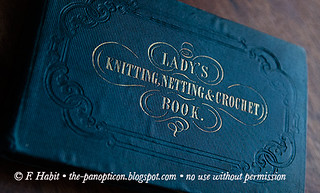
It's Jane Gaugain's The Lady's Assistant for Executing Useful and Fancy Designs in Knitting, Netting, and Crochet Work.

Jane Gaugain, in case she's not a household name for you (yet), is the woman you might call the mother of fiber arts publishing. She ran a haberdashery business in Edinburgh with her husband, she wanted to sell wool yarns from Germany, and she realized that you sell more yarns with pattern support. So she began to circulate patterns by request and subscription. (There is a wonderful article about her in this issue of Twist Collective.)

Then, in 1840, Mrs Gaugain produced her first book. This book.

This book, which is the beginning of everything that brought you all those knitting and crochet titles on your shelf. Elizabeth Zimmermann, Mary Thomas, Barbara Walker, Alice Starmore, Interweave, Soho, STC–it all starts here.

Now, please keep in mind that I went to England owning exactly one (1) knitting book that pre-dates 1880. And it's terrible. I mean, absolutely terrible. Fun as a relic, interesting to look at, useless to work from.

So for me, standing face-to-face with the first widely acclaimed, best-selling collection of knitting patterns was a little overwhelming.

But not so overwhelming that I didn't check the price. I was afraid to look.

It was really good. More than I'd normally drop on a single book–but really good. There aren't piles of knitting titles from this era lying around. Think about it. What do you usually do with outmoded books of knitting patterns? You throw them away, that's what you do. Or you donate them, or trade them, so that others may throw them away. And so it has always been.

It means that when you do find Mrs Gaugain for sale, she's pricey. But this shop was not a specialist in this topic, and though they did note "scarce" on the front flyleaf they didn't price it to keep it lying around in space that could be better occupied by, say, a nice first of Wind in the Willows.

So I bought it, with a beating heart and just one sad glance at the big, blue, oblong, I'd-never-even-heard-of-it album of Caldecott illustrations that's still sitting there, probably, and she said they would ship it to me if you haven't yet bought my Christmas present.

When I left the shop, I checked the time. I had been inside for exactly ten minutes.

While strictly speaking I had another hour and twenty-seven minutes allotted to book shopping, I found myself unable to go on. After you find the book at the top of your Life List just sitting there, what's the point of trying to beat that in a second venue?

I didn't know what to do, honestly. I felt like a dog that had spent his life chasing cars, and then caught one.

I stumbled toward the pub, clutching Mrs Gaugain to my palpitating chest.

Liz and Tom weren't there, of course. They weren't expecting me for more than an hour. In fact they were probably expecting me to forget them entirely, then scream NO NO LEAVE ME HERE IN PEACE as they attempted forcibly to extract me from the stacks.

(Liz and Tom have done this before.)

I turned around and ran smack into them on the street. They were startled.

"What happened? Did you find something?" said Tom.

"Mmrrbrblp," I said.

It was all I could do to get the book out of my bag and show it to them. They, being kind people, did not even make fun of me (much) when I started to cry.

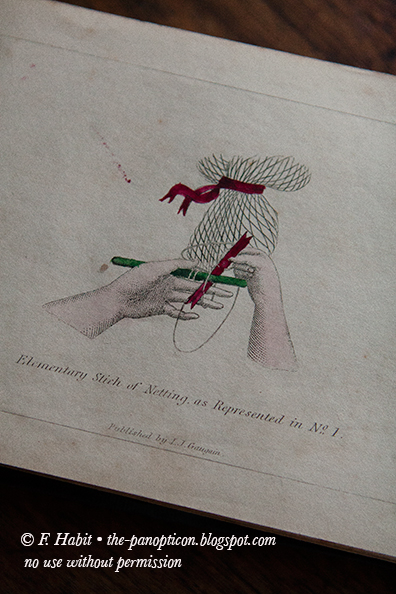
The copy's in beautiful shape. Sound and complete, right down to the hand-colored plates demonstrating netting.

gaugain-illo

Note the errant smudge of red left by the colorist, who was probably a tubercular orphan, aged four, or similar. Poor kid.

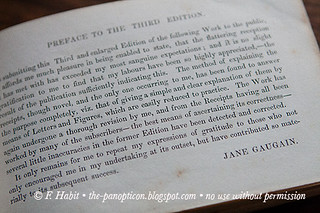
This is not, I hasten to add, a first edition. It's a third edition (1842) as shown by Mrs Gaugain's preface.

gaugain-preface

She notes:

The Work has again undergone a thorough revision by me, and from the Receipts all having been worked by many of the subscribers–the best means of ascertaining its correctness–several little inaccuracies in the former Edition have been detected and corrected.

Inaccuracies corrected? Does this mean–can it be?–that am I holding the corrected version of the Pineapple Bag?! Did she fix the decreases at the bottom?!!

gaugain-pattern

No.

Tuesday, December 04, 2012

English Notebook: Three

Last Bits and Bobs

True to my promise, these photographs from the England trip have no relationship to one another except that what I saw, I liked. And what I liked, I tried to photograph.

This was especially challenging in a setting like King's College Chapel in Cambridge, where the lighting was extremely subdued. It was tough to get a decent shot of anything without recourse to a tripod, so the haul was very small. I suppose I could have tried lying flat on my back in the aisle, as one misguided tourist did; but as he was politely but firmly escorted to the door I'm glad I didn't.

I'm more for details than sweeping views in a space like that. Sure, the vaults and the stained glass are spectacular. They've also been photographed thousands of times. I spent a lot of time admiring them, but the camera turned on for smaller things.

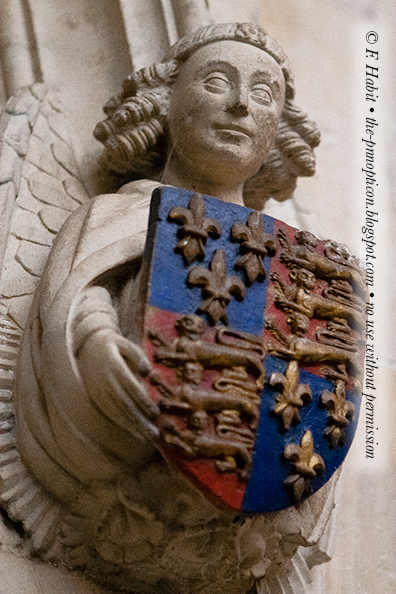
Kings, Angel

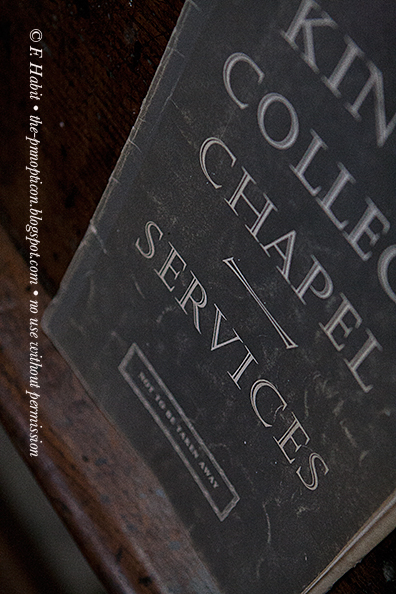
Desk, Kings

The book above was on a chorister's desk. I had to shoot it "blind" by craning my short, peasanty arm over the top of the desk, therefore the odd angle and framing. The note at the bottom of the cover says NOT TO BE TAKEN AWAY. I've been listening to the annual "Festival of Lessons and Carols" live broadcast from the chapel for years, so it was more than a little thrilling to stand where the music is made.

Even walking past London's Greatest Hits (like the statue of Eros at the center of Piccadilly Circus) I tend to be more attracted to obscurities. These are carved into the entrance of a theater spitting distance from the Piccadilly tube station, half-hidden by posters.

Piccadilly, Theater

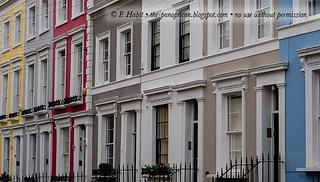
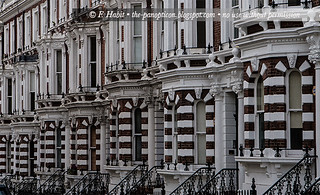
One of the things I notice, in looking them over, is how much of what I love in the London cityscape boils down to color and pattern.

Portobello

Near Portobello Road. (Click it.)

Kensington

Somewhere in Kensington. (Click it.)

No visit to London is complete without my friend Jane, who is (surprise) a knitter. Jane arranged for us to have dinner at Brown's Hotel. (I had grouse, of which there is no picture. It was delicious.)

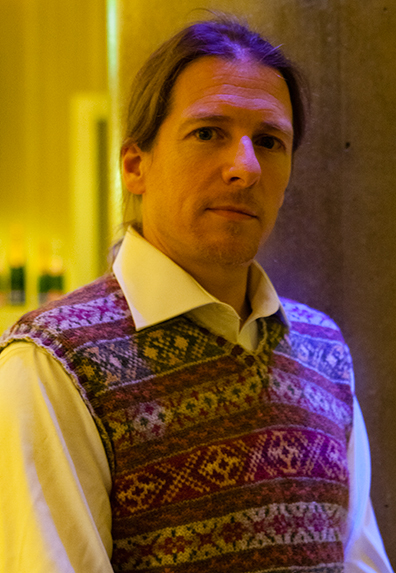
Jane introduced us to her splendid fellow, Nick, who is not only charming but the perfect size to model the Fair Isle sweater Jane had just finished. She took endless pains selecting the colors, none of which shows properly in the photograph because the aggressively trendy hotel bar we were in was lit primarily (and dimly, of course) with purple lights. (Because nothing flatters the human complexion like purple light.)

Still, here is Nick and the sweater.

nick-sweater

The sweater isn't even for him. He just agreed to model it. Jane knit it for somebody else. Is that a cooperative boyfriend, or what?

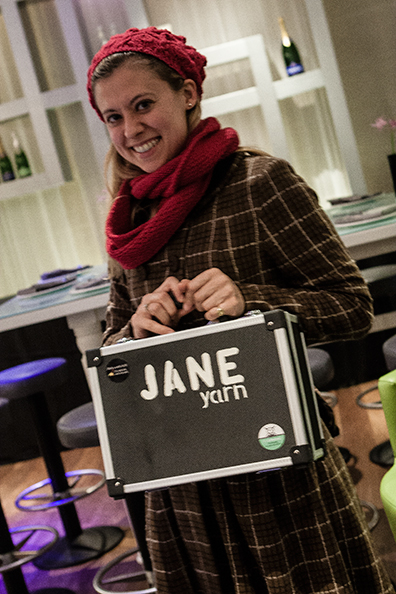
That's not even the most of it. The rank and file of knitters have to carry our work in bags. Not so Jane. Not since she met Nick, who's in a band, and who gave her a yarn road case. A yarn road case. So she can tour.

Jane's Case

Love you, Jane. You'll want to hang on to Nick with both hands, dear. And he to you.

There will be one more England entry. About...shopping.

Saturday, December 01, 2012

English Notebook: Two

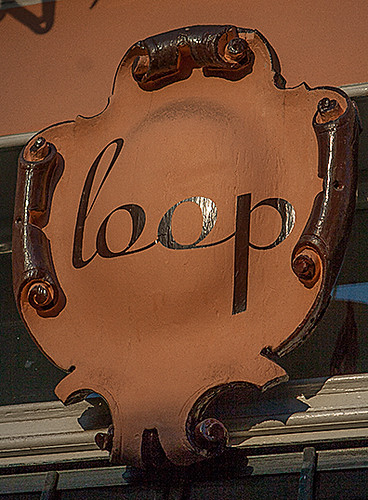
I spent one entire day in England at Loop.

loop-sign

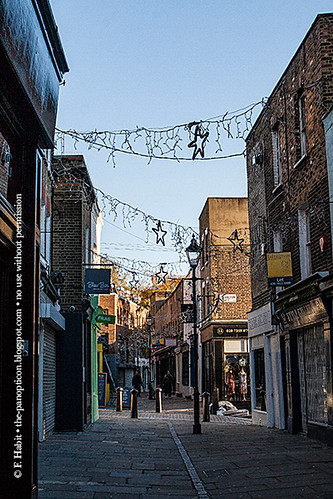
Loop is a yarn shop–the English often say "wool shop"–in a London neighborhood called Islington, on a sort of street called "Camden Passage."

When they call it a passage they aren't trying to be cute. Look.

camden-passage

It's exactly that–a narrow passage between old, low buildings. Most of Loop's neighbors sell antiques, and on certain days of the week the streets around fill up with more antiques dealers.

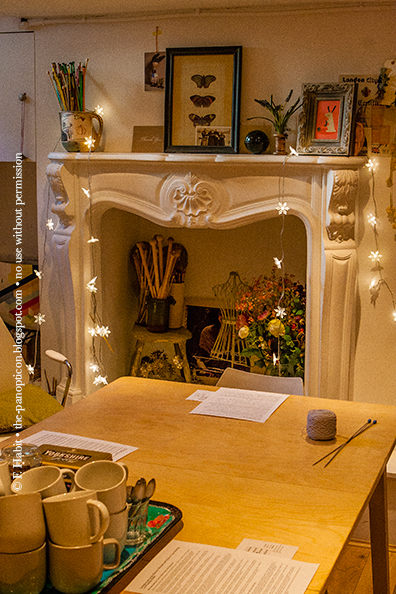
This is the Loop classroom. It holds eight, including the teacher. If you're going to teach at Loop it helps to be small and/or short.

loop-classroom

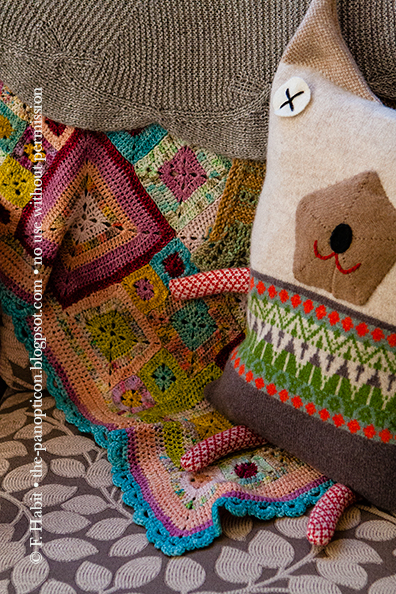
Loop's owner, Susan, has a gift–there is no other word for it–for arranging her stock in beautiful and unexpected ways. You don't just see the pretty things, you feel inspired to take them home and play with them. Before classes began, I had the place to myself and spent the time drinking it in.

loop-chair

loop-bunny

loop-needles

loop-shelf

loop-birdie

I was so enchanted I wanted a picture of me in the shop, as a souvenir.

loop-mirror

The students were lovely. We gathered around the table and had tea and little pecan tarts, and played with at lace and old patterns. The day flew.

To top it all off, I had the pleasure of the company of Jean, whose work and words I've admired almost since the day I began writing this blog. She knits everything, but it's her lace that first grabbed my attention, and I doubt I could have finished my first major piece of lace without her. She alerted me to Sharon Miller's Heirloom Knitting, and to Bridget Rorem's lace alphabet.

Jean came all the way from Scotland to meet me at Loop. I was almost too shy to ask if she'd have a picture with me after class. (My first impulse, on seeing her coming down the stairs, was to run over and hug her in shameless American fashion.) But I spoke up, and she obliged.

loop-jean

If you're one of Jean's fans, I can now tell you with certainty that she every bit as witty, sharp and fun as you'd think from reading her blog. I have a good mind to find a way to get up to Scotland and stalk her in her natural habitat. Fair warning, Jean. (And thank you.)

If you find yourself in London, you probably ought to go to Loop.  Really, you ought.

By the Way: 2012 Holiday Ornament

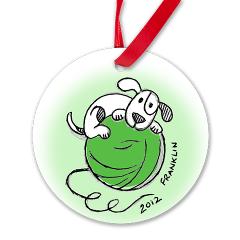
The annual Panopticon Holiday Ornament is ready to go. This year, the theme is yarn...and puppies.

2012 Holiday Ornament

Just realized I spelled "blogspot" wrong in the watermarks. Aw, screw it.

Thursday, November 29, 2012

English Notebook: One

I went to England and now I'm back again.

Listen. I've realized that if I try to arrange the notes and photographs from the trip into a neat, coherent, chronological set of entries, I will never get around to showing you anything at all.

So I'm going to post things as and how they occur to me. If you find the scattershot approach disconcerting, please consider that at least you are not trapped in my living room watching me click through slides while Dolores rests her head on your shoulder.

My very first note from this trip–scribbled after a stroll up Regent Street on arrival day–was this:

As usual, the sight of the classic Englishman in full fig is making me want to pile my entire wardrobe into a little wooden boat, douse it with paraffin, set it on fire, push it out to sea, and start over again.

I know perfectly well that not every guy in England is fashion plate. But the tweedy peacocks of Central London reminded me of the joy I used to take in dressing myself, and while my closet hasn't been set on fire it has come under close scrutiny. Time will tell whether I improve myself in any significant way. It can be tough to do while living in a city where a nice, clean Ohio State sweatshirt is considered suitable for an evening wedding.

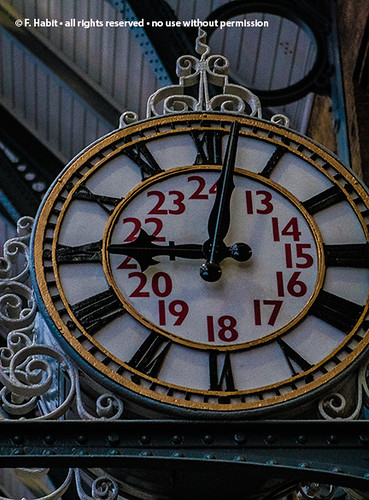
We took the train from King's Cross Station

kings-cross-clock

to Cambridge. I had never been there before.

My friend Liz lives there, and was graduated from Clare College, so she knows her way around. She took us places we would never have known to go, and told us things the tour guides would not have known.

This is Liz.

lizhat

She's a knitter (to put it mildly). The fantastic hat is by Woolly Wormhead and was finished while we were eating lunch.

Here are a few things we saw in Cambridge. (There will be more. These are the shots closest to hand.)

King's College Chapel and some of Clare College, from the river.  (Click to embiggen.)

From the River

Had it been snowing, this would have been the cover of my favorite Christmas record, A Festival of Lessons and Carols. I would like to thank King's College, Cambridge, for looking exactly as it was supposed to look.

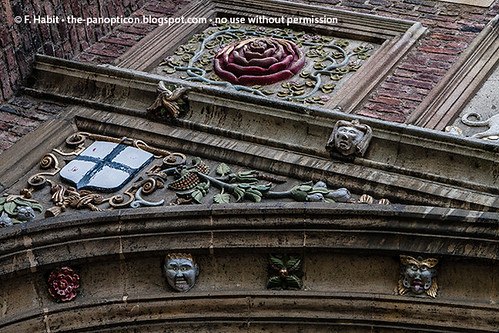
The Colleges of Cambridge put every other academic landscape I've ever seen (and I have seen far, far too many) in the shade. You can't move five feet without finding something like this polychrome archway in St John's College looming over you. (Again, click to embiggen.)

stjohns-gate

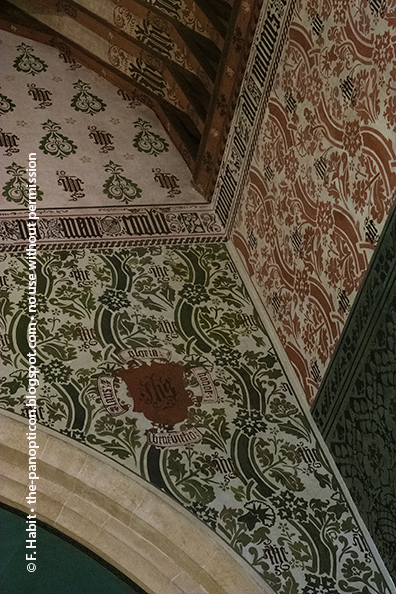
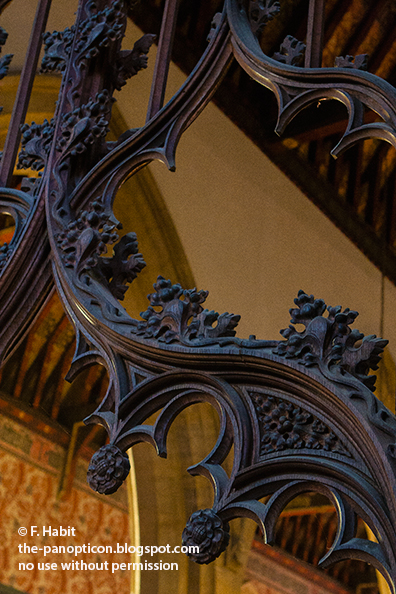
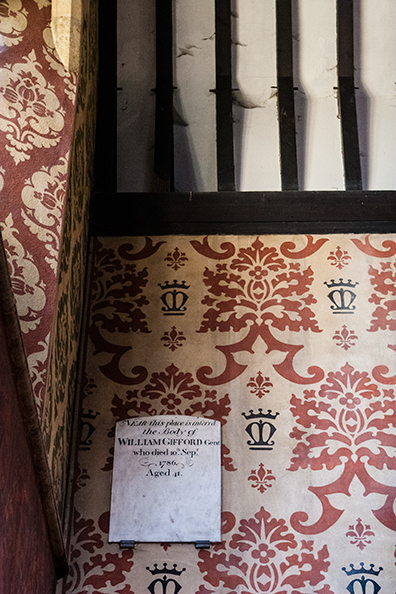
The Colleges, of course, are on the beaten path. Well off the beaten path was All Saints, a church only lately rescued from dereliction and neglect that was decorated by leading lights of the Arts and Crafts Movement. (There is a handy guide to the windows above the altar showing which designer–Burne-Jones or Morris–was responsible for which saints.)

There was a pottery sale going on in the church, and while Tom and Liz browsed I wandered freely and photographed things.

allsaints-wall-vaults

allsaints-screen

allsaintswall

The walls–all painted and stenciled–were not to be believed, even those still awaiting conservation.

There was a time, you see, when artists didn't consider it a waste of time to apply their talents to the decoration of mundane things like walls. And there was a time, you see, when people hadn't been conditioned by the lazy brutality of Modernism to accept the ugly, inhuman, undecorated box as the only form of construction. (Dear Mies van der Rohe, I hate you and you can suck it.)

There's more. But it'll have to wait a little while. I'll aim for tomorrow.